


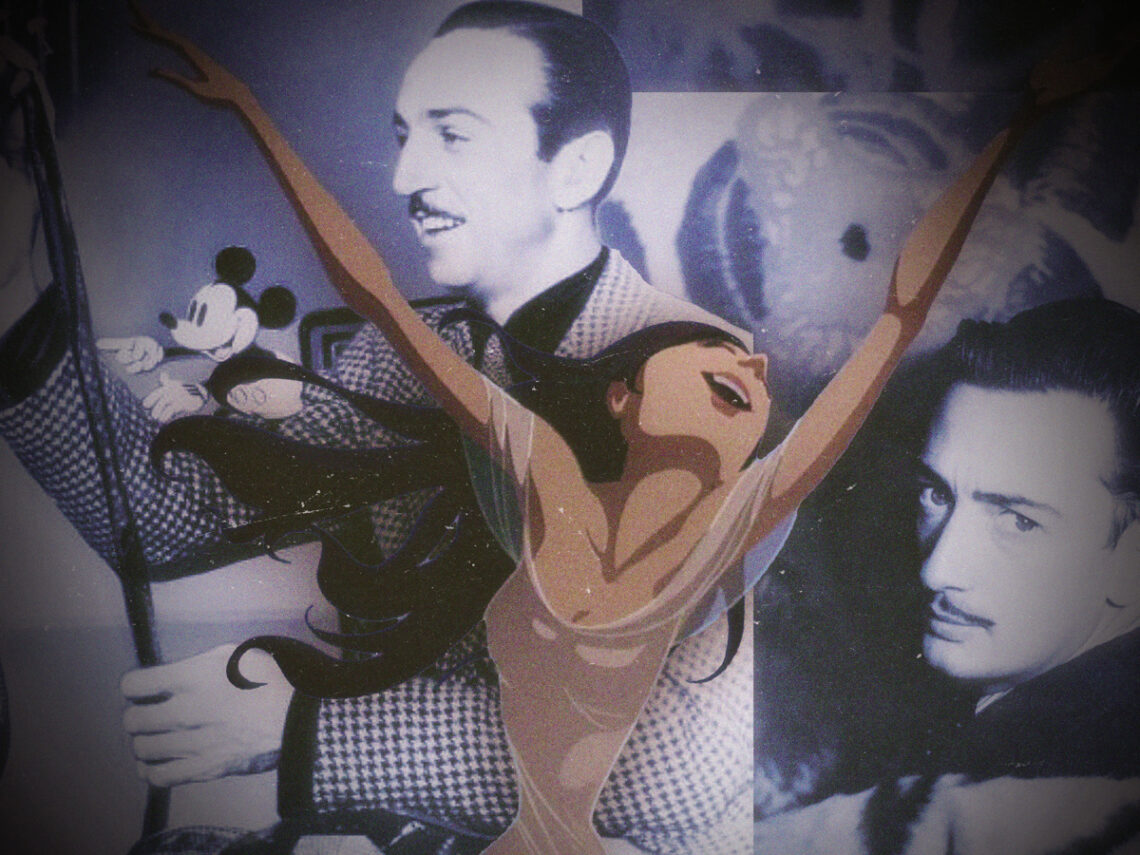
‘Destino’: the extraordinary 1946 Salvador Dalí and Walt Disney collaboration
On paper, Salvador Dalí and Walt Disney sound like two people who should never have occupied the same room.
One was the self-appointed king of Surrealism, forever painting melting clocks, impossible landscapes and dream imagery pulled straight from his subconscious. The other had become the world’s greatest popular entertainer, building an empire on talking animals, fairy tales and family-friendly fantasy. Yet for eight months during 1945 and 1946, the two men worked side by side on one of the strangest collaborations in 20th-century art.
The result was Destino.
Or at least, almost.
Working alongside Disney artist John Hench, Dalí developed storyboards, paintings and ideas for what he described as “a magical display of the problem of life in the labyrinth of time.” Disney, naturally enough, offered a rather simpler explanation, calling it “a simple story about a young girl in search of true love.” Both descriptions are accurate in their own peculiar way.
The project fell victim to financial realities before it could be completed. Disney’s studio was still recovering from the economic difficulties surrounding the Second World War, and Destino quietly disappeared into the company’s archives. For decades it became one of those tantalising “what if?” stories that film historians love: a legendary collaboration between two artistic giants that almost nobody had actually seen.
What survives from the original production amounts to little more than storyboards, production artwork, correspondence and a precious 17 seconds of completed animation. That brief sequence, featuring Dalí’s unmistakable imagery of turtle-borne parade floats drifting across a dream landscape while a baseball player watches on, offers a tantalising glimpse of what the finished film might have become.
The project remained dormant until 1999, when Roy Disney revived it during the production of Fantasia 2000. Rather than attempting to reconstruct something that no longer existed, Disney Studios France approached the material as an act of interpretation. Directed by Dominique Monféry, working with surviving artwork, production notes, conversations with John Hench and clues from Gala Dalí’s writings, the finished short finally appeared in 2003, nearly 60 years after work had originally begun.
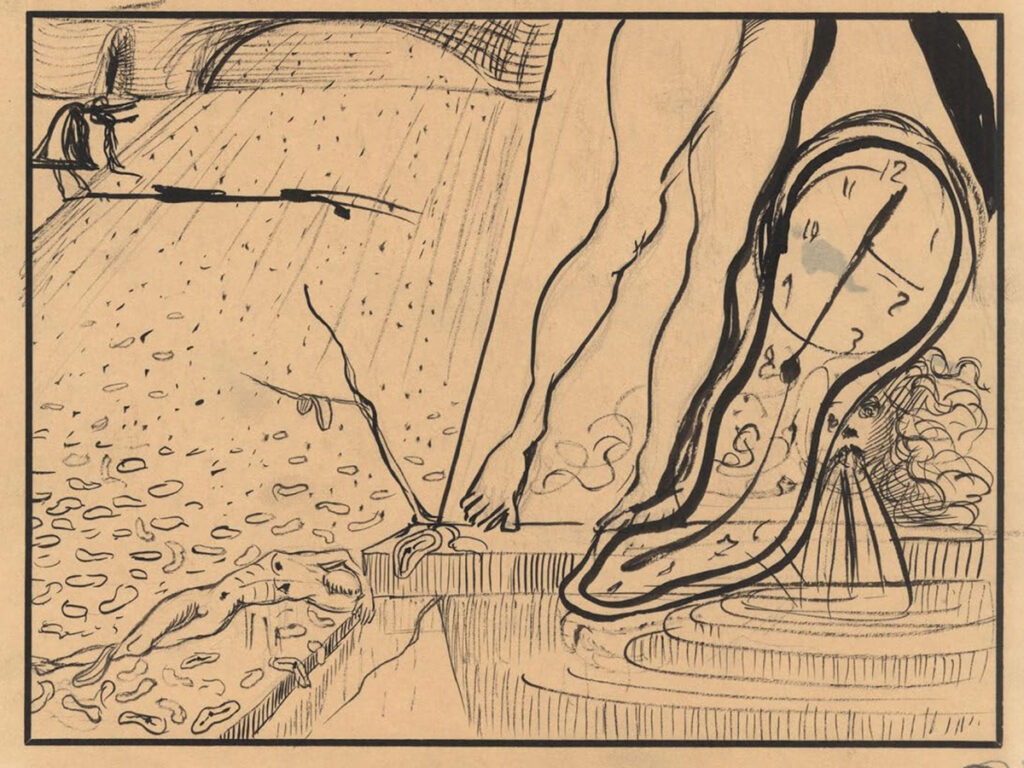
The completed film tells the story of Chronos, the personification of time, falling in love with a mortal woman. They wander through a succession of impossible landscapes populated by melting architecture, shifting statues, baseball players, floating eyes, dancing figures and all the wonderfully irrational imagery you’d expect from Dalí. As narratives go, it’s almost beside the point. Like the best surrealist art, Destino is less interested in telling a story than in creating a state of mind.
Watching it today, it’s impossible not to wonder what the original 1946 version might have looked like. The reconstructed film is undeniably beautiful, and Dominique Monféry’s team deserve enormous credit for translating Dalí’s paintings into fluid animation without losing their dreamlike quality. Even so, I have mixed feelings about calling it a genuine Dalí-Disney collaboration.
I’ve been lucky enough to see Destino projected twice in museums, once during the huge Dalí retrospective in Philadelphia and again as part of LACMA’s exhibition exploring Dalí’s relationship with Hollywood. I loved it both times. It’s an extraordinary piece of work, and visually it’s often breathtaking. My reservation has never been about the quality of the finished film. It’s about the way it has sometimes been presented.
What we’re watching isn’t quite the film Dalí and Disney made; it’s the film another generation of artists made after studying what Dalí and Disney left behind, and that distinction matters.
The surviving production material provided an invaluable blueprint, but no amount of careful reconstruction can completely bridge a gap of more than half a century. There are inevitably creative decisions that had to be made by people who weren’t present in 1946, and that’s perfectly understandable. I simply think Destino is more interesting if we appreciate it for what it really is: a remarkably faithful interpretation of an unfinished masterpiece rather than the masterpiece itself.
Perhaps that’s also why it remains so fascinating. Destino exists somewhere between historical document, restoration project and original work of art. Few films occupy that strange middle ground, and fewer still involve two of the twentieth century’s most distinctive imaginations.
For a project that was never actually finished, it’s remarkable how completely Destino still feels like the meeting of two creative worlds that, against all odds, turned out to have far more in common than anyone could have imagined.