


Burning Down the House: An Exclusive Interview with Artist Roxana Halls

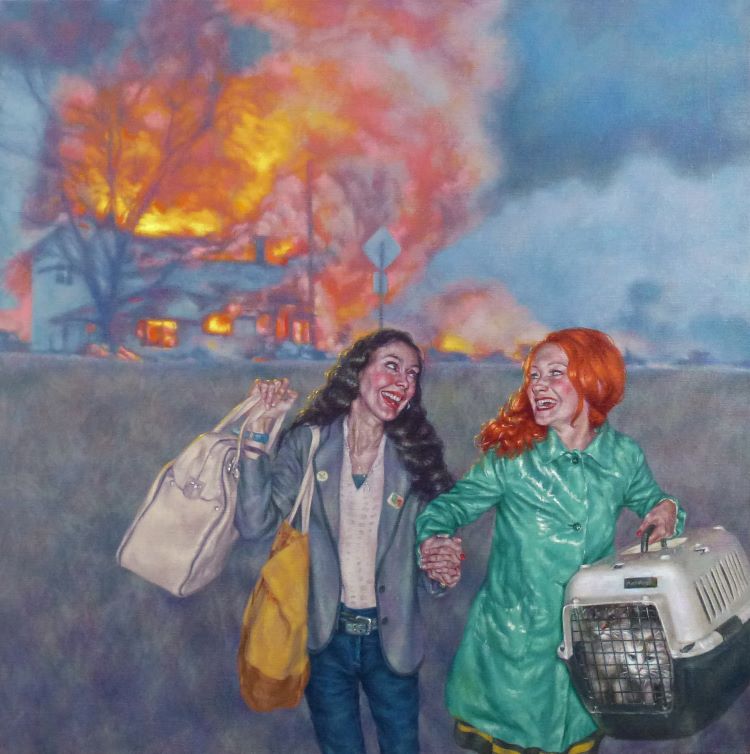
‘Laughing While Leaving’ (2017).
When the artist Roxana Halls was a child she considered becoming an actor or better still a film director when she grew up. Halls invented stories and ideas for the films she imagined she would make but soon realised the overly collaborative nature of filmmaking would only dilute her vision. This led Halls to seek other ways to capture the images which burst like fireworks in her head. She decided on painting. From early self-portraits in her bedroom-cum-studio at her parents home, first in Plaistow, London, later a small town in Devon, Halls taught herself how to paint picture by picture through hard work, discipline and an innate desire to make her ideas visible.
After briefly attending Plymouth College of Art & Design, Halls returned to London where she established her first studio in an abandoned theater. It was a perfect venue for an artist whose passions were art and performance. Around this time, Halls began collecting mannequins which she incorporated into her work – sometimes explicitly recognisable, sometimes appearing as an uncanny presence.
Among Halls early works is Tingle-Tangle a series of paintings exhibited at the Royal National Theater in 2009. Partially inspired by her time staying in Berlin and through the film Cabaret, Halls paintings revealed how “through the alchemy of paint, an inventive aesthetic can transform the mundane – cardboard sets and charity shop costumes – into extraordinary spectacle.”
Next came the series Appetite which examined sex, identity, and female repression through the inhibiting forms of censure, surveillance, and denial in women’s relationship to food.
Halls works within a feminist tradition as an artist. Her paintings engage the viewer in a dialectic. In her series Laughing While… (2013-ongoing), Halls presents women center stage laughing euphorically, joyously, while behind a wrecked car ignites, a house burns, a shop has been looted, or a plane has crashed. These are brave women. Revolutionary, rebellious women liberating themselves from the strictures enforced on them by others. Our first response may be to smile at these women in acknowledgement of their actions then perhaps wonder how much we are similarly seeking our own liberation.
Roxana Halls lives with her wife and has her studio in south London. Over the past twenty years, Halls has created a significant and substantial body of work, which places her as one of the most important and pioneering artists working today Dangerous Minds contacted Halls to discuss her work and career.
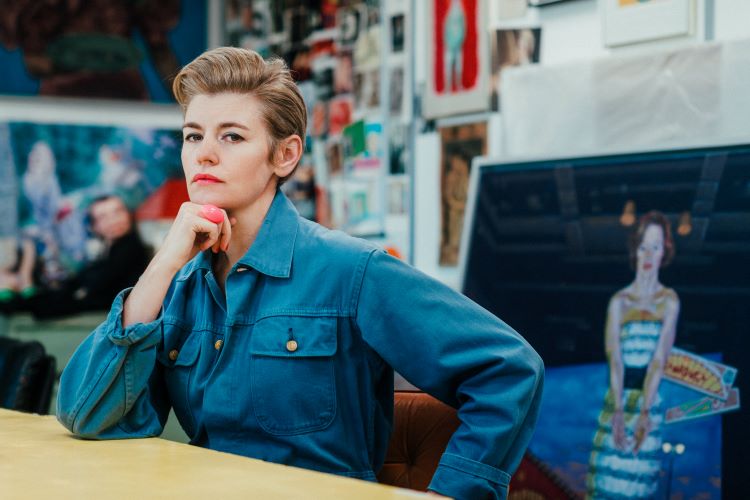
The artist Roxana Halls in her studio, photograph by Kris Kesiak.
How did you become a painter? What inspired you?
Roxana Halls: I didn’t exactly decide to become an artist, it was more of a sense of vocation to me. I hadn’t really made a great deal of work as a kid in terms of painting, I’d written stories and illustrated them and apparently one of my earliest activities was to cut shapes out of paper and images out of mags and move them around on a large board to make movable visual tales.
Painting, however, no more than the average child until one night aged sixteen I thought I’d try some oil painting and although the painting I made – it was a self-portrait which I still keep – is pretty abysmal I somehow just knew from then on there was nothing else for me. It was more a kind of uncovering of purpose than making a choice.
I have read you originally wanted to be an actor, if you had followed that path what kind of actor would you have become?
RH; Yes, for a while I imagined I might be, and I’ve often spoken about that in interviews in relation to self-portraiture and the taking on of guises. I can’t recall what I envisaged at the time other than to take on as wide the roles and possibilities that were offered to me but certainly, I didn’t imagine anything mainstream or broadly popular.
But long before enjoying acting for a while, one of my earliest memories is of the playground pretending to be a film director and casting fellow pupils as my performers in my upcoming movie. I strongly recall an incident where I made an error of judgment in casting my lead actress and causing some tears! I often feel that in another life and under other circumstances I would have been a film director, but we can’t choose our language, it chooses us. I’m often struck by how our younger selves can intuit some bedrock of truth about our natures which we keep mining for a lifetime.
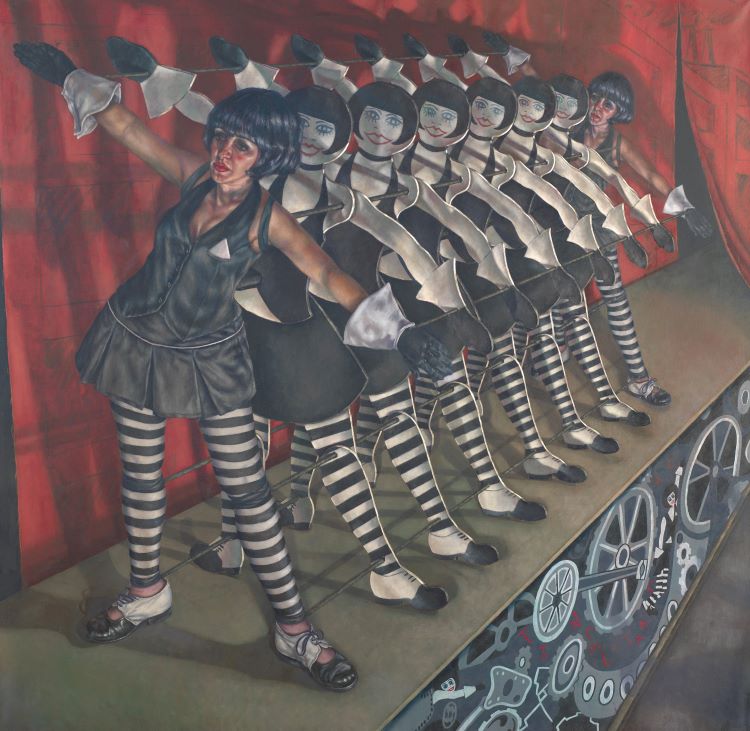
‘Grit and Ina Van Elben’s Tingel Tangel Machine’ (2007).
How has your artistic vision evolved?
RH: In some respects there are some core elements which haven’t changed, I have a continued thematic focus on a control versus chaos dichotomy, on exploring freedom, erotics, performance and refusal.
Last year I had my first major institutional exhibition at Haus Kunst Mitte in Berlin which brought together a wealth of work made over 20+ years, many pieces were loaned by collectors alongside very recent work, some made for the exhibition. It was a strange reflective experience to walk through my life and since then I’ve been thinking about this very question: how to evolve further, what to leave behind, how to integrate the seemingly disparate strands and understand how they form a whole.
In a prosaic sense my work process underwent great change once I began making my Laughing While… works, in that I had formerly worked exclusively from life which often meant building elaborate sets and props as tableau to work from. Once capturing a knife-edge laugh became my preoccupation, I realized that my old methodology was no longer fit for purpose and I had to develop a new one around photography and film.
This work also took me outside the enclosed studio environment for the first time, and now my figures roam as they please and they please themselves.
When you started painting what was your interest/inspiration/motivation?
RH: The sense that I had found my language. I had never felt anything akin to that sensation, whatever my previous interests had been I realized they were adjacent and subordinate. I’d always been a silent child, still am largely, and suddenly I found I had access to an entire vocabulary which was mine and which I could expand and explore. I’ve also always been very solitary by nature, so while I do love to work collaboratively on my paintings with my subjects I am mostly alone as I always was as a kid. I’d already created all kinds of things in privacy so that wasn’t new, but I suddenly felt I could create an entire world.
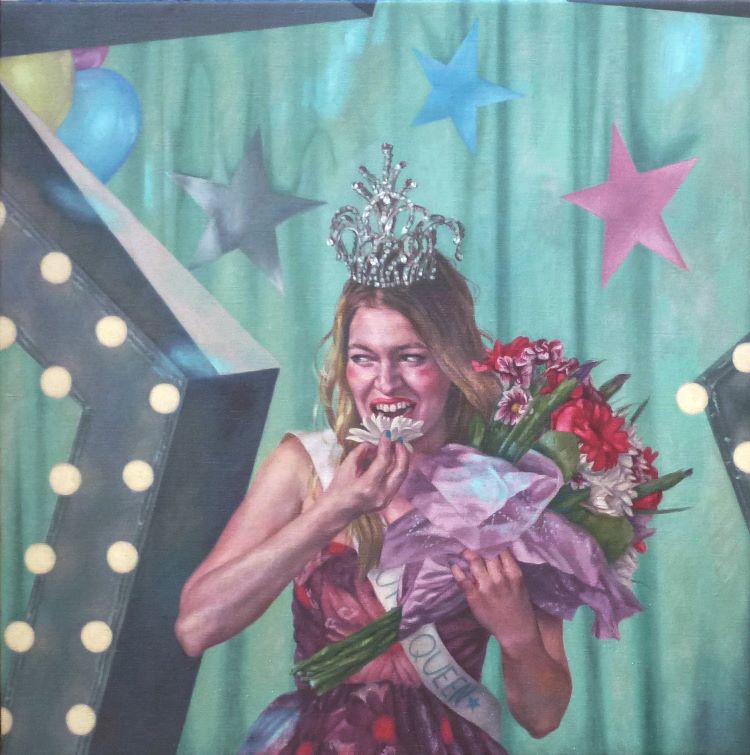
‘Beauty Queen’ (2014).
Tell me about your first paintings?
RH: I started out as many do painting self-portraits and still lives. All very available and accessible and something achievable in the confines of a tiny bedroom. I always worked with a guiding principle of wanting to make whatever needed to be made, no matter what, with little regard for what seemed feasible under my circumstances, and it didn’t take too long before I was bursting at the walls with bigger ideas and canvases and the still lives became stranger and more metaphorical and the self-portraits took on more elaborate guises. I never had any money so I lived on a shoestring and gave everything I could to make work. I’d find scraps of moldering fabric and turn it into a ghost template of myself which looked like sloughed skin and place it in empty rooms. I was very responsive to the potency of a found object then and was an avid skip diver. I’d find a bent up old, discarded parasol and turn it into a defiantly magical object, for one example.

‘Laughing While Smashing’ (2018).
Tell me about your series of paintings ‘Laughing While…’ Why laughter?
RH: I’ve always thought of wild unconstrained laughter as having a palpable eroticism, and I often describe these unbounded, often queer women in my paintings as erotic agents of change.
As Audre Lorde writes in her 1978 essay, Uses of the Erotic: The Erotic as Power
As women we have come to distrust that power which rises from our deepest and non-rational knowledge…. The erotic is a measure between the beginnings of our sense of self and the chaos of our strongest feelings…..Of course, women so empowered are dangerous.
Laughter is disruptive, it breaks unbidden and is often described as ‘inappropriate’. The act of laughter engages most of the body in its production and consequently my figures have a muscular dimension and in synthesis there is a deliberate sensuousness in the light falling on fabric and hair, and this is frequently suggested in my figures’ surroundings, dark woods, vivid pyrotechnics, neon-lit streets and smoke.
My figures are emphatically never passive; my women are urgently disruptive and active by necessity, but I’m skeptical of straightforward narratives of empowerment and self-actualization and generally swerve away from some kind of strong/weak binary by showing women in a range of less heroic, more plural guises.
Laughter is an eruption from the body, an uncontainable force. It can be the very thing that cuts through to the truth which cannot be policed or suppressed despite all attempts.
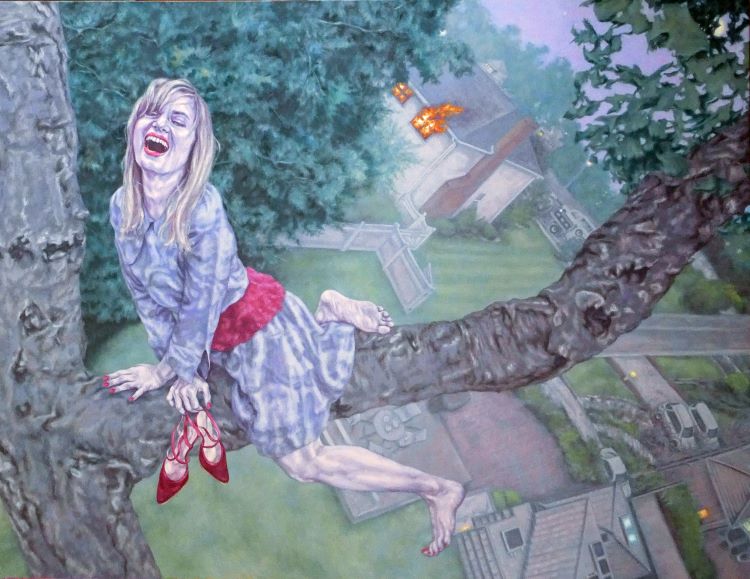
‘Laughing While Perching (a vulturous boredom)’ (2021).
RH: When I paint images depicting female pleasure, excessiveness or impropriety I think of Hélène Cixous, her ideas and her stories. She shows us how resistance can take so many forms – the cultural prohibitions on women being so numerous. When we laugh, we bear our teeth, and in doing so we offer a glimpse of our skeleton beneath.
In its hyperbolic intensity it has always felt like the closest thing to what might be described as truth. I rather like Werner Herzog’s distinction here of an ecstatic truth in that it is through an exaggerated lens we get to the heart of things.
My work using laughter explores ways of depicting women’s internalized rules of conduct, posing questions about the ways in which within contemporary culture women are appraised, influenced and policed and how ‘self- surveillance’ circumscribes the repertoire of legitimate actions available to them. Many of the subjects of my paintings offer a riposte to self-consciousness, toppling over the verge into indulging in ‘catastrophic’ behavior. They may be inappropriate and immune to self-censure. When women are laughing the most seemingly innocuous actions can be subversive, just as acts of transgression may be foregrounded by the prosaic.
Just seeing an image of an alternate world which presents a vision of women roaming, together or alone, in freedom from the constraints of self-consciousness and fear of consequence seems to hold a radical dimension. I’m really struck by how often people tell me that they hadn’t registered how rare it is to see laughter in paintings, and also how regularly people, complete strangers, contact me to tell me their very personal stories of seizing freedom and this means a great deal to me.
Paintings can be like wild animals, who knows what might happen if we let them into our homes?

‘Laughing While Marauding’ (2021).
How much of life is about performance? Is performance part of identity?
RH: It can be. How aware are any of us where the lines can be drawn? Remember that old Kurt Vonnegut quote, be careful what you pretend to be, it’s what you’ll become? That goes for good and ill, and you can harness that for useful purposes and venture beyond thresholds of fear and embarrassment.
I’ve never really subscribed to the psychoanalytic notion that it’s through the stripping away of the layers that you arrive at ‘the truth’, much as I don’t agree that work which is stripped down and somber of palette is inherently any more serious than work which is wild, baroque, satirical, exuberant. Often, as I’ve discussed above, it’s through artifice and guise that we reveal a deeper truth.
I’ve often spoken about the private performance involved in the making of a painting and that sense of turning up repeatedly with stage fright and nerves, hoping to pull it off each time you tackle a new passage in a work, not knowing if you will, as your own worst critic, fall through the trap door.
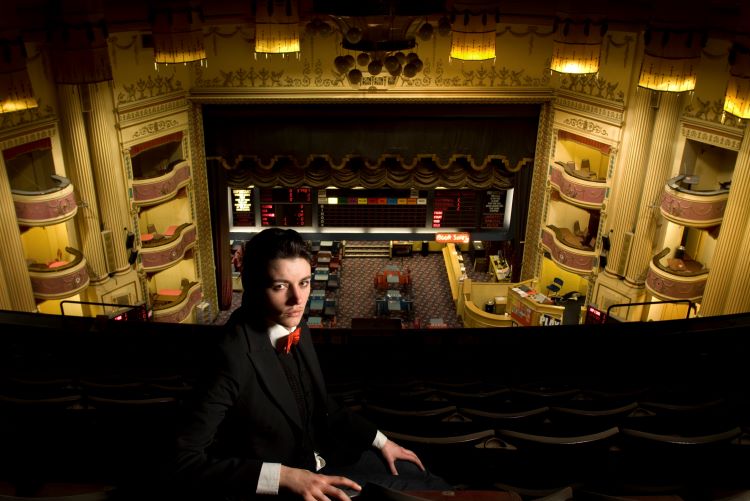
Portrait of Roxana Halls by Matthew Tugwell.
Can you tell me about your studio? Are you still working in the theater bar? Or has this changed? How important is a studio space?
RH: For just over 24 years I had my studio in a disused bar of the Streatham Hill Theater, a magnificent old building suffused with ghosts, layered with dust she was, and I loved her and made the very best use of her I could. I knew my luck couldn’t last and I was unceremoniously evicted when ownership changed to a new landlord with zero appreciation for the arts, much as most artists have been elbowed from most interesting spaces, my experience wasn’t special!
Incredibly I don’t mourn it, I knew the day would come and I’ll always count my stars that I was ever there in the first place. I used to worry that I was so much a part of that place that it was central and in some ways although it sounds perverse it was a gift to lose a place like that and to know that you’ll just get on with work, that you must get on with work wherever you are, and nothing will stop you.
I had that place at times when it was a real struggle to keep paying the rent and had little else left over, it was there when I needed it, it gave me what I required, and I’ll take that with me wherever I go next. Following that, I don’t especially want to remain in one place for too long, I’d quite like to explore a range of different environments and I’ll be moving studio again soon.
I really think you have to make the best of whatever situation you’re in and don’t let it get in the way, the work is key, you’ll most likely never be in a perfect situation. There was a long time when I only had a very small space in a bedroom to work in and I still made 6ft canvases, and in lockdown I had to work at home, my studio was inaccessible, and it was very invaluable to know I could keep working whatever the circumstances.
How do you work? Straight on to canvas? Preparatory drawings? Photographs? Do you work every day?
RH: Oh yes I work every day and it’s a job to get me to have a day out of the studio.
I don’t plan my pictures as such: they come to me unbidden, flashing into my mind formed whole as if stilled scenes from a film, so in a sense much of the creative work is a filtering of all that I experience, my job is to wait, to listen and suspend judgement or censure. My next job then is to commit that image to canvas, which can sometimes involve a convoluted process of staging. I start from the guiding principle that I will do whatever is necessary to make the image in my mind exist, and I’ve been known to build whole sets for my models to work within.
Agency and collaboration are a vital element of the work and I don’t describe the subjects of my paintings as ‘sitters’, it’s too passive, they are my partners-in-crime.
I cast them in their role, costume them and give them props and create an environment within the studio with the appropriate lighting or else work outside, as the painting demands. I’ll then describe the scenario within which I would like them to perform their role and together we mine the potential of the scene.
I photograph and film my models, then having constructed these ‘film stills’ I paint directly onto canvas, building the composition around them, situating them in whichever location their characters are operating within.
These times when I work with my models are really fulfilling. I’m very selective about who I work with and need to feel that there’s the potential for creative collaboration. It’s why I’ve mostly worked with actors who are able to inhabit the roles I create for them, my characters are fictionalizations and I ask that they adopt personas and because the process is so performative it requires physical awareness and a capacity for unrestraint.
I’ve painted some people multiple times and on the occasions when working from life over long periods of time. My preference is to work and be alone, so if I don’t sense that rare synthesis with someone I don’t paint them.
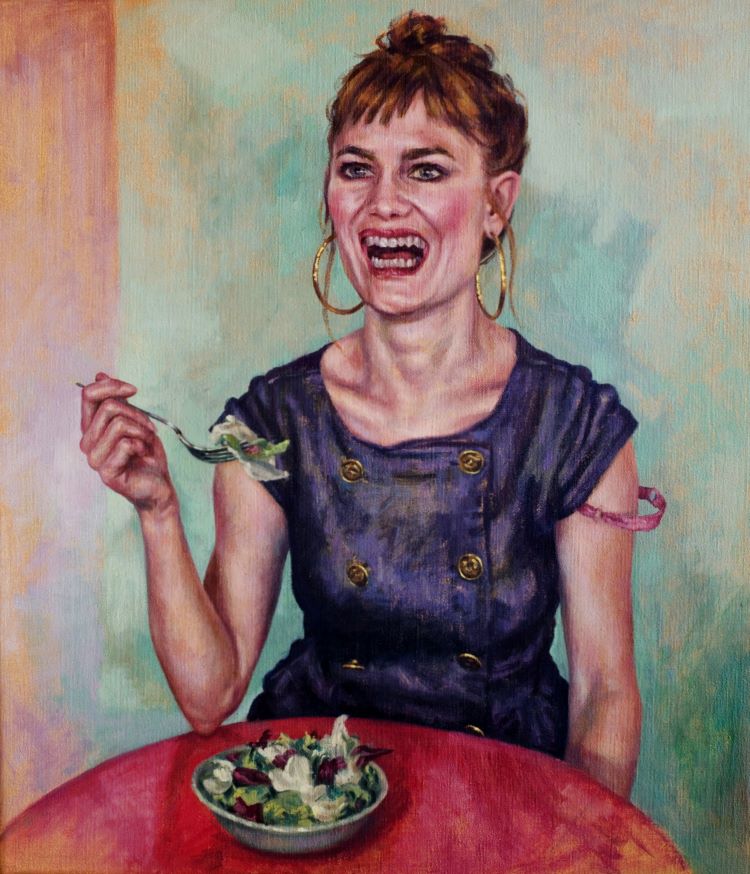
‘Laughing While Eating Salad’ (2013).
What is a typical working day like? Do you have any rituals or things you do before you start working?
RH: Yes, I start each studio day in the same way as I have for many, many years with little adaptation. Make some green tea, scrape the dry paint off, begin. There’s a little more to it but I’ll keep some to myself. Rituals take you immediately into the flow, I really value and always observe them.
Where do your ideas come from? Flashes of inspiration? Ideas from film or literature or paintings?
RH: Everything that we make as visual artists bears the imprint of all that we are, our class, our sexuality etc. and this is inevitably encoded or explicit in our work. But these personal prisms are not the only through route with which to engage with or respond to visual imagery and I’m frequently struck by how deeply personal my work can be for viewers whose lives do not reflect my own. Similarly, if I try to tease out where my ideas come from, while sometimes, rarely, they are made through direct research and in response to a specific source, mostly they seem to spring from an unholy alliance of sources. While some might be considered unimpeachably high-brow, others might be thought unlikely at best! I don’t discriminate, I prefer to be open to the influence of all flavors.
This is partly the training of class. As a young working-class person very often the only way into culture available to you is often through the most famous and mainstream artifacts and references. If you grow up without cultural capital, popular culture can be the only accessible starting point which then generates a hunger to know more and delve further. It’s partly why cinema became such a portal from a young age to a realm of possibility which didn’t exist in my immediate environment. Also, we queer readers become adept at appropriation and creative subtexts and learn to decipher them and tease them out from the prevailing visual culture.
All of this becomes a useful form of training in not installing a false hierarchy in what feeds thought and invention, everything can be interesting and useful.
How personal is your work? Are some of your paintings autobiographical? What have you discovered about yourself from this? In particular, with your self-portraits. How has your work changed?
RH: I always say that painting knows better than I do. It knows what’s really going on, it informs my direction in life, it’s braver than I, it can be highly personal and reveal far more than I’m willing to admit to myself, even when I didn’t think I was referring to anything remotely autobiographical. I don’t mean this in some esoteric way, it’s simply the function of it, as a crystallized filtration of everything that flows into and around me and it’s a mysterious process but as you age your trust in it grows and you increasingly listen to it.
Fundamentally, you could argue that whatever the painter paints, it’s all a form of self-portraiture, as it all comes from and through you and that what it reveals is often involuntary. I don’t think that my self-portraits are necessarily any more revealing or personal than anything else I’ve made, in some cases the opposite. I use myself as a testing ground, a lab. Maria Lassnig said ‘Embarrassment is a challenge. I want to paint things that are uncomfortable’ – I’ve certainly subscribed to her view and want to be ever more vigilant to the confines of self-censure.
When I was young, I remember hoping that my work could say all the things I wasn’t able to talk about, that it would be my personal language and speak when I could not. I now have a very different sense of what constitutes the telling of truth and am skeptical of what that means. I am far more interested in what an image can communicate to the viewer and how unexpectedly and variously it can be read. I am grateful that my work speaks to others, I have no wish to confine it to the precinct of my own experience or to determine how it is read. That would do it a disservice.
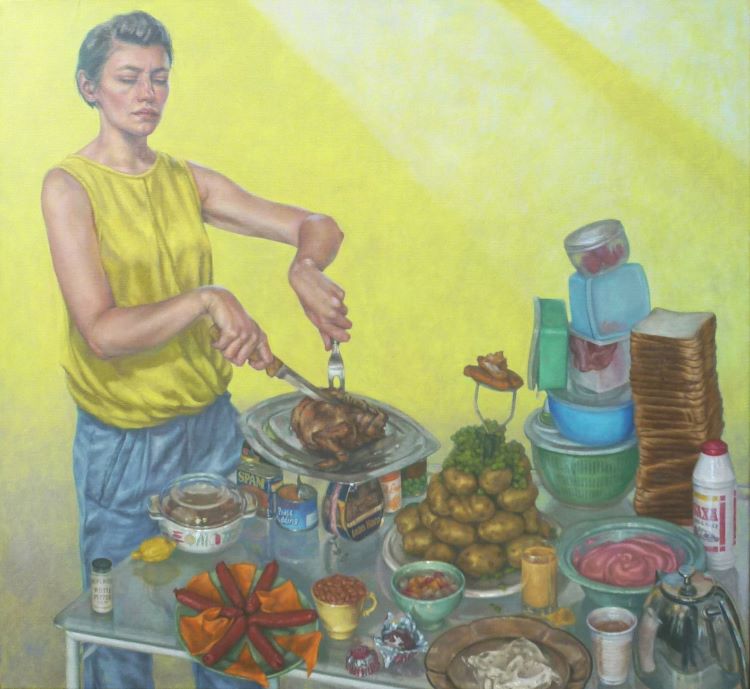
‘Carvery’ (2013).
Can you tell me about the series of paintings in ‘Appetite’?
RH: Well, while I know paint what comes out of the mouth I began by painting what went in. Some years ago now I started to look at the role of self-surveillance in policing women’s behaviour, and this led to my Appetite series, which was never really about food but rather about the extent of and the sloughing off of control. It’s so interesting how a train of thought can lead you to a wellspring of material and as a result sharpen your antenna for the manifestation of an idea in the world at large.
I had been reading about Foucault’s thoughts on the panopticon prison, a symbol of social control that extends into everyday life for all citizens, not just those in the prison system. His argument was that citizens always internalize authority, which is one source of power for prevailing norms and institutions. Around the same time I read about the stranger shaming creep Tony Burke who began a website and Facebook group called Women Who Eat on Tubes.
A regular passenger on the London Underground, Burke was both widely castigated but was also the recipient of support from his male followers when he wrote:
Everywhere I go I see women eating on Tubes…Slowly, secretly, guiltily raising each bite-sized morsel to their salty lips in the hope that no-one’s watching. Well I’m watching. And I’m photographing.
I can’t really remember a time when I wasn’t aware that most women exercise self-surveillance without even having an awareness that they were doing so….it just seems like breathing to many women, that whatever their impulse was they should learn to suppress it. I suspect most women are not aware of when they learned to subsume their true instincts but rather when they learned they could choose to no longer do so.
My Appetite paintings and the work which has followed, have constituted a kind of thought experiment: what might be possible were these women I paint to elect to no longer police themselves? What might they be capable of? At times their answer to these questions has unnerved me. I can’t claim to know how women can free themselves from being curtailed by expectation, but I suspect asking themselves such questions might reveal interesting answers.
Much of my work is concerned with this question and in making work about this subject I have felt like a spy mounting an investigation of sorts. I think my job as an artist is to really pay attention, but as much as I often feel like an onlooker it’s not as though I am not subject to the same forces. So how then to advise on freedom…physician heal thyself.
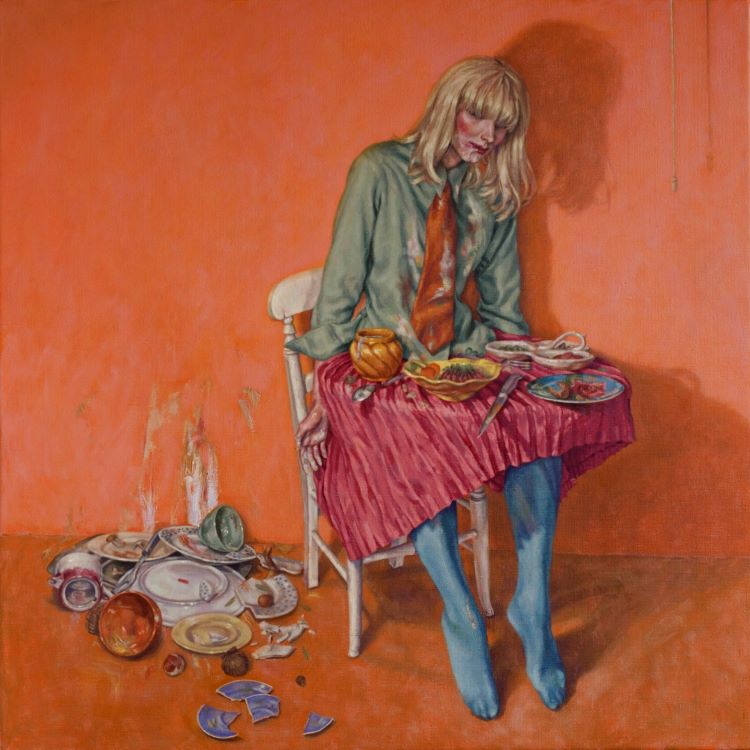
‘Girl Table’ (2014).
What was it like working for Disney on the portraits for ‘Haunted Mansion’?
RH: It was challenging, but I don’t shrink from a challenge and appreciate the opportunity to find new solutions to inevitable problems! I never could have imagined a commission such as this coming my way, who would? I’m an avid film watcher, I go to the cinema two-three times a week and also watch movies at home but I never imagined I’d see my own work in any film, certainly not a Disney film.
Although my personal cinematic taste is more art house and avantgarde as an adult, like so many, I grew up with Disney as a world of imagination which I could step into as a child and it’s no doubt part of my visual vocabulary. To explain, I was commissioned to create a series of paintings for 2023’s Haunted Mansion remake. Center-pieces in the house’s Stretching Room are four five-foot-high paintings, created by me, which come to life in one of the film’s most dramatic sequences.
I’ve made some work for TV, but this was my first film project and it being such a major multi-million production with a short window to make the work in time to be on set on schedule meant that the pressure was pronounced. But as with any work, you have to put that pressure outside the studio door as much as possible and get down to it.
As much as I couldn’t resist seeing my work on the big screen, my collaboration with the studios demonstrates that Disney takes inspiration from artists as it has always depended upon creative talent. From the very beginning, many of the most iconic Disney characters have been drawn by some of the best visual artists, illustrators, animators and painters. From designing characters and concepts to creating atmosphere and landscapes, artists have always been behind the Disney magic; I’m pleased to be part of this great tradition and for my work to be part of the Disney archive among their work.
Where did the ideas for ‘Grisaille’ come from? In particular ‘Laying a Table’, ‘A Hysterical Woman’ and the ‘Chevelure’ series?
RH: Well, as Wikipedia will tell you, a Grisaille is a painting executed entirely in shades of grey or of another neutral greyish color, and the technique used has a long and fascinating history.
I’m primarily interested in the metaphorical aspect of the way Grisaille operates as a negation of and abstention from color and how it was historically used during Lent, when statuary and paintings would be covered in cloth and vibrant altarpieces would be closed revealing only the monochromatic faces of their panels. For me it expresses stasis, reflection, reckoning and renewal.
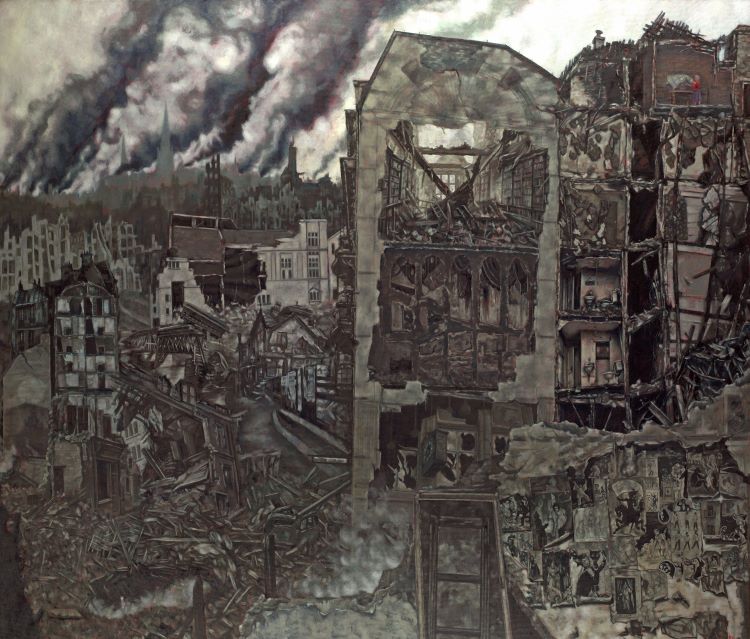
‘Laying the Table’ (2008).
RH: Laying the Table. This painting shows one small action of hope amidst a landscape of smouldering devastation in the form of a lone figure laying a table in the uppermost corner of a ruined building, the only point of color in a monochromatic panorama. The location of this dystopian city is an amalgam of many, some more immediately recognisable than others, from Berlin to Dresden to New York to London, on and on across time and continents, with the intact spire of Coventry Cathedral rising at the apex of the devastation.
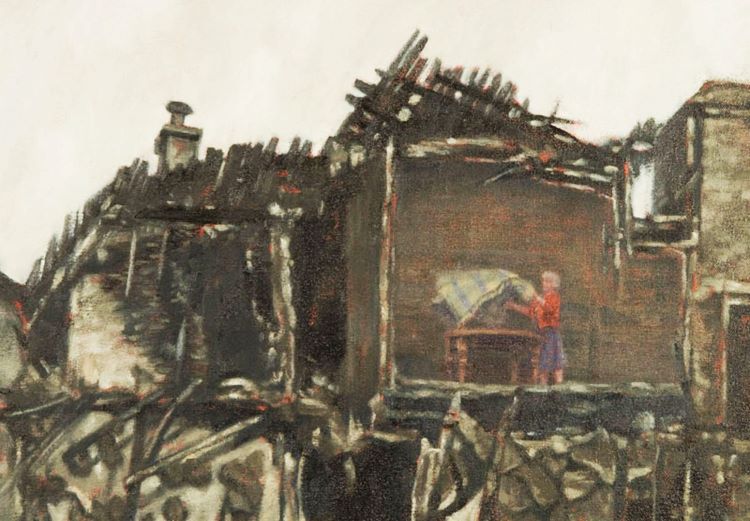
‘Laying the Table’ (2008) – detail.
RH: I painted this after a particularly debilitating depressive episode during which I was unsure if I could paint again. To break this impasse, I finally attempted to paint one tiny picture and discovered that it was only in the act of making work, however modest my intentions, that I would realise that my fears were unfounded. Shortly after this I began Laying The Table with far less timidity.
Since the painting’s execution it has seemed relentlessly apt, this woman simply laying her table in the midst of ruination, against all apparent futility, making her unceasing gesture of consolation and faith.
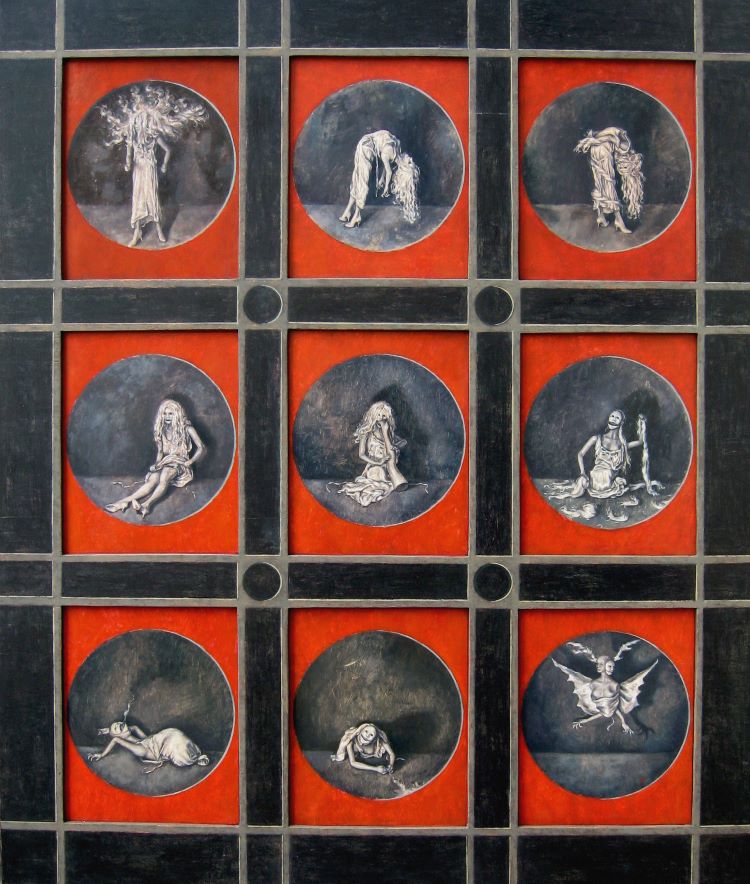
‘A Hysterical Woman’ (2010).
Referencing both Charcot’s late 19th-century photographs of female hysterics, the Medieval moral phantasmagoria of Bosch & Bruegel and the work of Cindy Sherman, A Hysterical Woman employs dark fantasy and sinister humor to offer frozen moments of a mysterious transformation.
The work was made, in part, as an attempt to chart and manifest the artists’ own intimate experience of severe depression.
Halls has long been fascinated by the grisaille technique; a painting executed solely in monochromatic tones used to imitate the inert appearance of stone. Northern Renaissance masters often used this technique when painting the external wings of hinged altarpieces and their limited palette was intended to be directly antithetical to their elaborate, sumptuously colored interiors. Grisaille panels were sometimes only visible when closed, generally during lent, a time of reflection and constraint. Today these works are often invisible, faces to the wall, as polyptychs are displayed open with their more exuberant aspects turned towards the museum visitor.
In A Hysterical Woman Halls draws metaphorical parallels between the intended purpose, current seclusion of these works and the state of depression. While within this state a sufferer often closes their external face, finds themselves shrouded in unease or indeed is removed from public view. In contrast to the artworks which inspired this piece, in these paintings there is no glimpse of an alternate panorama to be disclosed, there is one view only.
Compositionally the work describes a woman moving through one cycle of acute depression. Initially she appears taut and immobile until her body is racked with contortions. She begins to carve, disassemble then consume her own being, then to slowly re-craft herself from what remains. The curious hybrid creature who ultimately emerges in the final panel bears no resemblance to the figure from the first and it is only as we reach the end of this cycle that we realize that what we understood to be her face was actually a mask.
This piece is a complex wooden construction hand made by the artist comprising of nine individual panels recessed within one larger painted frame, with rectangular holes cut out of its surface in order to create the impression of nine windows, or ‘cells’. The surface of the construction itself is painted to give the illusion of further recesses within the main frame. Its execution was intended as a deliberately crude approximation of an early multi-paneled allegorical painting.
The figures depicted within these windows were, in keeping with methods the artist often employs, constructed as still-life tableaux at her studio from which she painted.
While Halls has worked with the theme of ‘female hysteria’ in much of her work it is the only piece of its kind made by the artist.
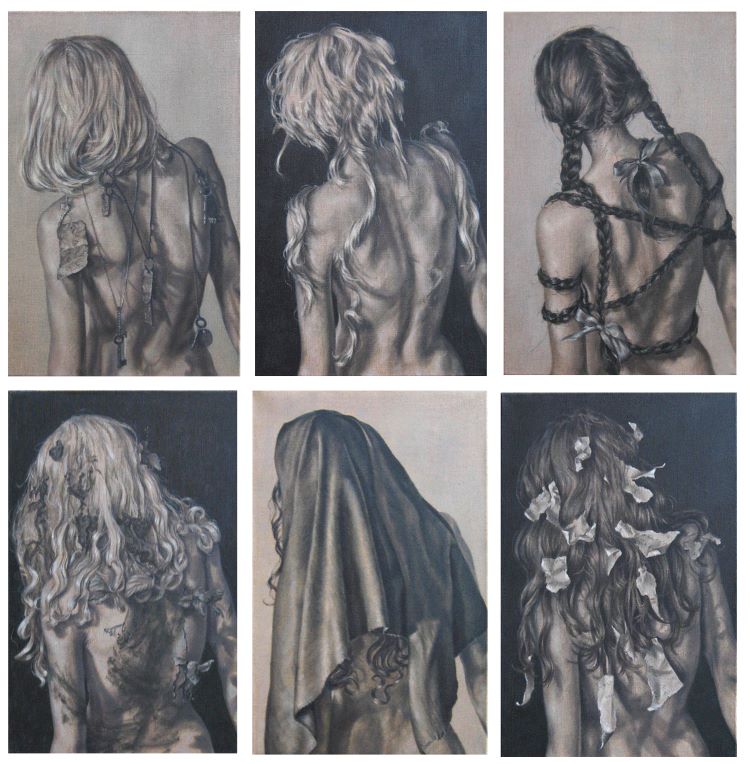
‘Chevelure Series’ (2010).
RH: Chevelure I was partly thinking about just how significant hair is to women, the traces of their pain, their paths, their renewal.
Each figure will evince a different response in each viewer, but here was my understanding of each of them.
The figure with short cut hair was a women shorn for being a collaborator, the bound plaits is a victim of child abuse, the covered hair a women concealed due to religious oppression, the keys which opened the locks of unknown doors hang from the hair of a sex worker, the torn paper may be documents of oppressive bureaucracy or perhaps of an intimate contract, the blonde figure with hair covered with leaves has been assaulted and abandoned.
Each woman symbolically carries the trace of their lives on their backs, in their hair. They will all stand awhile to reflect before walking on.

‘Mali und Ingels’ (2008).
What inspired ‘Roxana Hall’s Tingle Tangle’? Was Isherwood’s ‘Goodbye to Berlin’ or the film ‘Cabaret’ influential?
RH: In 2004 I was invited by Beaux Arts Gallery, London to submit a proposal for the Villier’s David award which I subsequently won. I had no doubt which subject of research would interest me the most were I to win the prize. I had for some time found fascination in the arts produced at the height of Wiemar and in German art and cinema more broadly and I knew that were I given the opportunity, funds and encouragement to thoroughly research this subject beyond my initial attraction to the work of this era then I would find rich material of my own there. I was also very interested in how it linked with the English working-class Music Hall tradition and how that chimed with my upbringing.
I couldn’t have been more right in what I merely intuited back then, because as it transpired, I then spent the next five years immersed in this subject and produced a substantial body of work which was exhibited at the National Theater in London, and some of the themes of the work have continued to reverberate.
When I started looking into the history of Weimar cabaret it was at a transitional point where there were relatively scant resources available online. I had to undertake research, to go on the lookout, trawl old bookshops and eBay to get hold of DVD’s and CD’s. Once I won the prize, I had the resources to travel to Berlin for the first time and visit museums and galleries and hunt for material there, alas mostly in German but there was a wealth of images available to me, inevitably far more than in my own country.
Nowadays there’s a great deal more and a knowledge of Weimar cabaret has become far more ubiquitous and mainstream. (I seem to be the only person I know who hasn’t yet been to see the latest revival of Cabaret in the West End!)
But that really wasn’t the case back in the early 2000’s, there were only really a few references around and a small resurgence of interest in the subject, and of that rather more of the soft erotics of Burlesque than the raw or probing political material which interested me.
In all honesty it was most likely Bob Fosse’s Cabaret which first brought me to the subject, as obvious as that is! And then to Christopher Isherwood, some Brecht revivals and Ute Lemper’s recordings, all of which seems so embarrassingly cliche. But framing this another way, as above – as a young working-class person very often the only way into culture which is available to you is via the most famous artifacts and references. Popular culture can be the only accessible starting point which then generates a hunger to know more. As my wife Melanie recalls, she learned about some of her now favorite poets via the songs of Kate Bush, she was introduced to the work of Anne Sexton via a song by Peter Gabriel.
By the time I submitted my proposal for the prize I had also had my studio at the once Streatham Hill Theater for a few years, so the atmosphere of that old place had seeped into me by then. But as much as I enjoyed the theater, when I could afford to go, it wasn’t this form of performance which most interested me, there was something very particular about Weimar cabaret.
I think what I found in this milieu which intuitively drew me to it was that I intuited that it articulated and dramatized certain things which matter to me a great deal. The sense that an art form could hold so many elements together. That it could be profoundly political, unpredictable and wayward, while also being glamorous, sexy, humorous, strange, enthralling, beautiful, indelicate, discomfiting. And the sense that there was no automatic contradiction or incompatibility between those elements and that it was no less serious for being all of those things.
We all look for work which embodies a similar spirit to our own and that sometimes means reaching across time and geographical space. Inevitably there was a patina of glamour which drew me to the period but perhaps there’s something particularly enabling about looking across to a significant cultural moment in another country?
Certainly, it chimed with my developing feminist sensibilities, I was drawn to the rare (relative) gender parity of the realm and how female performers could be at the helm, exploring their freedoms lyrically, sexually and indeed performatively – I was so excited to learn of women such as Anita Berber, Claire Waldoff, Valeska Gert and so on.
Especially I was enthralled by the expressions of sexuality and gender presentation. I didn’t grow up in a time where there was a wealth of significant queer, let alone lesbian, celebrities and performers in popular culture.
So partly I was doing a thing that queer people have done for a very long time. In the absence of anything much immediately around us we’re very active archaeologists and cultural historians, if you will, because we’re looking with such avidity for places and people that we can feel connected to, and with whom we feel a kind of cultural genealogy. We seek out our queer kin.
Which is not to suggest that there are/were no cultural touchstones to be found in the UK. Mere miles away geographically and at roughly the same historical period the Bloomsbury set and painters such as Gluck were active. But as much as some of the work they produced did interest me it just didn’t feel kindred, it didn’t cut through. And this I now suspect had a lot to do with class and privilege. It just didn’t quite have the grit, for me, it wasn’t unruly, not sufficiently strange to really appeal.
I can’t stress enough the precarity of my circumstances for most of my life, and at the point at which I made these paintings this was still the case. I was continually on the verge of not being able to buy materials and maintain the rent on my studio. I had no parental support. Everything I made was by the skin of my teeth but that didn’t mean that I wanted my work to look impoverished. I wanted to affect some alchemy over my paucity and make my work take on a richness which seemed somewhat impossible given the base matter that was available to me.
So I think this is among the many things that drew me to cabaret in general and tingel-tangel, In particular, the name given to a kind of third-rate theatrical variety show. that it wasn’t an enriched form, it was kind of dragged together, like me! That you’re putting on a show with barely any means, pasting over cracks, finding joy in hard times. And in conjuring that creating a realm in which to discuss and explore a pervasive anxiety and fear that everything might at any minute collapse.
I could write at length here about the cabaret series and what it articulates as a whole and about all the acts and how they were devised and so on. When viewed in sequence the viewer sees an evening’s cabaret from curtain up to finale. But in a nutshell, I would say they are about agency. About being caught in a system and trying to individuate and take charge of your circumstances, escape them and realize your own. The final work, Terina & Inferna, a double self-portrait, is key. Terina is there solemnly fashioning shapes out of nothing but paper while the fabric of the cabaret itself is collapsing around her, while Inferna is such a harbinger to the laughing work, gleefully burning those paper pieces as they fall to the ground. I feel like she knew all along where I needed to go but it took me a long time to get there. Inevitably it feels significant personally to be looking back on all this now a couple of years since I was evicted from the old theater after 24 years in that place!
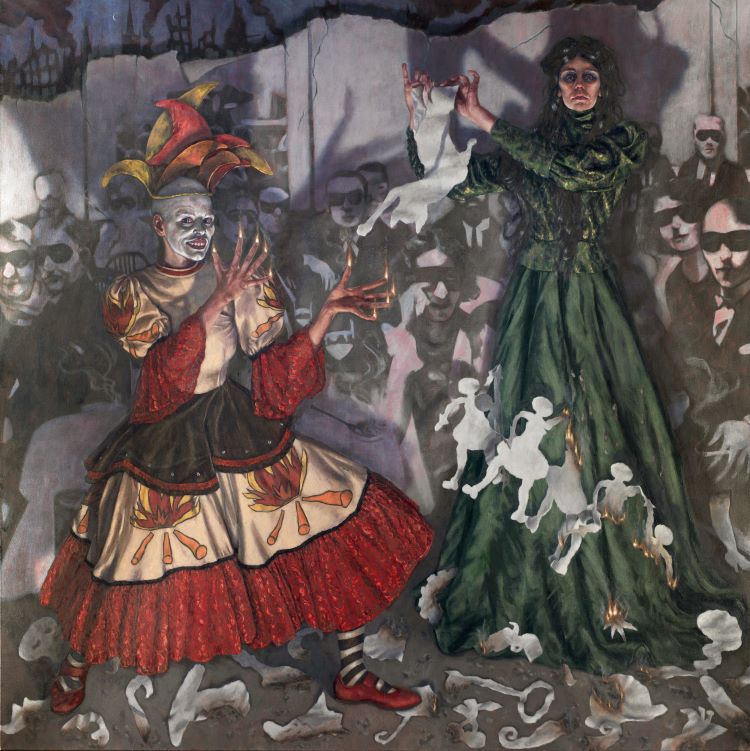
‘Terina the Paper Tearer and Inferna the Human Torch’ (2009).
What are you working on next?
RH: I’m moving studio again soon and that will bring new ideas no doubt but my list of work yet to be made is very long and it endlessly grows. Making work generates new work so part of my job is to try to make good choices about what I most need to make.
I’m in preparation to make some new large scale Laughing While extravaganzas, one of which I’ll begin as soon as I move studio. I have some fantastic co-conspirators to work with on my next works in this series, who are yet to be revealed.
Meanwhile, I’ve been working on the latest development of my series of Unknown Women They are in a sense stilled, quiet companions to my laughing women and I’ve at times turned from one to the other.
The infinite fold separates or moves between matter and soul, the façade and the closed room, the outside and the inside
Deleuze, The Fold
I’m excited to be about to start on a large-scale portrait of the interstellar designer, artist and activist Pam Hogg.
I’m also working on a multi-paneled series – The Adventures of Mona & Lisa : a queer picaresque which draws on true crime tales and the signification of color in silent movies.
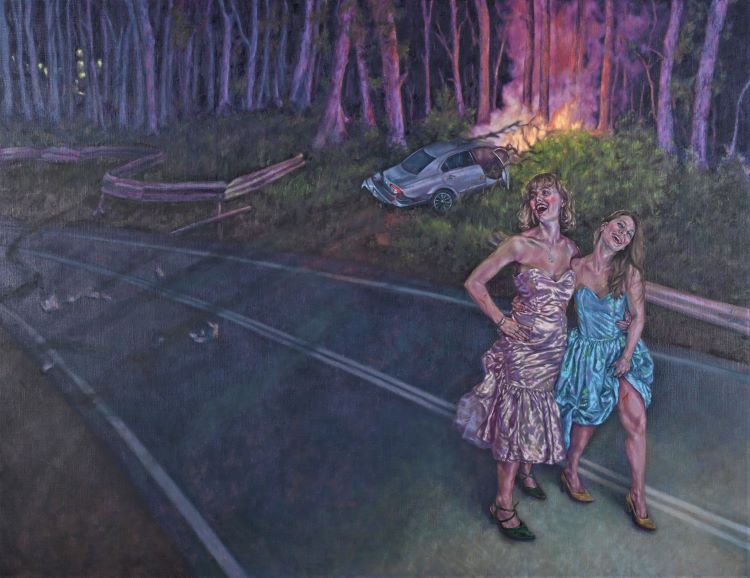
‘Laughing While Crashing’ (2019).
Images copyright Roxana Halls, used by kind permission.