


The Bullet Catch: a brief, bloody history of the world’s deadliest magic trick
Only in the weird and wonderful world of magic could the dangers of firing a gun at someone be a little underrated.
I know that sounds absurd on the surface. There is absolutely no world in which firing a gun at someone isn’t a clear and direct attempt on their life. Even with fake guns, prop guns, and blanks, things can go terribly wrong, just look at the myriad of tragic onset accidents for proof of that. A misfiring prop gun in The Crow infamously claimed the life of Brandon Lee. I’m sure we don’t need to go over the horrible events on the set of Rust that took the life of Halyna Hutchins.
Because of that, even bearing in mind the trickery and unreality of everything else on stage, there are few more terrifying sights in magic than a magician setting up for the famed bullet catch. The basics are more or less the same in every restaging. The magician somehow fires a gun at themselves and miraculously finds a way to catch the bullet. There have been variations on this theme over time. Ralf Bialla had the bullet seemingly go through a glass panel before he caught it. Penn and Teller doubled the amount of guns and bullets, firing two pistols at each other and each catching a bullet.
While countless magicians have put their own spin on the trick, there’s never been a real need to reinvent the wheel here. No matter the time, no matter the place, no matter the audience, there will never not be a frisson of genuine danger with the bullet catch. The kind that leads to the kind of audience investment that magicians of any generation would kill for. That doesn’t stop them from adding to the drama of this particular illusion with choice quotes from the trick’s bloody history.
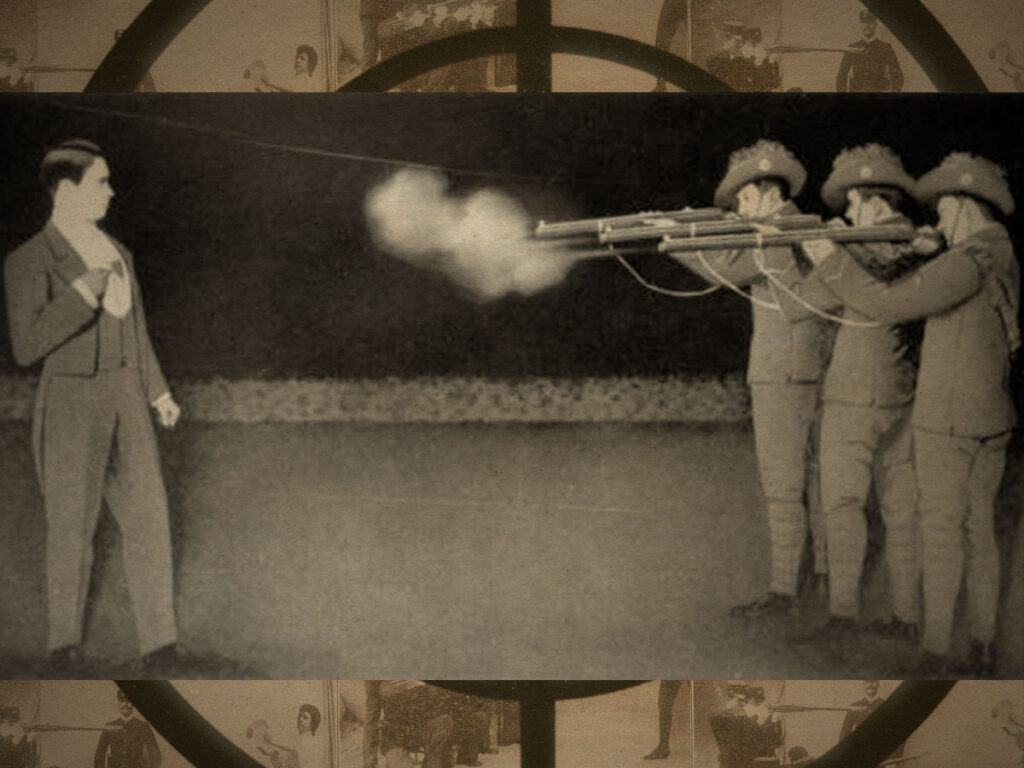
Why is the bullet catch such a dangerous magic trick?
What a history it is too. The first recorded version of the bullet catch was (I kid you not) in 1586. Jean Chassanion wrote about the trick in his Histoires mémorables des grans & merveilleux iugements et punitions de Dieu. While there may be reason to believe that Chassanion’s work is hyperbole or just straight-up misinformation, the world of magic is such an insular one with secrets guarded with an almost religious fervour that we can never really know for sure.
For one thing, there’s also reason to believe that Phillip Astley invented the trick in 1762. The problem is that the source of this is Phillip Astley himself. Magicians are nothing if not a carney lot. This may be closer to the truth, though, as shortly after Astley claimed to invent the trick, other performers started adding it to their repertoire as well. By the mid-1800s, the mark of a big-time magician was to incorporate a version of the bullet catch into their act, which is where the stories of the trick going horribly wrong start popping up everywhere.
Now, as believable as it is that to develop a bullet catch trick is to play dice with your own life, the main thing to do here is to take everything with a pinch of salt. We’re citing sources here who are mainly magicians. People who have a… some what say interesting relationship with reality and the truth. Some within the magic community will tell you that up to 15 magicians have all died in tragic accidents connected with the bullet catch, but in terms of verifiable casualties, only one stands out.
In 1918, the magician Chung Ling Soo (actually a white American called William Ellsworth Robinson, magic is weird), performed the trick on stage in London. His version featured a gimmicked musket that, while legitimately loaded with a real-life round, was supposed to fire a blank out of the ramrod tube below the barrel. On one fateful night, the musket malfunctioned and legitimately fired the round into Soo’s lung, fatally injuring him.
So, if a magician tells you that their next trick has claimed many lives, watch out. That may be more true than anyone would like.