


The Nuclear Option: Dìxià Chéng, the underground city beneath Beijing
From Beijing to Beirut, people act like the apocalypse is closer than it’s ever been, and while that might be technically true, it does also carefully ignore those moments in the history of the world where it seemed like we were on the brink of annihilation.
World War I. World War II. The Cuban Missile Crisis. The entire 1980s. All times when people went about their day with a little voice in the back of their mind saying, “This really could end tomorrow”.
Whether that was from warfare spiralling out of control in the first half of the century or the knowledge that a nuclear war wasn’t just possible but actually quite likely in the second. While most people just kept calm and carried on, nations couldn’t quite have that attitude.
Instead, they actually had to prepare for the worst to happen. Yet still, most countries didn’t. Settling instead to tell their panicked populace that they’ll be fine so long as they duck and cover under a desk or dinner table. Neglecting to mention that all that’d do is make their bodies easier to find. No, perhaps there should have been more countries doing it the way China did, and not just telling their populace to get under a large piece of wood, but under the ground itself.
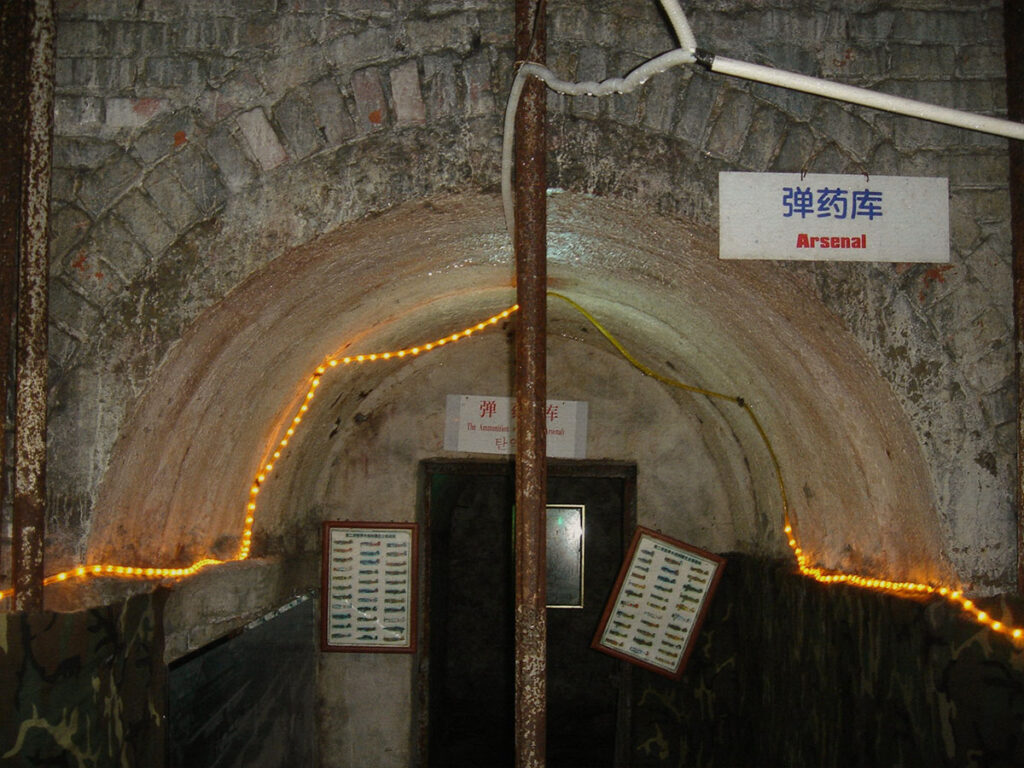
It’s true, buried deep within the guts of Beijing is a densely connected series of tunnels covering a 33 square mile portion of the city between 25 to 60 feet under the ground. All to prevent a nuclear strike on the city of wiping out its six million strong populous at the time of the start of its construction in 1969. Now, official word on the extent of the construction is hush-hush; all we have to go on is what little the Chinese government has said on the matter.
There’s reason to believe they’re not exaggerating, though.
How would these tunnels protect Beijing from a nuclear strike?
The closer you look, the more you find that these vaults were not meant to be a temporary thing. Which makes sense.
A nuclear strike isn’t the Blitz, where a populous can emerge from tube stations, look at the destruction surrounding them and get on with their day with a shake of the head and a muttered “Blimmin’ ‘itler.” A nuclear strike of the kind possible even in the 1970s, when this vault was being constructed, made Hiroshima and Nagasaki look like love taps.
Thus, this was built for the entirety of Beijing (so they said), not just to hunker down for a night but to live in for an extended period of time. This saw restaurants, theatres, clinics, factories, and even a roller skating rink built into it. Vault-Tec could never. They even put in a mushroom farm and made room for 70 potential sites where water wells could be dug if needed. The complex was completed thanks to the efforts of 300,000 volunteers, with even school students doing their bit, and was completed in 1979.
Upon completion, it was thankfully never needed for its intended use, so the vault stayed closed for the next 21 years. This was until it was opened up in 2000 for tourists to visit, with its main entrance being housed in an unassuming shopfront just off Tiananmen Square. However, the tunnels were closed again for renovations in 2008 and remain so to this day. One hopes that they’re just preparing for more tourist visits.
Anything else they could be preparing for is too horrible to consider.