


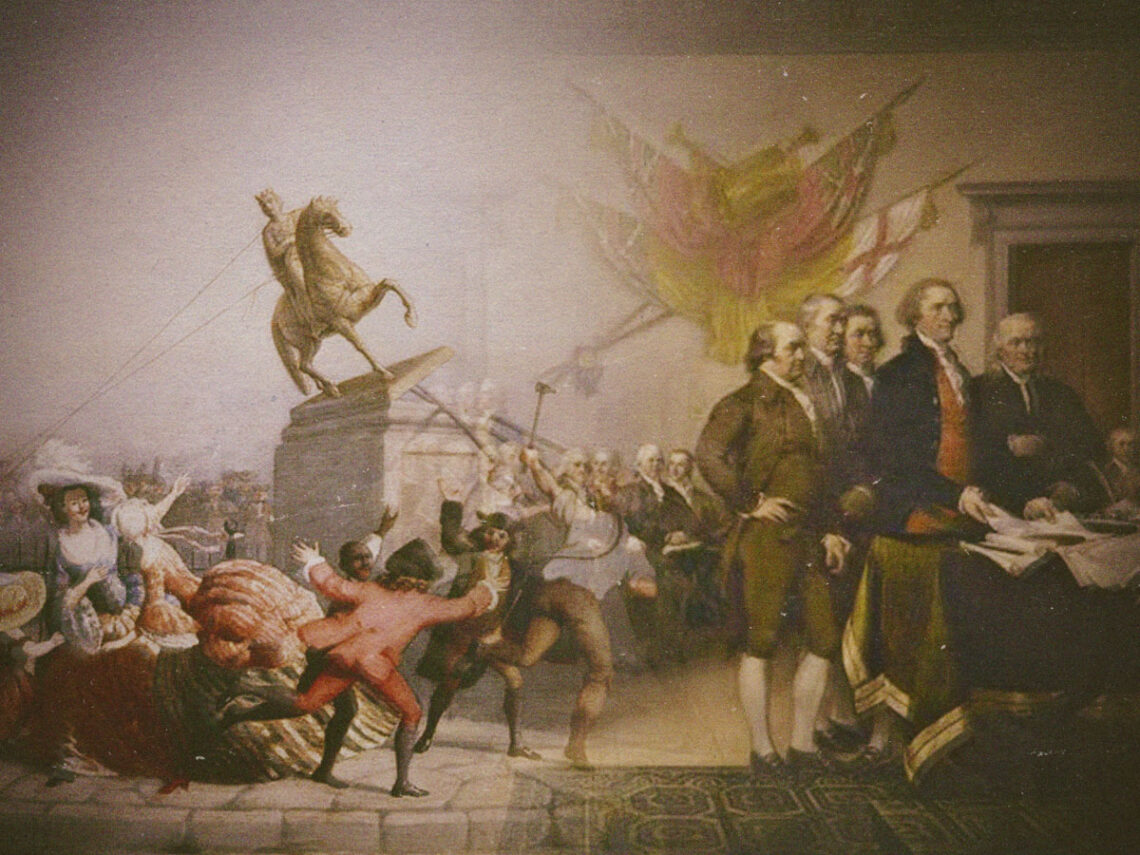
How the Declaration of Independence started a riot in New York City in 1776
The United States of America is now 250 years old. It’s safe to say that the country’s 349 million people, stretching from New York City to Los Angeles, are in a jubilant mood.
This is natural. After all, America has been obsessed with creating its own mythology and culture for as long as it’s been a country, perhaps because of its youth. Even something as simple as a disagreement over the difference between North Carolina and South Carolina barbecue can cause fistfights to occur, let alone the uproar caused when the actual Declaration of Independence was fully adopted by Congress on July 4th, 1776.
Even though it was 1776, word found a way to spread about the document. Remember, this was a time long before any form of mass media we’re familiar with today, and the urgency of the Declaration of Independence meant that the founding fathers of America couldn’t just send it off to a printing press and wait for people to get around to it like that Netflix series you’ve been putting off for years. While it was sent off for printing shortly after it was finished, the Founding Fathers knew that the citizens of America needed to hear it as soon as possible.
And they meant that literally.
So, shortly after the Declaration of Independence was adopted by Congress, a series of readings was announced. These events drew crowds of tens of thousands of people, including one reading in New York City that was specifically for the estimated 20,000 to 25,000 continental soldiers stationed there.
This reading was to be delivered by George Washington himself, and if you’ve seen how New York City reacted to the New York Knicks winning the NBA Finals this year, you can only imagine how the Big Apple reacted to the actual Declaration of Independence read aloud by George Washington.
There’s no specific report of how Washington delivered the address, but I’m sure it had the desired effect. In the crowd’s resulting fervour, 40 soldiers led by Captain Oliver Brown rushed down to Bowling Street Park and confronted a statue that was, moments ago, of their King. Now, although it had pretty much always been this, it was of their oppressor. King George himself stood as a 4000-pound lead statue, styled, ludicrously enough, as the Roman Emperor Marcus Aurelius.
Captain Brown and his men, fuelled by patriotism and probably a few pints of liquid courage, tied ropes to the statue and brought the symbol of British dominance over the country crashing to the ground. This would have been enough, but in true New York fashion, they were not done. You see, lead isn’t just what statues were made of at the time; it was also what musket balls were made of. Once the King was on the ground, he was then hacked apart and melted down to make 42,088 musket balls for use by the Continental Army.
They were thorough, too, but it was a big statue and in the years since, pieces of it have been recovered. The one part that no one can find any scrap of, however, is its head. Which, in all likelihood, was the first part of that cursed statue into the furnace.