


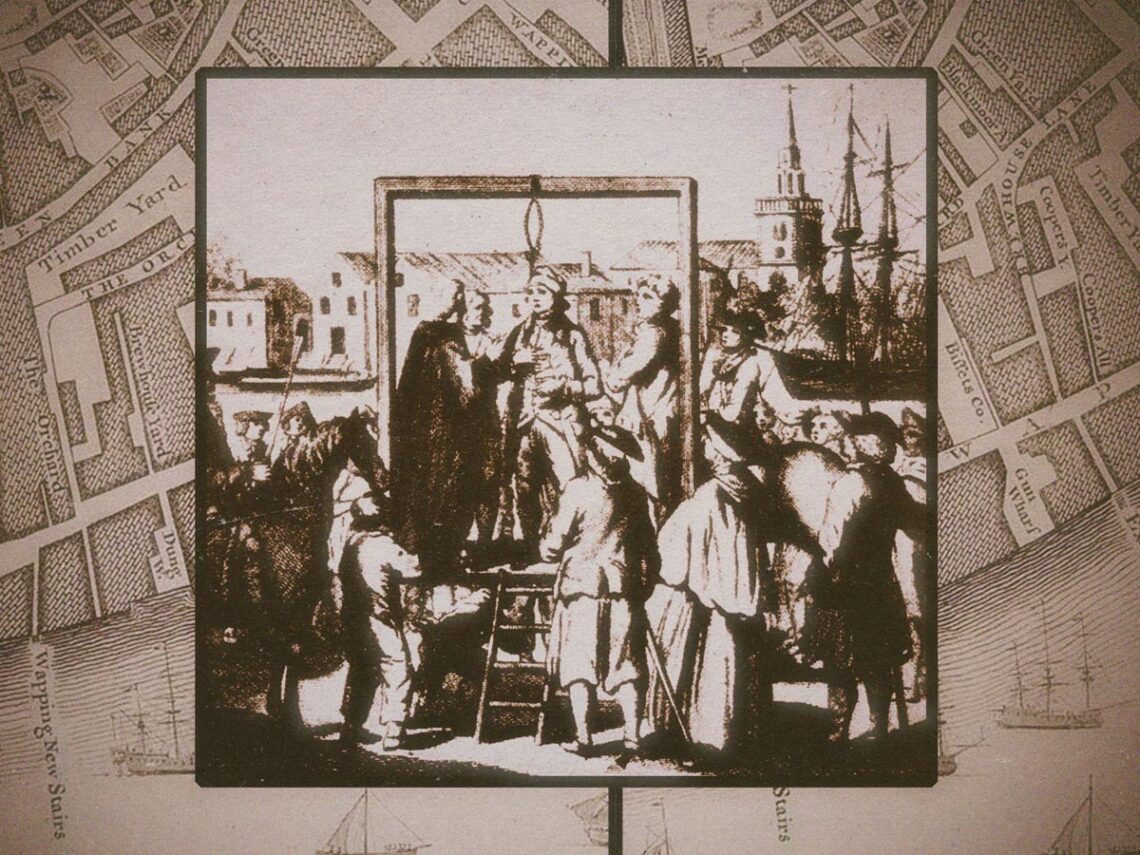
Execution Dock: London’s most feared location in the 1700s
As facts from the history of London go, the tale of Execution Dock, where hanging was a spectator sport, isn’t one of the most fun. Instead, offering a window into a dark and depraved time that the capital has thankfully long left behind.
Believe it or not, back then, hanging was considered the humane option for execution. The idea wasn’t to make someone suffer by suffocating them; the idea was to break their neck with the drop and keep the suffering to an absolute minimum. At least, in theory. When all you have is a wooden scaffold and a length of rope, it’s vanishingly difficult for anything to be precise, and as time went on, it became vanishingly rare for hanging to work out the way it was originally intended to.
However, if you asked anyone, that wasn’t the intention at the very least. In most cases. The truth is that capital punishment has always been more about the cruelty and the spectacle rather than doling out actual justice, and if you need proof of this, just look at the way that hanging was deployed for pirates in the late 1700s and early 1800s. It’s a hell of a thing to find a way of making being hanged from a rope until dead even more barbaric, but if anyone was going to do that, it’s the British government from the Georgian era.
In a way, this checks out. Britain was in full rule the waves mode at the time. Not only were pirates flaunting that dominion right in their faces, but they were getting the public on their side while they did it. As a result, a small part of the shoreline of the River Thames in Wapping was marked out as Execution Dock.
For 400 years, it remained one of the most notorious parts of London for the spectacle it made out of pirates.
If found guilty of piracy (which is to say, were you found at sea by the Royal Navy and weren’t killed), you would be transported back to London and held at Marshalsea Prison. On the day of your execution, you would first be paraded across London, most often across London Bridge and past the Tower of London. As a way of hammering home Britain’s dominance of the sea, they’d often be led by a High Court Martial on horseback, who would carry a silver oar to show who was really in charge of the waves.
Then, the prisoner would arrive at what soon became infamous as the Maritime Gallows. These were no typical gallows, as everyone hanged at them was executed with a shortened rope. Rather than the short drop and sudden stop making for a quick death (if not exactly painless), pirates were throttled in full view of immense crowds of people. The kind who cheered on their death throes, nicknaming their jerking limbs as ‘the Martial’s Dance’.
The punishment didn’t end with their death, though. Remember, this was not only to give pirates a slow and painful death, but it was also to remind the public of what happened when you stood against the state. Thus, people who were hanged at the Maritime Gallows stayed up for at least three days – this was because the gallows were positioned in such a way that when the tide of the Thames came in, it would cover the corpses as they hung there.
Once they’d been covered by the tide three times, they were removed. This practice would continue for literal centuries, finally coming to an end in the 1800s.