


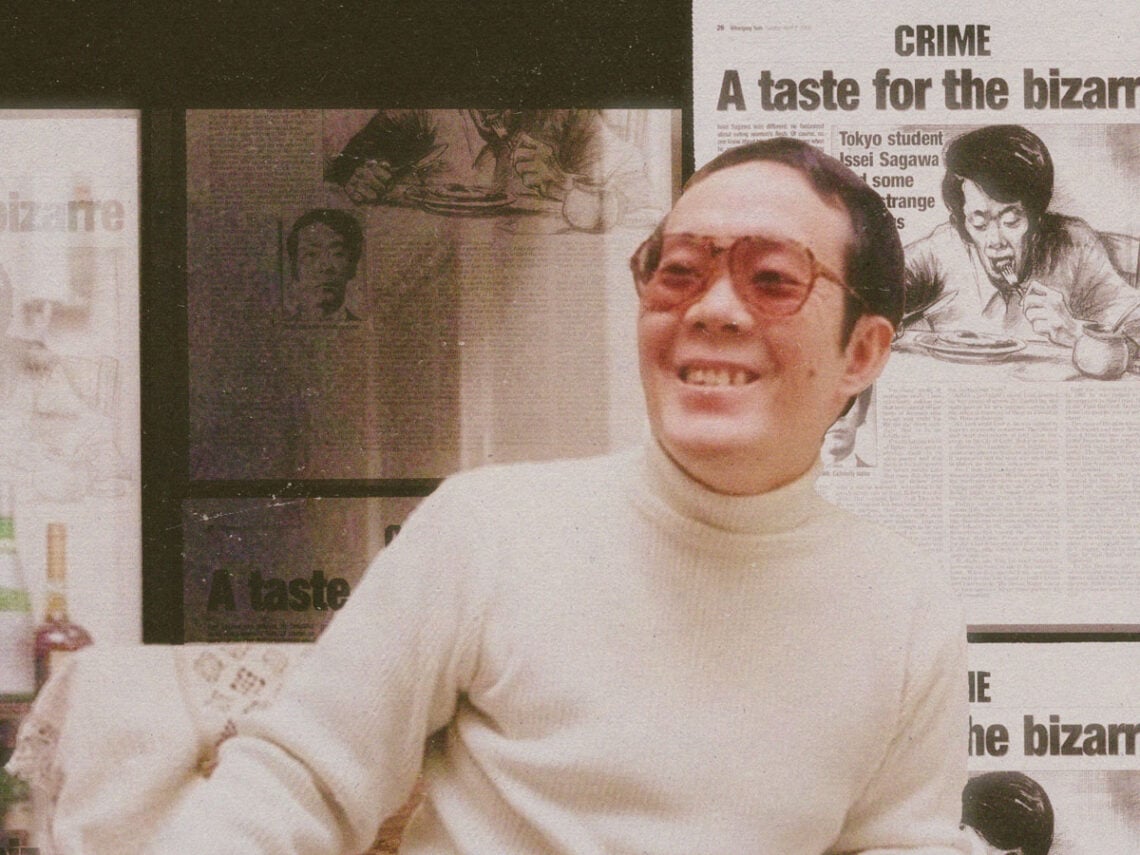
Issei Sagawa: The necrophile cannibal who walked free in 1986
Despite being guilty of a fistful of crimes against humanity, Issei Sagawa spent the last 35 years of his life free as a bird, not due to serving his time, but because of red tape.
One never wants to believe that some people are just built wrong, but Sagawa provides a fairly compelling argument that, occasionally, people can just be unfit for interacting with people on some core level. This was a man whose upbringing was consumed by uncontrollable lust directed at anyone and anything in his life, including his family pets. He coped with this by immersing himself in literature and reading, but the more his thoughts were repressed, the more intense they got, leading to violent, cannibalistic fantasies taking over his every thought.
The first time he acted on this was when he was 24. Sagawa followed a German exchange student back to her flat before breaking in while she slept. The student fought Sagawa off, before he was subsequently arrested and charged with attempted rape. He didn’t explain the extent of his desires, though, which wouldn’t emerge until it was far too late.
When he was 28, he moved to Paris to pursue a PhD in literature at the Sorbonne. Four years later, in 1981, he invited a friend he’d made on the course back to his apartment for dinner. When her back was turned on him, Sagawa shot and killed 25-year-old Renée Hartevelt with a rifle. After forcing himself on her corpse, he spent the next few weeks carving parts of her body up, cooking them and eating them, taking photos of her corpse after every stage of his consumption of her.
Eventually, her remains started decomposing, and he tried disposing of her remains in a nearby lake. He was caught in the act, however, and four days after that, he was arrested by French police.
The high-priced lawyer that Sagawa found successfully argued that he should be found unfit to stand trial due to reasons of insanity. The story had become a national sensation in Sagawa’s native Japan and, presumably for that reason, the French authorities saw fit to deport him back home, where he was immediately committed to Matsuzawa Hospital in Tokyo. Astonishingly, the doctors in Tokyo ruled that he was sane.
Their logic was that Sagawa had committed his crimes out of lust and sexual desire. Those were not grounds for insanity in the eyes of the Japanese doctors, so he couldn’t be committed to a psychiatric hospital.
However, the court documents remained sealed in Paris along with the mountain of evidence against him and thus, neither were released to Japanese authorities. The ruling in the French court of insanity had meant the charges were dropped. For them to be picked up again, the Japanese courts would need the evidence and the court documents. They didn’t have those, or the psychiatric proof that he was insane.
Thus, Issei Sagawa, who had murdered, raped and cannibalised a woman, walked free.
Sagawa went on to be a minor celebrity in Japan. Not only because of his actions, but because the notoriety that came from his actions and his subsequent freedom made him available for public appearances and media appearances. He made guest appearances in films and TV and, as the ultimate, mind-bendingly horrible punchline to all this, picked up a few bylines as a journalist. With a very specific focus.
Bizarrely, Sagawa was, even for a period of time, a food critic when he should have been behind bars in France.