B-Movie Magic: The five greatest PR stunts William Castle ever pulled
While most people think we are witnessing the death of movie theatres as we know them, it’s often wise to take a breath and realise that these are conversations that we’ve already been having for literal decades.
For as long as there have been media outlets in the home, the cinema has been “at risk”. In the early 20th century, it was the radio ruining everything. In the 1980s, it was the dawn of video. However, the only other time when the death of the movie theatre seemed as real a prospect as it does today was in the 1950s, when television was coming for its everlasting soul. When everything could be beamed directly into someone’s living room, why would you ever leave the house?
Obviously, the upper crust of Hollywood weren’t hugely fussed, people turned out in droves to see the biggest movie stars of the day. Instead, TV was a threat to lower-budget pictures whose productions weren’t all that different to the biggest shows of the day. Thus, people making B-movies had to convince people to go to the movie theatre with different tactics. Some of which were creative and interesting, while most were downright bizarre.
Nestling right in the middle of those two is the work of the undisputed master of the B-movie gimmick, director and producer William Castle.
His deeply camp, deliriously cheesy horror classics were exactly the kind of picture that people would neglect in favour of their telly. So, he began devising completely absurd promotional schemes that would get butts in seats not to see a great film (though his pictures did have their own kitsch-y charm) but to find out exactly what “The Tingler”, or “Illusion-O” was.
So here are five of his most ludicrous promotional stunts, listed in chronological order.
1. Emergo
The first stunt Castle pulled was a relatively tame one connected to his 1958 picture Macabre. Every single audience member was given a $1000 ‘Fright Insurance Policy’ in case they “died of fright” while watching the film. This was supported by selected theatres stationing an ambulance and ushers dressed as doctors outside. This worked pretty well, but the first stunt Castle pulled that really worked was for 1959s House on Haunted Hill.
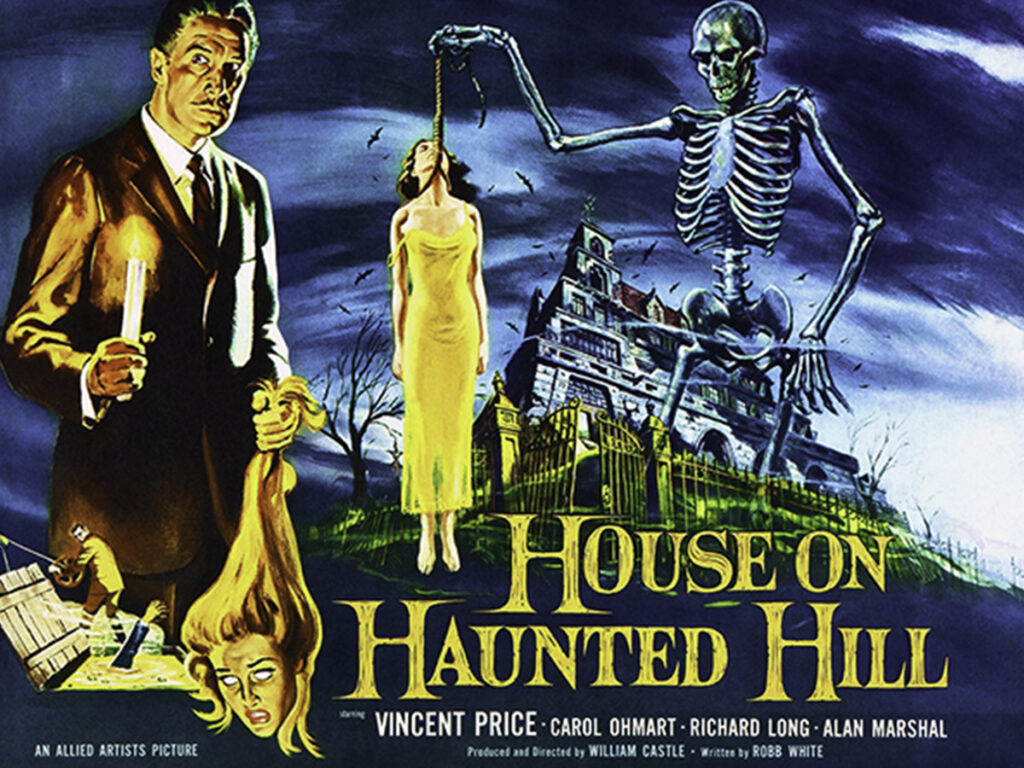
A major scene in the film shows Vincent Price’s character trying to chase his wife into a vat of acid with a plastic skeleton on pulleys and strings. Castle set a number of theatres up with a large box at the foot of the screen. When the scene played, a large glow-in-the-dark skeleton would be pulled from it and whipped over the audience by a team of ushers. Macabre had intrigued people’s curiousity, but this stunt, which Castle called ‘Emergo’ made House on Haunted Hill a bona-fide hit.
2. The Tingler
1959 was the year that William Castle truly arrived as a cult concern. In the first half of the year, House on Haunted Hill had become a box office hit. In the second half of the year, he made one of the most iconic B-movies ever in the form of The Tingler. Now, if the plot of his first film barely mattered, it looks like Kafka compared to the nonsense contained in The Tingler, a picture almost entirely put together in service to a stunt Castle wanted to pull off in the theatre.
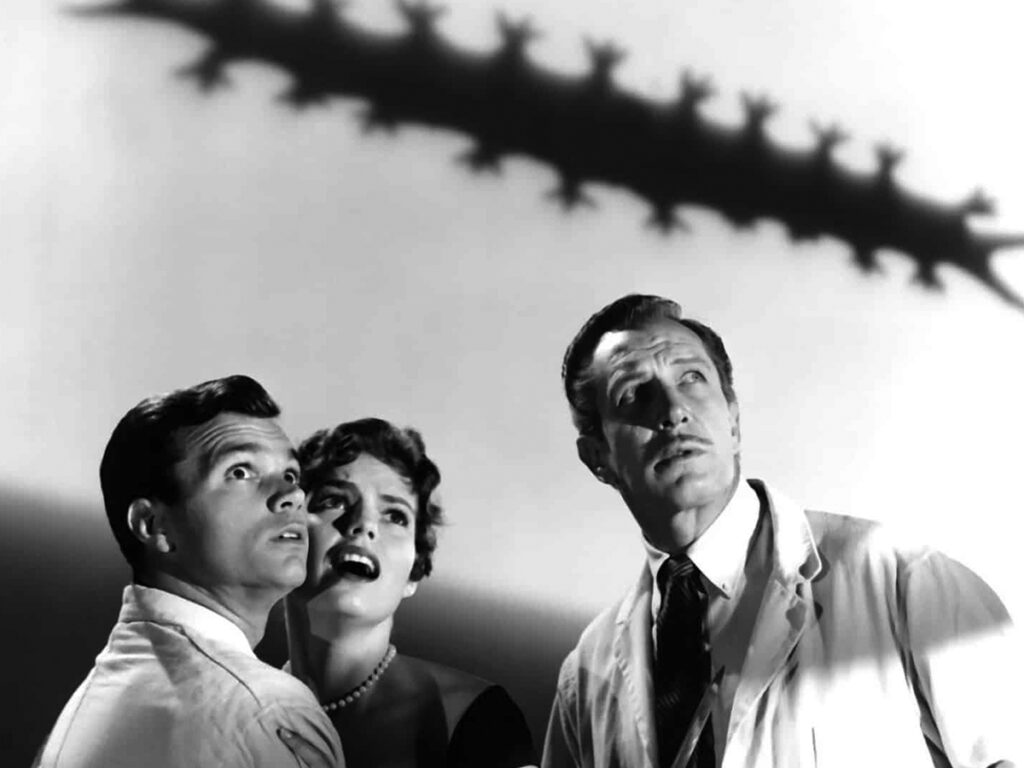
The Tingler concerns a parasite that lives in the base of the victim’s spine and feeds on fear. You can kill The Tingler by screaming; however. So, in the climax of the movie, the parasite escapes the screen and jumps into the movie theatre, where several things would happen at once. First, all the lights would go out, then Vincent Price (it’s a living, I guess) would wail over the PA system that “The Tingler is loose in this theatre! Scream! Scream for your very lives!” Which is when the pièce de résistance would unfurl. A set of buzzers placed in select theatre seats would go off, giving audience members the fright of their lives and causing utter pandemonium in the cinema.
3. Illusion-O
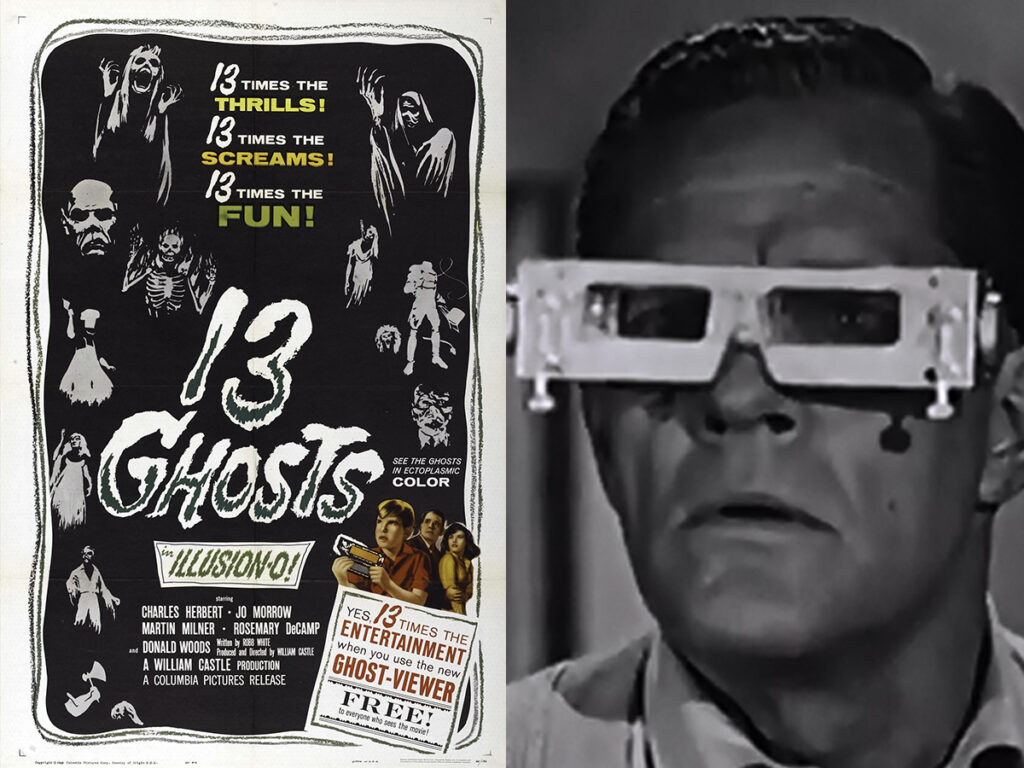
The Tingler wasn’t the hit that Haunted Hill was, but Castle was now a made man in horror circles for his absurd PR stunts. It hardly mattered whether the film was any cop or not; there would always be something worth dropping everything and going to the movie theatre for, if only for the gimmick. Case in point, his 1960 picture Thirteen Ghosts, whose gimmick was inspired by another attempt to make 1950s audiences forsake TV for the movie theatre, 3-D glasses.
The 3-D effect of the time was achieved by putting on the glasses, one lens being blue plastic and the other being red plastic. Castle was interested in what else you could do with such simple technology and created the ‘Illusion-O’ viewer, two strips of blue and red plastic through which you viewed the picture, but only when the black and white picture turned blue. The blue tint would signify when the ghosts were about to show up, and if you didn’t want to see them, you put the blue strip to your eyes, and you’d miss them. However, if you were brave enough, you could look through the red strip and see the horror in full.
4. Coward’s Corner
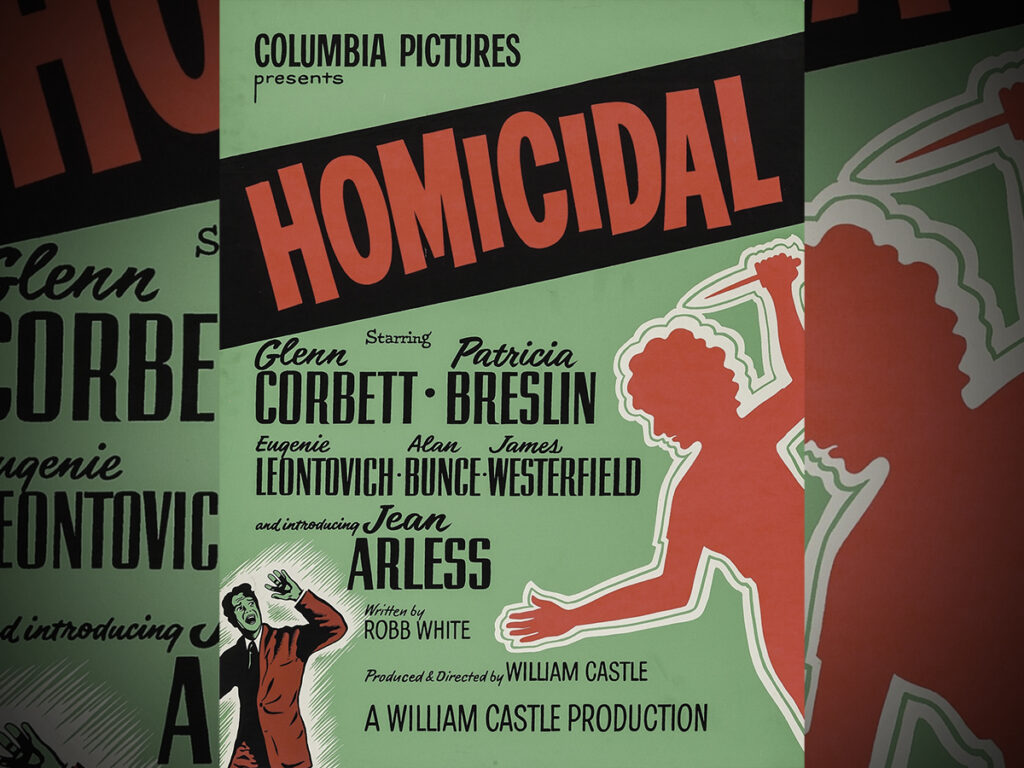
The ‘Illusion-O’ gimmick seemed to point the way forward for Castle’s next set of stunts. They were about informing the audience that the content of the film was so scary that he legally had to give people a way out if they wanted to leave. This was the core of the gimmick for his otherwise forgettable 1961 picture Homicidal, which came with a bold promise that you could get a refund for your ticket if you left before the film ended. However, there was a catch.
The movie paused for 45 seconds to give those who wanted out a chance to leave, but if they did, they had to follow a streak of yellow footsteps into the lobby. There, ushers would lead them into Cowards Corner, a cardboard booth with loudspeakers blaring out, “Watch the chicken! Watch him shiver in Coward’s Corner!” There, you could only get your money back if you signed a certificate saying “I am a bona fide coward”. Needless to say, vanishingly few audience members took that walk of shame.
5. Punishment Poll
As the 1960s went on, horror started to become less B-movie fodder and more of a genuine box office mainstay. Ironically, this was partially because of Alfred Hitchcock’s marketing of Psycho with a similar set of tricks that Castle had perfected in the 1950s. However, the pull of legitimising his art was too strong, and Castle tried to go mainstream. However, not before he tried one last stunt with the ludicrously named Mr. Sardonicus.
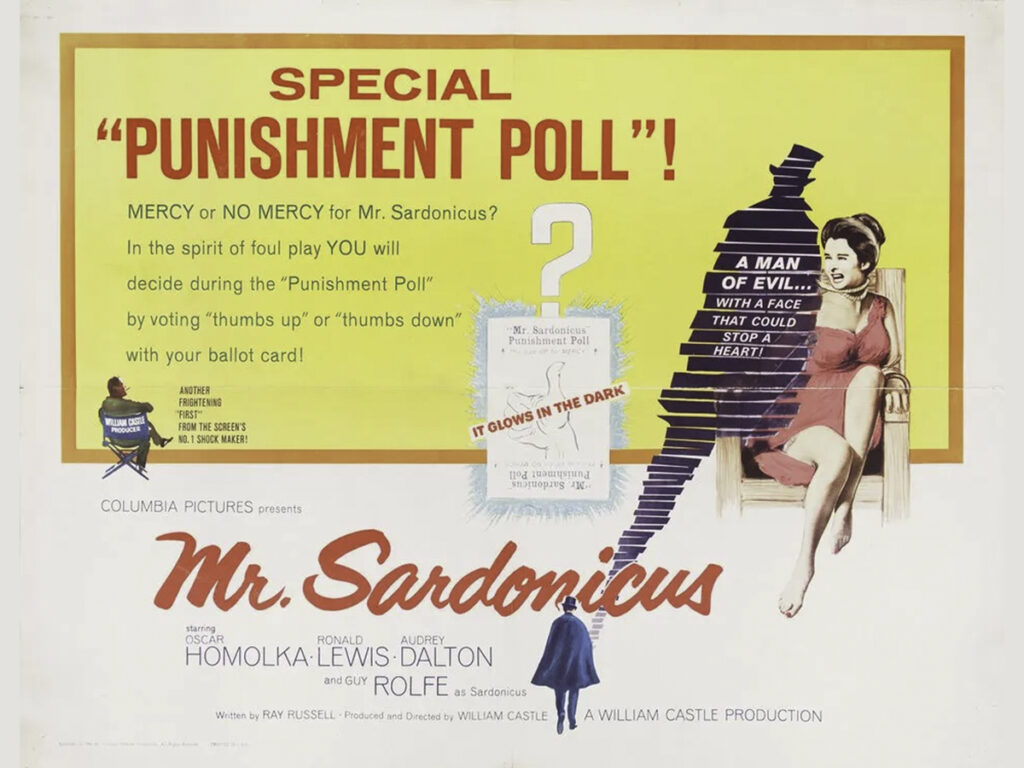
The hook for this one was that the audience could (supposedly) choose the ending of the film. Each audience member was handed a glow-in-the-dark card on their way into the screening, one side had the thumb up, and one had it down. At the appropriate point in the film, the audience would decide whether the title character would live or die by showing their vote to the projectionist, who would then show the ending the audience requested.
Except, obviously, there was no alternative ending. Castle knew that an audience of his would only ever ask for the gory ending where the villain got put to death, so he only ever shot that one. However, in true showman fashion, Castle maintained until his death that the alternate ending existed, but no-one ever wanted to see it. So they didn’t. Castle did eventually go mainstream, producing Rosemary’s Baby, one of the most acclaimed horror movies ever made.
However, he will most likely be known for delightful stunts like this and that’s one hell of a legacy.