


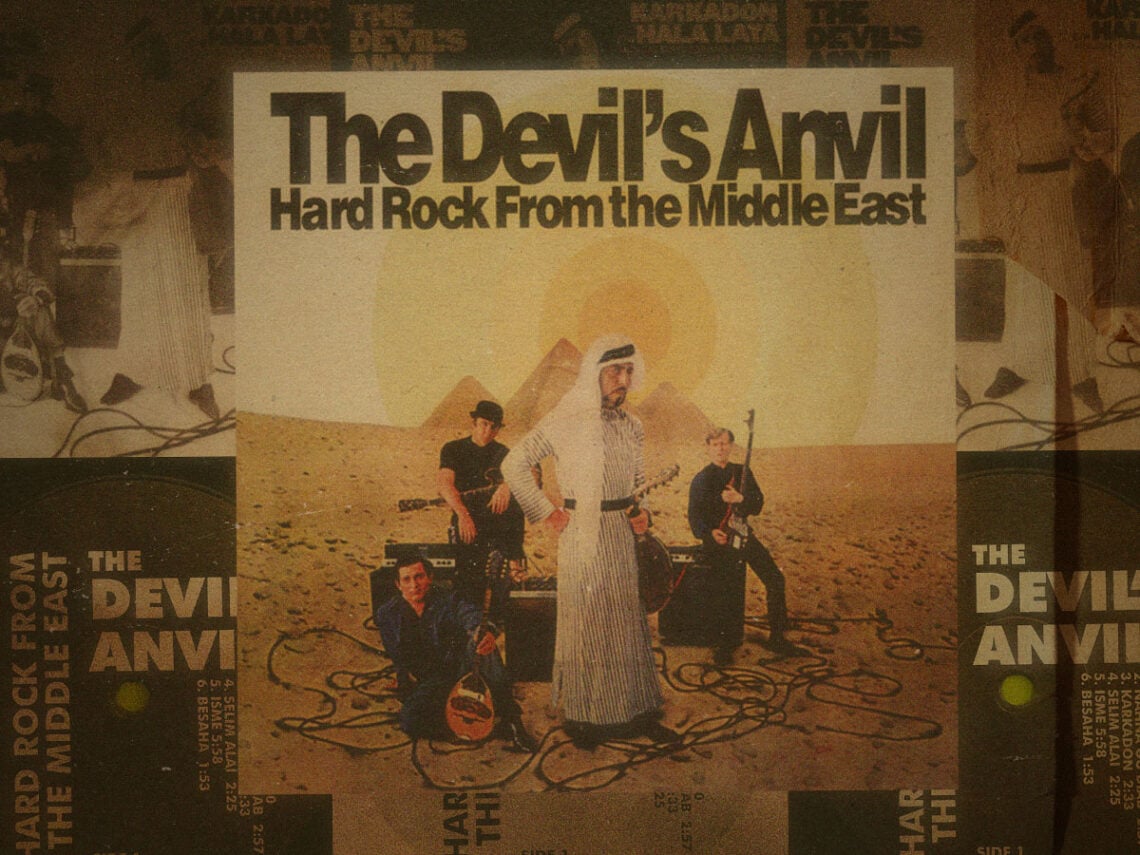
The soundtrack to a parallel universe: The Devil’s Anvil and the psychedelic future that never happened
Long before “world music” became a handy record-shop category, and decades before Western pop stars started casting their nets further afield for inspiration, there was The Devil’s Anvil. The New York-based quartet created one of the strangest and most fascinating records of the psychedelic era, blending Middle Eastern folk traditions with garage rock, fuzz guitar and a healthy dose of 1967 weirdness.
The ill-fated Middle Eastern-sounding rock group were discovered by record producer Felix Pappalardi (Disraeli Gears) playing in a New York City cafe in 1967. Pappalardi got the band signed to Columbia Records and even played bass on their album.
Pappalardi had a knack for spotting talent. Before becoming famous as the driving force behind Mountain, he was already building a formidable reputation as a producer and arranger, lending his touch to records by Cream and The Youngbloods. He was also one of those rare characters who seemed instinctively drawn to leftfield ideas. Most A&R men in 1967 would probably have run a mile from a band fusing Arabic melodies with fuzz guitar. Pappalardi heard something special.
At the time, the idea of mixing Middle Eastern folk music with amplified rock and roll was practically unheard of. Psychedelia was just beginning to flower in the West, but The Devil’s Anvil were already tossing together electric guitars, bouzoukis, accordions and the oud into something that sounded like the soundtrack to a lost Ray Harryhausen epic beamed in from another dimension. Looking back, it’s hard not to hear the group as accidental pioneers, arriving decades before “world music” became a marketing category.
The Devil’s Anvil were Steve Knight (rhythm guitar, bass, bouzouki), Jerry Satpir (lead guitar, vocals), Elierzer Adoram (accordion) and Kareem Issaq (oud, vocals). Hard Rock from the Middle East would be their only record. Despite their truly original sound, which predated “world beat” by many years, luck was not on the side of the band. On the very same day Hard Rock from the Middle East streeted, the Six-Day War broke out, and suddenly no radio station would touch it.
Talk about bad timing.
The irony is almost too much. Here was a group drawing on Jewish, Greek, Turkish and Arabic musical traditions, united by a love of the same ancient melodies, only to find themselves caught in the crossfire of world events. Their music suddenly became politically awkward, even though the record itself was anything but political. It was simply four musicians following their ears.
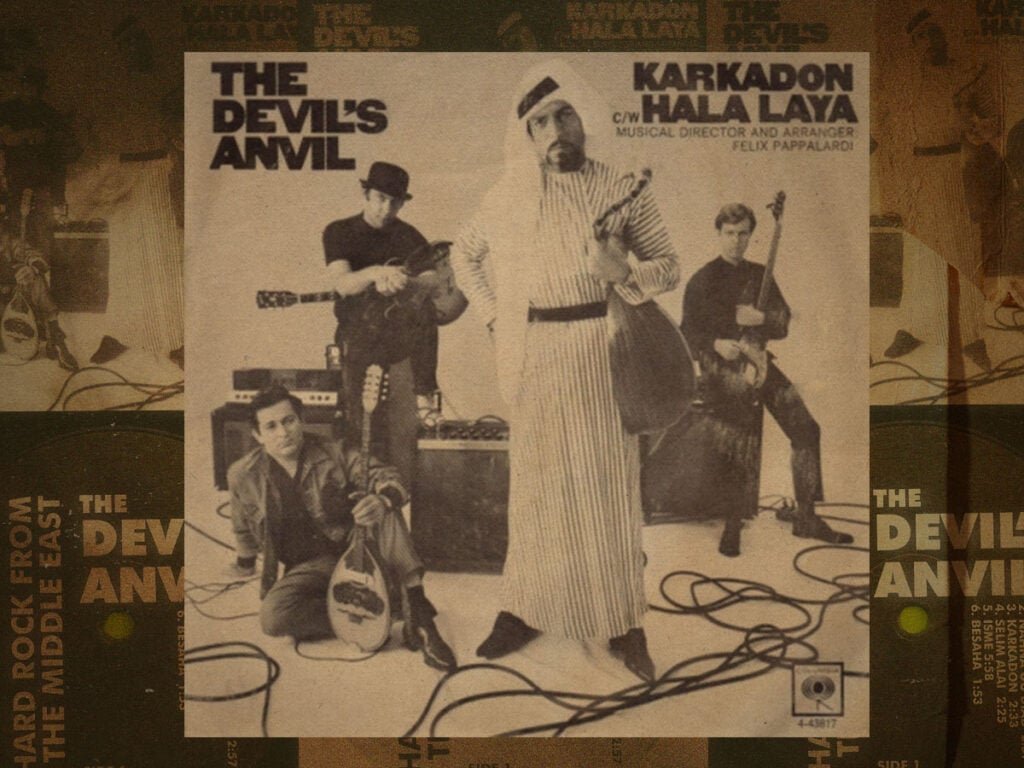
Which is a shame, because Hard Rock from the Middle East wasn’t some novelty record dreamed up in a boardroom. The group approached traditional melodies with genuine affection, smashing them together with fuzz guitar and garage-rock energy in a way that felt entirely natural. Tracks like ‘Karkadon’ and ‘Hala Laya’ possessed the hypnotic pulse of folk music that had already existed for centuries, but they were wrapped in arrangements that wouldn’t have sounded entirely out of place on a Nuggets compilation. Strange, exotic and wonderfully out of step with just about everything else being released in 1967, the album remains one of the more singular artefacts to emerge from the psychedelic underground.
Listening to it today, you can almost hear a parallel universe taking shape. In another timeline, perhaps The Devil’s Anvil became stars of the ballroom circuit, opening for Jefferson Airplane and The Doors, introducing American audiences to sounds they’d never encountered before. Instead, the album vanished almost as quickly as it appeared.
And perhaps that’s what makes the whole story so bittersweet. Just as the Summer of Love was exploding and listeners were becoming more adventurous than ever, world events conspired against the group. Their record arrived at precisely the wrong moment. Instead of being celebrated as a bold new hybrid, it became collateral damage in a conflict half a world away.
For decades, Hard Rock from the Middle East was one of those whispered-about records passed between collectors and serious psych heads. Original Columbia pressings became increasingly scarce, and by the time the psychedelic revival of the 1980s and ’90s rolled around, copies were changing hands for serious money. Reissues eventually helped rescue the album from obscurity, introducing a whole new generation of crate-diggers to one of the great lost curiosities of the era.
Today, collectors and psych obsessives regard the LP as one of the hidden treasures of the 1960s. Had history been kinder, or simply better timed, The Devil’s Anvil might have occupied the same cult status enjoyed by Kaleidoscope or even early Traffic. Instead, they became one of those tantalising “what if?” stories that litter rock history.
Pappalardi later went on to form Mountain with Steve Knight and Leslie West.
There was one final twist, too. Knight remained in Pappalardi’s orbit, joining Mountain and playing on classics like Climbing! and Nantucket Sleighride. But while Mountain became one of the heaviest bands of the early 1970s, The Devil’s Anvil faded into obscurity, their bizarre and beautiful experiment surviving largely through crate-diggers, collectors and late-night YouTube rabbit holes.
Which is fitting, really.
Hard Rock from the Middle East feels less like a lost album than a message in a bottle from an alternate universe where East and West collided on the dance floor several years before anybody thought to give the movement a name.