


The strange and brutal breakdown and familicide of artist Richard Dadd
It should be a tragedy that Richard Dadd isn’t solely remembered for his paintings.
His work is utterly astonishing to look at over two centuries after his birth in 1817. Richly detailed, artfully realised work bursting with character and colour. The kind of work that people still get lost in hundreds of years later. The kind of work that, without the horrifyingly sad story behind it that would still be remembered today as one of the great artists of his generation.
Alas, the sad truth is that tragedy is so central to the life and times of the great Victorian painter that he couldn’t be remembered any other way.
Born in Chatham, Kent, the artistic aptitude of Richard Dadd was clear from an early age. He obsessively painted and drew at any moment he could and thus was accepted into the Royal Academy of Art Schools when he was 20. Upon graduating, his work flew in the face of not only the ideals of the Royal Academy that trained him, but the Pre-Raphaelite Brotherhood that was the mainstream face of British Art at the time. He wasn’t the only one like this, either, and together with other artists like Augustus Egg and Thomas Craswick, he founded The Clique in the late 1830s.
Dadd was regarded as one of the most exciting artists of his era, and seemed set for a long, successful career. Then everything changed in 1842, when Sir Thomas Phillips asked Dadd to accompany him on an expedition from Europe to Greece, Turkey, Southern Syria and then Egypt. Whether it was going on this gruelling expedition that changed him or whether it would have happened anyway, something fundamental about Dadd broke on this expedition, causing a profound personality change.
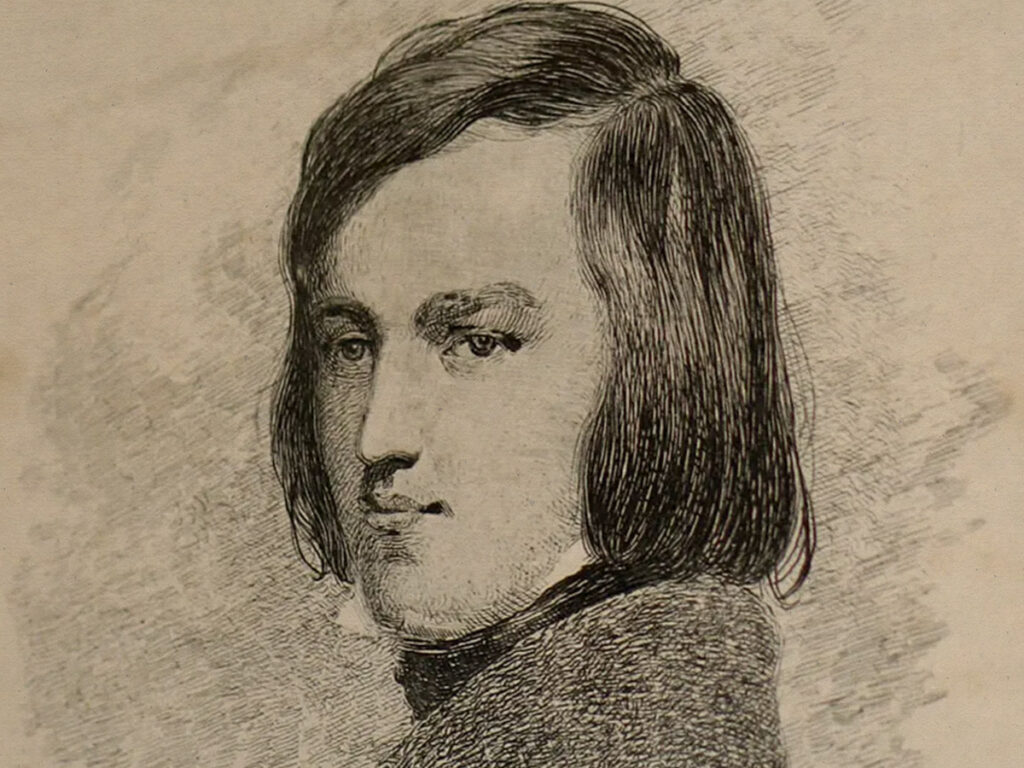
How did Richard Dadd change?
Well, he became violent and delusional, believing himself to be possessed by the Egyptian God Osiris.
After it became clear that this was far more than a nasty bout with sunstroke, he was rushed back to England and immediately sent back to his family to recuperate. This was the worst thing possible for Richard Dadd, as he was a danger to himself and others. In a violent break from reality, he became convinced that his father was actually Satan in disguise, then killed him with a knife.
Dadd tried to escape England and head to Paris. Yet while en route, he attacked a fellow passenger with a razor blade. This time, he was subdued and arrested before he could do any lasting damage. Clearly, something lifted after this arrest because Dadd was lucid enough to confess to the killing of his father and willingly submitted to being committed to Bethlem Psychiatric Hospital. Dadd’s psychiatric care was recorded by his doctors, and by looking through their notes, it seems that he suffered from what we’d call paranoid schizophrenia today. What’s more, so did two of his siblings.
From there, Dadd spent the rest of his life in psychiatric care, at first confined to Bethlem (otherwise known as Bedlam) before being moved to Broadmoor Hospital after two decades. Despite his situation, Dadd never stopped painting until his death “from an extensive disease of the lungs” in 1886. Some of his most celebrated works were painted while he was committed, and still hang to this day in the Bethlem Royal Hospital Museum.