‘Another Green World’: Another documentary on Brian Eno
01.18.2013
02:30 pm

Topics:
Art
Music
Thinkers

Tags:
Brian Eno


Another Green World, a 2010 Arena episode profiles musician/polymath intellectual Brian Eno. He’s seen in the studio, talking about Roxy Music, working with David Bowie and U2, and conversing with friends like Richard Dawkins, Malcolm Gladwell, journalist Paul Morley and record producer Steve Lillywhite about science, art, and making things.

The title track of Eno’s 1975 album Another Green World has been used for the famous Arena title sequence since the program debuted that same year.

Previously on Dangerous Minds:
Brian Eno Frisbee vs. Bryan Ferry Kite
 

Posted by Richard Metzger | Discussion
Paul Laffoley explains how to build a working time machine (and a house made entirely of plants)
01.18.2013
11:32 am

Topics:
Art
Thinkers
Unorthodox

Tags:
Paul Laffoley


As I have posted about here recently, there’s an exhibition at Kent Fine Art in New York of the work made by artist/inventor/architect Paul Laffoley during his residence at The Boston Visionary Cell, his enigmatic one-man, one-room think tank on the second floor of a staid Boston office building (He was evicted a few years ago when the landlord discovered that he been living there).

The show is up through March and I’ve heard from everyone I know who has seen it, that it’s an absolute stunner, a “must see.” If you’re going to be in the NYC area in the next few months, it’ll be worth the pilgrimage to Chelsea, I can assure you. Ken Johnson at The New York Times called it “an excellent introduction to one of the most unusual creative minds of our time.”

I’ve been to The Boston Visionary Cell and it was certainly one of the most eccentric dwellings I have every experienced. Obviously the home of a genius living in modest circumstances, the tiny space had neither windows, a kitchen, bathroom or anything more, really, than a sink and yet for decades, some of the most extraordinary artwork of our time was produced there.

Aside from several works in progress, some large easels and a drafting table, there were LOTS OF BOOKS, thousands upon thousands of them on every subject under the sun in stacks that were up to 5 feet tall. It was not easy getting a small TV crew into the room without knocking anything over, although we more or less managed. During a lull in the taping, I mentioned to Paul how I’d recently been trying to find a copy of Timothy Leary’s rare book Terra II without success, and he went right over to the stacks and plucked the book from near the bottom of one with the dexterity of a kung fu master, disturbing nothing.

In the clip below, from my 2000-2001 British TV series, Disinformation, you can actually see a little bit of the tiny, crowded, one room space where Paul Laffoley not only worked, but slept, for decades, his head down at his desk ala “Howard Roarke” in The Fountainhead. The reason you don’t see even more is that we had a shot with a depth of about 4 feet, I was practically sitting on Paul’s lap for the interview.

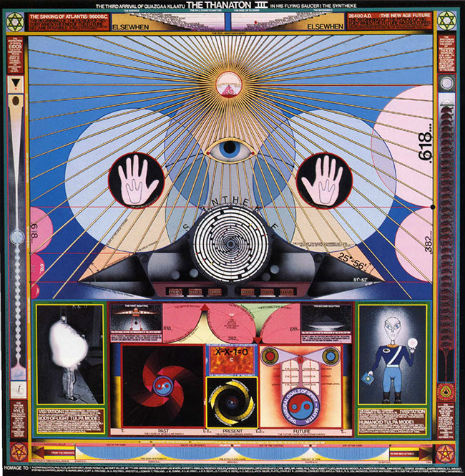
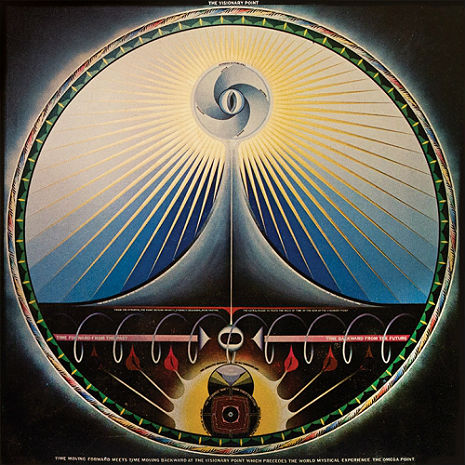
There is an extensive online catalog of The Boston Visionary Cell exhibit in PDF format that you can download here. You can also buy posters of Paul Laffoley’s work, including the image above (“Thanaton III, not in the NYC, but will be in the London show at the Hayworth Gallery later in the year) at the Kent Fine Art website.

KENT FINE ART, 210 Eleventh Avenue, Second Floor, NYC (212) 365-9500

Previously on Dangerous Minds:
Paul Laffoley: Ambitious retrospective of visionary artist opens tomorrow night in NYC
 

Posted by Richard Metzger | Discussion
In the Court of the Crimson King: Intelligent BBC documentary about Robert Fripp
01.16.2013
12:29 pm

Topics:
Music
Thinkers

Tags:
King Crimson
Robert Fripp


Contemplative 1985 BBC doc about Robert Fripp, who gives the cameras a real glimpse into his life in Wimborne—we even get to meet his mother—his career as a constantly traveling musician and his reasons for leaving King Crimson (and his worldly possessions) behind in the mid-1970s to study the work of philosopher JG Bennett.

Fripp also discusses working with David Bowie, living in NYC and having brunch with Debbie Harry and Chris Stein. Musically, he’s seen playing with Andy Summers and doing a solo Frippertronics piece.


Posted by Richard Metzger | Discussion
Robert Anton Wilson audio and video pack, free bit torrent download
01.16.2013
09:51 am

Topics:
Heroes
Occult
Thinkers

Tags:
Robert Anton Wilson


“Mr. RAW’s Psychedelic Hand” by Dimitri Drjuchin. Acrylic on canvas.

Joseph Matheny writes:

I plan to commercially release four more pieces from my Robert Anton Wilson archives later this year, so in preparation for that, I have put the last four I released into the public domain. After a sufficient time, I will do the same for the four I will be releasing in 2013, and so on, until I have exhausted my archives and they are all in the public domain.

Everything except “The I in the Triangle” video is hosted on Archive.org. Unfortunately, Archive.org can’t seem to facilitate a decent sized MP4 of the video, so I have included it in an all-inclusive torrent pack here.  Included in this batch is:

TAZ: Temporary Autonomous Zone: A night of ontological anarchy and poetic terrorism captured live at the Komotion International in San Francisco in February 1993. Introduced by Joseph Matheny and featuring Rob Breszny, the elusive Hakim Bey reading from his unpublished manuscripts, Nick Herbert performing his Quantum Tantric poetry, and Robert Anton Wilson rounding out the evening with his RAW witticisms.

Robert Anton Wilson Remembered by Douglas Rushkoff, Antero Ali, Tiffany Brown, David Brown, Zac Odin, Joseph Matheny, and Alan Meridian.

Robert Anton Wilson: The “I” in the Triangle: Wilson introduces this lecture as a discussion of “The Western Hermetic Tradition”…and it is, but from Bob’s unique point of view. Its sweeping scope covers centuries of individuals and groups from the Illuminati of Bavaria and the Freemasons to the Priory of Sion and the Bilderbergers. Carl Jung, Philip K. Dick, Rajneesh, Jean Cocteau, Aleister Crowley, the Gnomes of Zurich, Harvey’s 6-foot white rabbit and many more all play a part. Along the way there are the strange connections among Nostradamus and the earthquakes in Los Angeles, the Merovingians and extraterrestrials from Sirius, Rastafarians and the Cult of the Black Virgin, Atlantis and Satan, the Vatican Bank and the Mafia and much, much more. Educational? Definitely. Informative? Absolutely! Truly a roller-coaster ride that will leave your head spinning and your sides splitting!

Robert Anton Wilson: The Lost Studio Session Recorded in Chicago in 1994, this previously unreleased audio session with the renowned Robert Anton Wilson has been stored away for fifteen years…and almost lost entirely. If Bob knew how many synchronicities surround the rediscovery and release of this “lost” studio session, he would be chuckling in that half-jolly, half-mischievous way of his. If you believe in any kind of afterlife, maybe you can imagine him laughing right now. I like that image: Bob the laughing Buddha, still having one over on us from the great beyond. -Joseph Matheny (from the liner notes)

Also included in the torrent file are some bonus ebooks.

Posted by Richard Metzger | Discussion
Jean-Paul Sartre documentary: ‘The Road To Freedom’


Human, All Too Human was a BBC television documentary that originally aired in 1999. Taking its title from Nietzsche’s book of aphorisms Human, All Too Human: A Book for Free Spirits, the three-part series covers the lives and work of Friedrich Nietzsche, Martin Heidegger and Jean-Paul Sartre. Although biographies, the overall theme was an exploration of the philosophy of Existentialism, as developed by these radical European thinkers.

The final episode, The Road to Freedom, focused on Sartre, whose name, of course, is synonymous with Existentialism. Sartre thought that it was up to each of us to create meaning and purpose in our lives in a Godless universe and the film—one of the only (if not the only) film about Sartre made in English—includes interviews with his life partner, feminist novelist and philosopher, Simone de Beauvoir.

Previously on Dangerous Minds:
How to pronounce “Sartre”
 

Posted by Richard Metzger | Discussion
Outer Spaceways Inc: Killer footage of Sun Ra and His Arkestra from 1969
01.10.2013
10:55 am

Topics:
Heroes
Music
Thinkers

Tags:
Sun Ra
Jazz


“I never wanted to be a part of planet Earth, but I am compelled to be here, so anything I do for this planet is because the Master-Creator of the Universe is making me do it. I am of another dimension. I am on this planet because people need me”—Sun Ra

Dazzling short documentary film from French television of Sun Ra and His Arkestra, with the great June Tyson, circa 1969. Killer takes on “Enlightenment” (from his 1958 masterpiece Jazz in Silhouette and “Outer Spaceways Incorporated.”


Via Bedazzled.tv (Beddazzled’s head honcho Spike Priggen will be DJ’ing at Sidecar in Brooklyn every other Thursday starting January 10th)

Posted by Richard Metzger | Discussion
We’re doomed: No More Industrial Revolutions, No More Growth?
01.02.2013
12:00 pm

Topics:
Economy
Thinkers

Tags:
Charles Hugh Smith


Our brainy friend Charles Hugh Smith posted this chilling essay about the “limits to growth” mankind faces in this century at his essential Of Two Minds blog. As he points out, the innovations of recent decades have more often than not served to destroy jobs, not create them. (I can’t source this because someone told me this conversationally, but apparently there is one factory, owned by Samsung, that manufactures nearly all of the world’s supply of a certain size HD flatscreen (not the entire TV, just the screen). The factory, I was told, employs fewer than twenty workers! Keep that in mind as you read the following).

The common feature of the transformative technologies of the 20th and 21st centuries is that they were one-offs that cannot be duplicated.

What if the engines of global growth that worked for 65 years (since 1945) have not just stalled but broken down? The primary “engines” have been productivity gains from industrialization, real estate development and expansion of consumption based on the continual expansion of debt and leverage—in short-hand, financialization.

The Status Quo around the globe has responded to the obvious endgame of financialization (the 2008 financial crisis) by doing more of what has failed: expanding credit and leverage, flooding the global economy with liquidity (money available for borrowing), credits and subsidies for real estate development and a near-religious belief in “the next industrial revolution” that will spark rapid growth in employment, profits and productivity.

“The usual suspects” for the next engine of growth include nanotechnology, biotechnology, unconventional energy and Digital Fabrication, i.e. 3-D printing and desktop foundries. But are any of these capable of not just replacing jobs and revenues in existing industries, but creating more jobs and expanding revenues and profits?

There is a growing literature on this very topic, as many start questioning the quasi-religious faith that there will “always” be another driver of growth, i.e. the expansion of wealth, profit, employment and assets.

The Status Quo dares not even entertain this question because the only way to service the fast-rising mountain of debt that is sustaining the Status Quo is to “grow our way out of debt,” i.e. expand the real economy faster than debt.

The past 250 years has been one long “proof” that we can indeed “grow our way out of debt” because the low-hanging fruit of industrialization and cheap, abundant energy enabled wealth to be created at a faster pace than debt.

Clueless Keynesians mock those questioning the possibility that the low-hanging fruit has been plucked by noting that doomsdayers were actively decrying the ballooning debt of the British Empire in the mid-1700s. We all know how that story ended: what looked like crushingly massive debt in 1780 was reduced to a trivial sum by the rapid expansion of industrialization.

But suppose the end of cheap, abundant energy (replaced by abundant, costly energy) and the Internet spells the end of centralized models of growth? What if all the innovation currently bubbling away only produces marginal returns?

Take biotechnology for example. Those with little actual knowledge of biotech are quick to latch onto the potential for genetic engineered medications, biofuels, etc. What they don’t ask is if these technologies can scale up while costs decline, i.e. the computer technology model where everything progressively gets cheaper and more powerful.

Biofuels may have promise, but it still takes “old fashioned” energy to collect the feedstock, and it is a non-trivial task to keep micro-organisms alive on the scale that would be needed to produce a useful amount of liquid fuels, i.e. a few million barrels every day. Some processes may not scale up, and others may not see any significant reduction in fuel costs once the full input costs are calculated.

Genetic engineering also may not scale up—it may be limited by key barriers of individual patient complexity and by intrinsic costs that do not drop enough to make a difference.

Consider the diseases that have almost been eradicated—polio, for example—and the lifestyle diseases such as diabesity. The wave of diseases that were eradicated were caused by bacteria or viruses: a vaccine or agent that disabled or killed the bacteria/virus wiped out the disease.

Diabesity, cancer and heart disease are not caused by a single virus or bacteria. The “one med/vaccine works for all” model has failed and will always fail because diabesity and other lifestyle diseases have multiple, non-linear causes that are beyond the reach of a single “solution.” These diseases may well be tied to epigenetic factors, for example, the interaction of “junk DNA” with environmental stresses that extend back into the individual genome.

What we face is the confusion of symptoms and effects with causes. Lowering cholesterol is not the “magic bullet” many hoped for, and neither was hormone therapy.

In the technology sector, it is clear that the Internet is destroying entire sectors of employment. The jobs that have been lost for good have not been replaced by jobs created by the Internet, nor is there any credible evidence to support this hope: automated software continues chewing up one industry after another, and the politically protected fiefdoms of healthcare (sickcare), education and government have yet to taste the whip of real innovation.

Rather than add jobs, we will lose tens of millions of jobs as faster-better-cheaper breaches the walls of these massive politically protected fiefdoms.

Healthcare spending is clearly in terminal marginal return: our collective health continues to decline in key metrics even as spending doubles, triples and quadruples. The same can be said of defense, education and many other industries.

Sectors such as agriculture have already seen employment decline by 98% even as production rose; there are still improvements in agriculture (robotic milking machine, for example) but the low-hanging fruit in agriculture as well as in medicine, education, etc. have all been picked.

The next wave of innovation will destroy protected profit centers and employment; even the Armed Forces are not immune, as the “ships of the future” will have relatively small crews and robotic drones will replace high-cost, high-employment weapons systems.

The semi-magical belief that technological innovation will create wealth in such quantities that all other problems become solvable may well be false. We may have entered an era of marginal returns, where innovations destroy jobs, wealth, assets and debt—the very foundations of “growth.”

I have begun to speculate about a future where energy might be abundant but few can afford to consume much: money and income may be scarcer than energy.

The one innovation that might energize an entirely new field of employment is digital fabrication, the decentralization and distribution of production. But this will also creatively destroy jobs dependent on the present supply chain.

National governments have over-promised entitlements to their citizens on a vast scale, and the current “solution” to the mismatch of promises to national surplus is to borrow monumental sums to fund the promises. If innovations actually shrinks employment, incomes and wealth, then the base for taxes and debt will quickly shrink to the point that the debt is unserviceable. The Status Quo will collapse financially, even if energy and labor are both abundant.

Consider END OF GROWTH - six headwinds: demography, education, inequality, globalization, energy/environment, and the overhang of consumer and government debt. (via Zero Hedge)

The point made in this lengthy essay is a powerful one: the common feature of the transformative technologies of the 20th and 21st centuries is that they could only happen once. They are one-offs that cannot be duplicated. Doing more of what has failed will only set up a grander failure as returns on all our debt-based “investments” become ever more marginal and the return on increasing complexity drops into negative territory. Once complexity yields negative returns, the systems that depend on complexity quickly destabilize and implode.

Read more
No More Industrial Revolutions?

The Collapse of Complex Business Models

This is a cross-post from Charles Hugh Smith’s Of Two Minds blog. You should bookmark it and read him daily. Charles Hugh Smith’s newest book is Why Things Are Falling Apart and What We Can Do About It

Posted by Richard Metzger | Discussion
An Introduction to the World of Noise Artist: Elizabeth Veldon

elizabeth_veldon_noise_artist
 
Inspiration is hard work.

It’s early December and the first snow of winter is falling across the west coast of Scotland. Friends tweet their excitement, their child-like hopes for a white Christmas, posting images of blurry snow on lamp-lit streets. At her home in the north of Glasgow, Noise Artist Elizabeth Veldon stands in her garden, recording the sound of the snow falling.

Veldon is one of the most prolific and talented Noise Artists working today. Her work includes some of the most beautiful, brilliant, challenging and powerful soundscapes recorded. Her albums, such as A Blasted Victoriana, work on multiple levels offering up an intelligent critique of history, politics and sex. Others, including the beautifully mesmeric Dies Natalis Solis Invicti, a haunting celebration of the winter solstice.

When asked about her background, Veldon says there’s not much to tell. She was born in Scotland, into ‘a poor village with massive unemployment and a strict demarcation between Catholic and Protestant .’ This she says ‘probably led to my less than forgiving approach to religious belief.’ Veldon moved to Cambridge to study English Literature at college. It was as a student that her interests in the themes of gender, sexuality, feminist critical theory, poetry and politics, which would influence her musical work.

Returning to Scotland, Elizabeth met her partner 8 years ago. Her partner has been ‘a guiding force in my music.’ Over 6 years ago, Veldon started recorded her first CD. It sold out, and was collected by the Scottish National Library. From this Veldon started recording on a weekly then a daily basis. ‘I launched my bandcamp site around a year-and-a-half ago and since then have uploaded over 100 albums to it. I also formed my own label Black Circle records’ around 1 year ago, as a way to publish music based upon ideas of co-operation, collaboration and community.’

Paul Gallagher: When did you become interested in music and creating noise music/soundscapes? What were the key moments/influences?

Elizabeth Veldon: ‘I’ve always been interested in music, but I suppose this really took off when I met my present partner and two people obsessed with music got together.

‘I don’t know exactly when I became interested in making music but I remember why: I wanted to show that it was possible to make music without studios or finances, a kind of democratisation of the music making process. I began posting these on myspace (back in the days when everyone used myspace) and got positive feedback so I kept going. Originally I improvised tracks by playing multiple pieces by other artists over each other and recorded this to tape using a stereo with no speakers connected. This was then recorded back to my computer and then used as one of the tracks in a second layer and so on and so on until I had a completed piece.

‘As I began taking this process seriously, I started to think of it in terms of John Cage’s Fontana Mix, and began half-jokingly referring to it as Fontana Mix Without A Score, and John Cage has stayed my primary influence since then. I think it’s his belief that music is that which is produced by an artist or composer that most captures my imagination.

‘This led me to try to produce music that echoed the ideas of Pure Abstraction that is something which was not inspired by an external object or sensation. It was this that led me to experiment with feedback and wave forms.

‘More often than not the germ of a work comes from something read in a book or something I hear. For instance The English And Their Dogs came about from my partner saying ‘The Germans love children the way the English love their dogs’. While Satan Is A Very Poor Fellow was inspired by the cover of a book about German artists in exile during and after World War Two.

‘Other influences have included geometric abstractionism (in that it gave me a way to think about producing abstract music), 90’s feminist punk such as Bikini Kill, Derek Jarman (for his fearlessness) and early music.

‘That sounds like the most pretentious list of influences ever.

‘Lately I’ve found myself interested in landscape and finding inspiration from that and then, of course, there’s politics which is always present in everything I do.’

For more information about Elizabeth Veldon and Black Circle.


More from Elizabeth Veldon, plus an introduction to her music, after the jump…

Posted by Paul Gallagher | Discussion
‘Face to Face’ with Carl Jung on the BBC, 1959
12.21.2012
10:53 am

Topics:
Thinkers

Tags:
Carl Jung
Face to Face
John Freeman

image
 
This is fascinating, an extended interview with Swiss psychoanalyst Carl Gustav Jung conducted by the BBC’s John Freeman in October of 1959, when Jung was 84-years-old. The format of this program, Face to Face, is fascinating, almost like an interrogation. The camera zooms in on the subject and they rarely cut away.

Face to Face was the first program on British television to unmask public figures and show what lies beneath the surface. Harsh lighting and close-up camera angles were employed to capture each flicker of emotion, a method critics referred to as “torture by television.” Among those who submitted to Freeman’s remorseless scrutiny were Evelyn Waugh, Henry Moore, Bertrand Russell, and Carl Gustav Jung.

When Carl Jung consented to be interviewed, the medical community was surprised that this very private figure was suddenly willing to allow an interviewer into his personal space. When the program was first aired in 1959, Jung himself was taken aback at the unexpectedly positive response from the general public. This strong interest in his work inspired Jung to write his final work, Man and His Symbols, his theory of the symbolism of dreams, explained in lay terms so as to be accessible to all who would come seeking answers.


Thank you Jesse Merlin!

Posted by Richard Metzger | Discussion
‘Future Now’: A brilliant portrait of novelist J. G. Ballard, from 1986

J_G_Ballard_portrait
 
Writers need stability to nurture their talent and unfetter their imagination. Too much chaos dilutes the talent and diminishes the productivity. Writers like Norman Mailer squandered too much time and effort on making his life the story - when in fact he should have been writing it. J. G. Ballard was well aware of this, and he had the quiet certainty of a 3-bed, des res, with shaded garden and off-street parking at front. Yet, Ballard’s seeming conformity to a middle class idyll appeared to astound so many critics, commentators, journalists, whatevers, who all failed to appreciate a true writer’s life is one of lonely, unrelenting sedentary toil, working at a desk 9-5, or however long - otherwise the imagination can not fly.

That’s why I have always found suburbs far more interesting places than those anonymous urban centers. Cities are about mass events - demonstrations, revolution, massacre, war, shared public experience. Suburbia is about the repressed forces of individual action. It’s where the murders are planned, the orgies enjoyed, the drugs devoured, the imagination inspired. Suburbia is where dysfunction is normalized.

And J. G. Ballard was very aware of this.

Future Now is a documentary interview with J G Ballard, made in 1986 not long after he had achieved international success with his faux-biographical novel Empire of the Sun. Opening with a brief tour of his Shepperton home, Ballard gives an excellent and incisive interview, which only reminds what we have lost.

Simon Sellars and Dan O’Hara have edited together a brilliant collection of interviews and conversations with J G Ballard 1967-2008, in one volume called Extreme Metaphors, which is a must-have for anyone with an interest in Ballard.


Previously on Dangerous Minds

Postcards from J. G. Ballard


With thanks to Richard!
 

Posted by Paul Gallagher | Discussion
Page 3 of 30  < 1 2 3 4 5 >  Last ›