


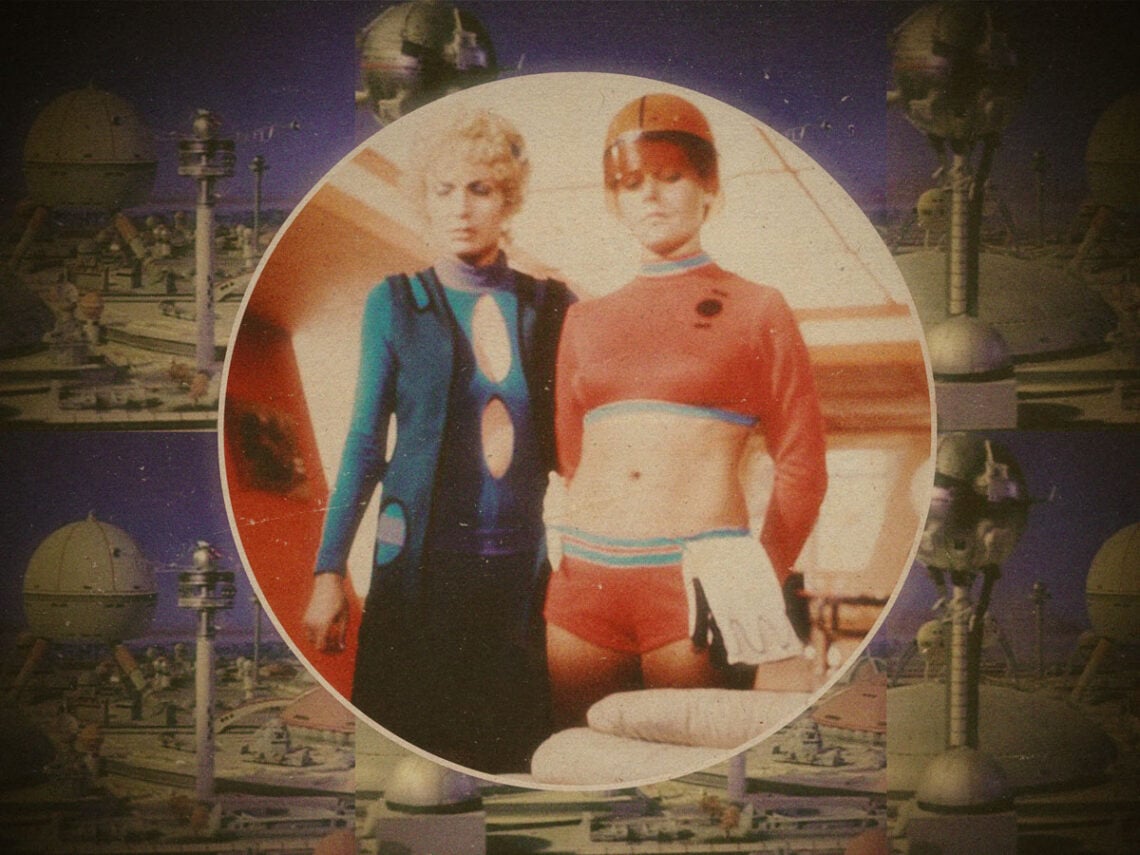
Space, satin and sexual politics: the curious world of ‘Star Maidens’
If you’ve ever wondered what might happen if somebody crossed Space: 1999, second-wave feminism, bargain-bin British television and a healthy dose of 1970s Euro-camp, then allow me to introduce you to Star Maidens, one of the strangest television series you’ve probably never seen.
Produced as a British-German co-production in 1975, the show somehow disappeared into the cracks of television history despite possessing just about everything a cult series could possibly need: questionable acting, wonderfully cheap special effects, an utterly bonkers premise and enough platform boots to outfit an entire glam-rock festival.
The action takes place on the distant planet Medusa, a supposedly advanced civilisation where women occupy every position of authority while men exist largely as obedient servants. Two long-suffering male workers eventually decide they’ve had enough of this arrangement, steal a spaceship from one of their female rulers and head for Earth, where they’re convinced they’ll discover a society run along much more familiar lines. Instead, they arrive on a planet where men and women are, more or less, equals, and the whole fish-out-of-water premise becomes an excuse for the series to poke fun at everybody.
It’s one of those ideas that could only really have emerged during the 1970s, when science fiction television still had room for strange little experiments that weren’t afraid to mix satire with space opera. Looking back now, it’s easy to forget how often British television was willing to take these kinds of chances. Not every programme needed to become Doctor Who or The Six Million Dollar Man. Sometimes a broadcaster would simply commission something wonderfully odd and hope an audience found it.
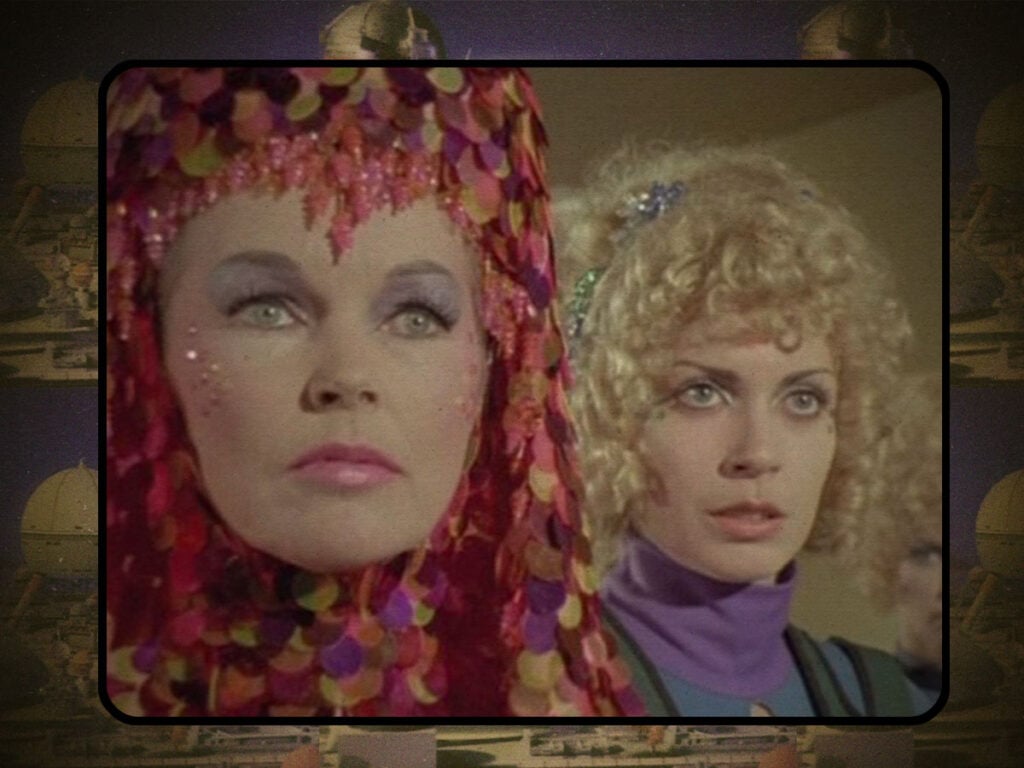
The production itself has become almost as legendary as the series. Much of the futuristic hardware was borrowed from Space: 1999, and viewers have spent decades gleefully pointing out props that appear to have been assembled from household objects, including tennis balls, air fresheners and whatever else happened to be lying around the art department that week. By modern standards, it all looks delightfully homemade, but that’s part of the appeal. There’s something enormously likeable about a television programme that tries to build an entire futuristic civilisation with little more than imagination, clever lighting and an enthusiastic props department.
The costumes deserve almost as much attention as the sets. Medusan security guards patrol the corridors in hot pants and towering platform boots while much of the wardrobe looks as though it wandered over from a David Bowie concert via a West German department store. Nobody involved seems remotely embarrassed by any of it either. The cast perform the material with complete conviction, which somehow makes the whole enterprise even more entertaining than if they had treated it as a joke.
The cast itself is packed with familiar faces for anyone who enjoys British cult television. Gareth Thomas would soon become a household name as Roj Blake in Blake’s 7, while Judy Geeson had already established herself in To Sir, with Love before later popping up as Paul Reiser’s long-suffering British neighbour in Mad About You. Then there’s Dawn Addams, remembered by horror fans for Hammer’s The Vampire Lovers, Amicus’s The Vault of Horror and Charlie Chaplin’s final film, A King in New York. Looking back through the cast list now, Star Maidens feels like one of those fascinating crossroads where a surprising number of careers briefly intersected before everybody wandered off in completely different directions.
What surprised me most on revisiting the series is that beneath all the camp there’s actually a reasonably clever idea trying to get out. By reversing traditional gender roles, the writers occasionally stumble into observations that still feel surprisingly sharp, even if they’re wrapped in broad comedy and spectacularly questionable fashion choices. It’s hardly radical political theory, but neither is it quite the empty cheesecake fantasy its reputation sometimes suggests. Like a lot of science fiction from the period, it uses an absurd premise to hold up a slightly distorted mirror to the real world.
Unfortunately, audiences never really embraced it. After just 13 episodes, Star Maidens quietly disappeared from British television, although it continued turning up in various countries well into the early 1980s before fading almost completely from view. It wasn’t until the DVD release in 2005 that a new generation of cult television devotees finally had the chance to discover just how gloriously peculiar the series really was.
Watching it today is a reminder that television used to be willing to fail in much more interesting ways. Modern science fiction tends to be expensive, polished and desperate to convince us of its own importance. Star Maidens never had that problem. It’s imaginative, faintly ridiculous and completely sincere, and those qualities have allowed it to age far more gracefully than many supposedly superior productions from the same era.
I honestly can’t believe this thing vanished for three decades.
Somebody really ought to bring it back, although I’d insist they keep the hot pants, the platform boots and the wonderfully ramshackle special effects. Without those, it just wouldn’t be Star Maidens.