



‘Technicolor Skull’: Kenneth Anger’s wonderfully strange musical detour
It’s easy to forget that Kenneth Anger wasn’t only obsessed with cinema.
Granted, that’s what most people remember him for. If your introduction to Anger came through Scorpio Rising, Lucifer Rising or one of the endlessly pirated editions of Hollywood Babylon, it’s tempting to imagine that film was the only language he ever really spoke. But Anger always seemed drawn to whatever medium happened to let him indulge his lifelong fascination with ritual, symbolism, old Hollywood, Aleister Crowley and things that made sensible people just a little uncomfortable. Movies happened to be the one he became famous for.
By the late 2000s, when most filmmakers of his generation were content to bask in retrospective screenings and lifetime achievement awards, Anger was busy making music with Los Angeles artist and filmmaker Brian Butler. Calling Technicolor Skull a band doesn’t quite feel right, because nothing about it was organised like one. There were no obvious singles to promote, no grand ambitions of conquering the charts and certainly no attempt to behave like a conventional rock act. It was really another Kenneth Anger project that simply happened to involve amplifiers, a theremin and enough occult imagery to make complete newcomers wonder what exactly they’d wandered into.
The collaboration first appeared in 2008 before turning up at museums and festivals around Europe and the United States, including a memorable performance during the Kenneth Anger: ICONS exhibition at Los Angeles’ Museum of Contemporary Art in 2011. The exhibition celebrated decades of Anger’s filmmaking, paintings and personal archive, yet one of the most intriguing things taking place wasn’t hanging on the gallery walls at all. It was Anger himself, standing onstage with Butler, still making new work instead of simply looking backwards.
Brian Butler handled guitar and electronic instrumentation while Anger played the theremin, which somehow feels like the only instrument he ever could have chosen. The theremin has always sounded faintly supernatural, all ghostly swoops and disembodied vibrations, as though the music were arriving from somewhere slightly outside the room. Pairing that with Butler’s dense electronic textures and projected imagery produced something that existed halfway between a concert, an art installation and a ceremony whose original purpose had long since been forgotten.
That uncertainty was part of the attraction. Butler described Technicolor Skull as an experiment in light, sound and ritual rather than a musical group in the ordinary sense, and audiences were largely left to decide for themselves whether they were watching performance art, experimental music or something altogether stranger. Knowing Kenneth Anger, the correct answer was probably all three.
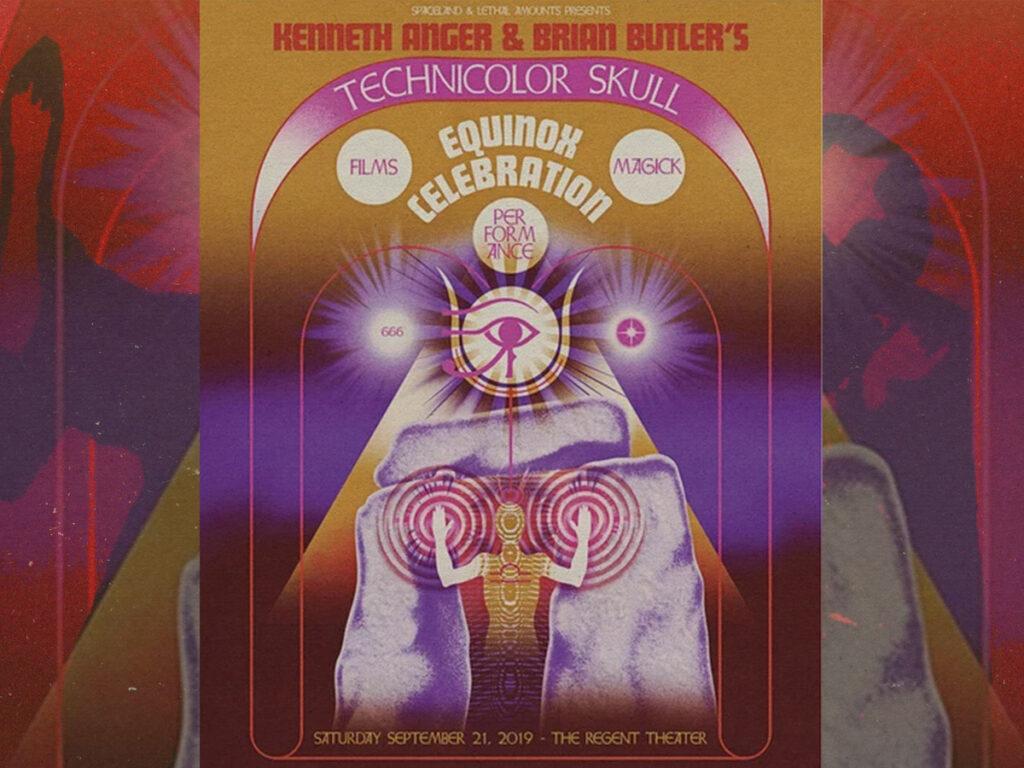
Even the record itself felt unmistakably Anger-esque. The duo’s debut arrived as a one-sided blood-red 180-gram LP in an edition of just 666 copies, because if you’re going to spend your entire career weaving occult symbolism into your work, there’s really no point abandoning the joke at the very end. It was exactly the sort of detail that separated Anger from artists who merely borrowed esoteric imagery. He understood that the object itself should become part of the mythology.
Watching Technicolor Skull today, what strikes me isn’t that Kenneth Anger was making music in his 80s. It’s that he never seemed especially interested in repeating himself. Plenty of filmmakers become curators of their own legacy once they reach that stage of life, endlessly revisiting old triumphs and allowing younger generations to tell them how influential they were. Anger seemed far happier wandering off into another strange corner of the cultural landscape to see what might happen if you plugged a theremin into one of his obsessions.
Perhaps that’s why Technicolor Skull remains such an overlooked footnote. It wasn’t designed to become anybody’s favourite record, and it certainly wasn’t an attempt to launch a late-career musical reinvention. It was simply another curious Kenneth Anger artefact, sitting quite comfortably alongside the films, books and legends that had occupied him for more than half a century. Like so much of his work, it refuses to fit neatly into a single category, which is probably the highest compliment you could pay Kenneth Anger.
Below is footage of Technicolor Skull, one of the more unusual final chapters in the career of one of American underground cinema’s greatest original minds.