‘Private Eye’: Vintage documentary on the ‘thorn in the side’ of the British Establishment

0000eyeetavirp.jpg
 
1976 was a difficult year for the satirical and current affairs magazine Private Eye.

This was the year its then editor, Richard Ingrams received over 60 writs from disgruntled billionaire businessman Sir James Goldsmith (aka Sir Jams Fishpaste, as the Eye called him). Goldsmith had objected to 3 stories the Eye had published about him—one in particular that suggested Fishpaste had helped his friend, Lord Lucan escape Britain from a murder charge.

Goldsmith and Lucan were bonded by several things, one in particular was a belief Communists had infiltrated western media, and Britain was on the verge of a Communist revolution. It led Fishpaste and Lucan to discuss the pros and cons of a Fascist military coup over “smoked salmon and lamb cutlets.” Their conversation reflected the paranoid, Boy’s Own fantasies of a very privileged and ruthless class.

But “Goldsmith was angry, as well as rich,” as one of Private Eye‘s lawyers, Geoffrey Bindman later explained:

“[Goldsmith] set out to destroy the little magazine that had presumed to offend him. He sued….But he spread the net far beyond Private Eye. In a novel exercise in overkill, he issued separate writs against all the distributors and wholesalers of the magazine. There were over 60 writs. Private Eye faced a huge financial burden. It was liable to indemnify all those whom Goldsmith had chosen to sue.

The first task was to reassure the recipients of these writs that the indemnity would be honoured. Private Eye lacked the resources but had a lot of supporters. A drive to raise money began, inspirationally named the Goldenballs Fund.

 
000eyeetavirpkoocsmargni.jpg
Peter Cook and Richard Ingrams check an early edition of ‘Private Eye’
 
The legal action brought considerable media attention, and in October, the BBC made a documentary about Ingrams and Private Eye:

“Richard Ingrams’ offices are at 34 Greek Street. A former haunt of prostitutes and drug addicts. Now the main problem is writ service. Rented at sixty-pounds-a-week, the building is small and dilapidated, but it’s all that Private Eye can afford. The magazine runs on a shoe-string budget. It comes out once a fortnight, price 20 pence, and has a circulation of 90,000.”

Ingrams may have looked like an unassuming university lecturer—dressed in a corduroy jacket, with a Viyella shirt and tie, but he was (surprisingly) a reformed drinker and smoker, who believed in God and played the organ at the local church. He was, more importantly, a superb and strongly principled editor, who understood Private Eye‘s role:

“It has to be anarchic. It has to be prepared to hit everyone—even its friends. As long as you attack everybody indiscriminately, completely indiscriminately you are safe. Immediately you start taking sides, or sticking-up for somebody, or keeping quiet, then you get into difficulties.”

Under his editorship, Private Eye had a golden decade in the seventies. It attracted some of the very best writers, journalists and artists, who brought an excellence other magazines (Punch) could only dream about. There was Auberon Waugh who produced an hilarious and corruscating diary; Paul Foot who delivered brilliant investigative reports; Peter Cook offered memorable comic contributions; and “Grovel” the Eye‘s (in)famous gossip column written by the late, Daily Mail diarist, Nigel Dempster, who claimed:

“We live in a banana peel society, where it gives no-one greater pleasure than to see someone trip up.”

Not all of the Eye writers were happy with Dempster’s column, Christopher Booker thought it edged too close to exaggeration, without thought of the damage done.

This lack of thought had led a 100 people to sue Private Eye by ‘76, which had depleted much of the magazine’s profits. But then the Eye was never really that interested in profits—it was a product of those patrician attitudes Public Schools can afford to inspire.

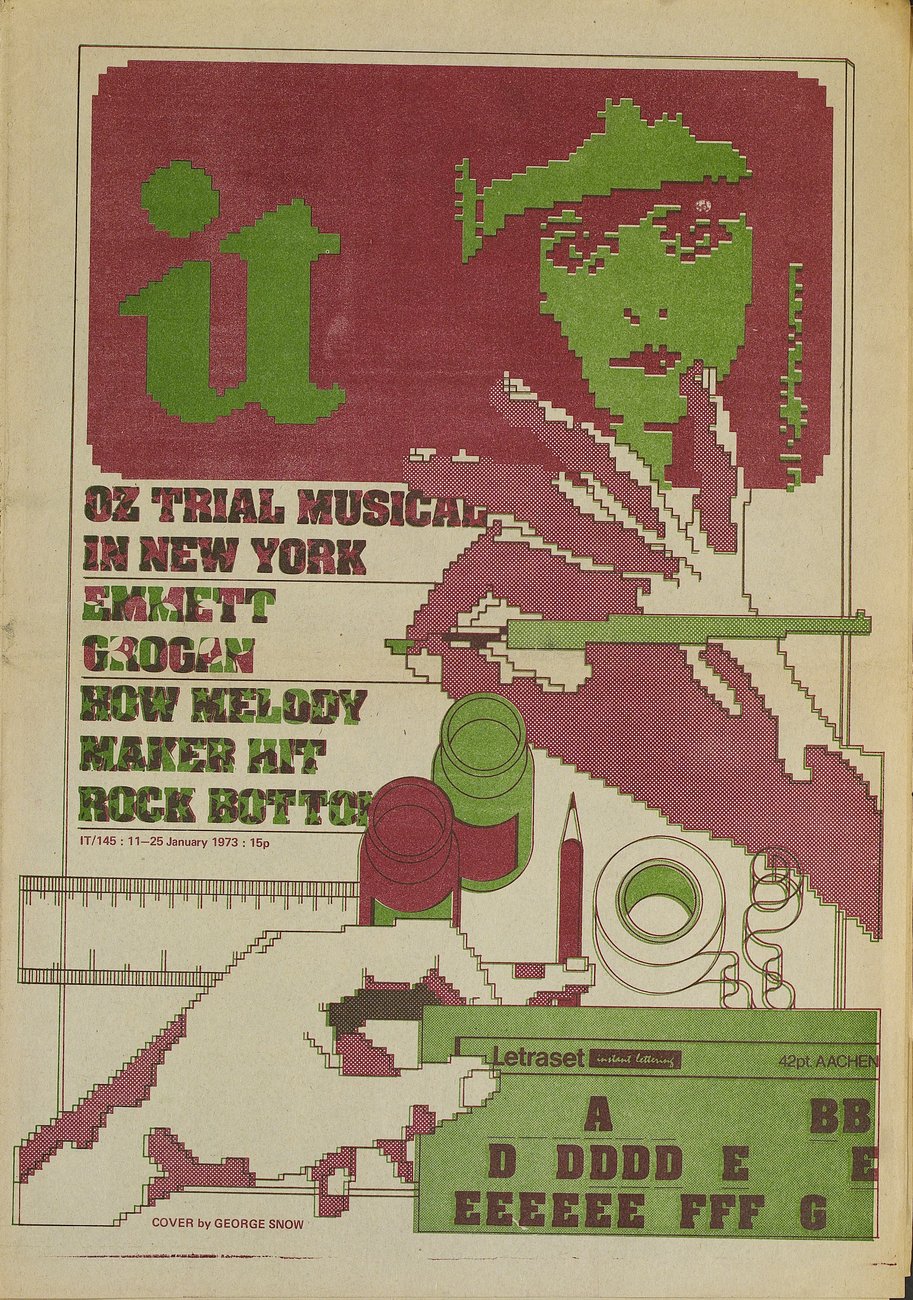
The magazine’s original quartet Richard Ingrams, Christopher Booker, Paul Foot and William Rushton had all met at Shrewsbury School, where they had produced their own teenage satirical magazine—a first issue was covered with hessian and embedded with free seeds. After school, university, where Ingrams hoped to become a leading comic actor. It didn’t happen, and the Famous 4 regrouped to produce the very first Private Eye in 1961, from typescript, Letra-set and cow-gum. It is interesting to note how this amateur, home-made style has remained very much the template for the Eye ever since.

This new magazine chimed with the so-called satire boom, in which Peter Cook, Dudley Moore, Alan Bennett and Jonathan Miller conquered the world with Beyond the Fringe, and producer Ned Sherrin made a star of David Frost (who Booker later described as a man with “..a peculiar ambition to be world-famous simply for the sake of being world-famous”) on the highly successful That Was The Week That Was—which proved so successful it was canceled after 2 series.

The Eye continued long after both these shows and the satire boom had run out of laughs, in part much aided by the backing of Peter Cook, who helped finance the magazine until his death in 1995.

What makes Private Eye essential is the ephemeral nature of its exceedingly good journalism. As Auberon Waugh once wrote (in the introduction to Another Voice—his essential collection of writing for The Spectator), “Timeless journalism is bad journalism”:

“The essence of journalism is that it should stimulate its readers for a moment, possibly open their minds to some alternative perception of events, and then be thrown away, with all its clever conundrums, its prophecies and comminations, in the great wastepaper basket of history.”

Though it has been occasionally wrong (MMR comes to mind) and wrong-headed (comic attitudes towards race, women, and gays have been questionable), Private Eye is indispensable and essential reading for those with an interest in the follies of politics and business of contemporary life, or the strong tradition of good investigation journalism, which most newspapers appear to have abandoned long ago. This is what made, and still makes Private Eye truly great.

Sir Jams Fishpaste launched his own magazine Talbot!, which soon disappeared without trace, before forming the I Can’t Believe It’s Not Margarine Party, a popular movement that failed to be..er..popular. He died in 1997.

Richard Ingrams quit Private Eye in 1986, and appointed alleged schoolboy Ian Hislop as Editor, who has managed the magazine with great success ever since.

Ingrams started a new magazine The Oldie in 1992, which has been described as “the new Punch and the new New Yorker,” which he continues to successfully edit today. Richard Ingrams is 94.

Check Private Eye online here.


With thanks to NellyM
 

Posted by Paul Gallagher | Discussion
‘The New View You’: A short film about Google Street View
03.23.2013
05:54 pm

Topics:
Amusing
Media

Tags:
Google Street View
Sheep Films

pamelgoog.jpg
 
The New View You—a short film about Google Street View, made by Dave at Sheep Films, and filmed by Ant Carpendale.


Bonus short ‘iEye’, after the jump…
 
H/T b3ta
 

Posted by Paul Gallagher | Discussion
‘Very unpromising material’: A review for Beckett’s ‘Waiting for Godot’, from 1955

todoghiojknhvfgkghjm.jpg
 
A review for Samuel Beckett’s Waiting for Godot from when the play first opened in England, at the Arts Theater Club, London, in August 1955.

Writing in the Guardian, critic Philip Hope-Wallace described Beckett’s play as “inexplicit and deliberately fatuous..” and claimed it “bored some people acutely. Others found it a witty and poetic conundrum.”

‘TWO EVENINGS WITH TWO TRAMPS

“Waiting for Godot”

By Philip Hope-Wallace

“Waiting for Godot” at the Arts Theatre Club is a play to send the rationalist out of his mind and induce tooth-gnashing among people who would take Lewis Carroll’s Red Queen and Lear’s nonsense exchanges with the food as easiest stuff in the world. the play, if about anything is ostensibly about two tramps who spend the two acts, two evenings long, under a tree on a bit of waste ground “waiting for Godot.”

Godot, it would seem, is quite possibly God, just as Charlot is Charles. Both tramps are dressed like the Chaplinesque zanies of the circus and much of their futile cross-talk seems to bear some sort of resemblance to those music-hall exchanges we know so well: “You know my sister?” “Your sister?” “Yes, my sister,” and so on, ad lib. One of the tramps is called Estragon, which is the French for tarragon herb; the other is called Vladimir. On the first evening their vigil is broken by the arrival of a choleric employer called Pozzo (Italian for “a well”), and a down-trodden servant Lucky, who looks like the Mad Hatter’s uncle.

On the second evening this pair reappears, the former now blind and led by the latter, now a deaf mute. As night falls on both seasons a boy arrives to announce that Godot cannot keep the interview for which the tramps so longingly wait. And at the end of it, for all its inexplicit and deliberately fatuous flatness, a curious sense of the passage of time and the wretchedness of man’s uncertainty about his destiny has been communicated out of the very unpromising material.

The allegorist is Sam Beckett, who was once James Joyce’s secretary and who writes in French for preference. His English version bears traces of that language still. The language, however, is flat and feeble in the extreme in any case. Fine words might supply the missing wings, but at least we are spared a Claudelian rhetoric to coat the metaphysical moonshine.

The play bored some people acutely. Others found it a witty and poetic conundrum. There was general agreement that Peter Hall’s production did fairly by a work which has won much applause in many parts of the world already and that Paul Daneman in particular, as the more thoughtful of the two tramps, gave a fine and rather touching performance. Peter Woodthorpe, Timothy Bateson, Peter Bull and a boy, Michael Walker, the mysterious Godot’s messenger all played up loyally. There was only one audible retirement from the audience though the ranks had thinned after the interval. It is good to find that plays at once dubbed “incomprehensible and pretentious” can still get a staging. Where better than the Arts Theatre?”

While the daily papers were generally negative in their reviews of the play, Kenneth Tynan was more favorable and wrote in the Observer:

By all the known criteria, Mr Samuel Beckett’s Waiting for Godot is a dramatic vacuum.

It has no plot, no climax, no denouement; no beginning, no middle and no end.

Unavoidably, it has a situation, and it might be accused of having suspense, since it deals with the impatience of two tramps waiting beneath a tree for a cryptic Mr Godot to keep his appointment with them; but the situation is never developed, and a glance at the programme shows that Mr Godot is not going to arrive.

Waiting for Godot frankly jettisons everything by which we recognise theatre. It arrives at the custom house, as it were, with no luggage, no passport and nothing to declare: yet it gets through as might a pilgrim from Mars. It does this, I believe, by appealing to a definition of drama much more fundamental than any in the books.

A play, it asserts and proves, is basically a means of spending two hours in the dark without being bored.

Not long after this review, Waiting for Godot transferred to the West End, London, and went on to win an Evening Standard award.
 
todogttekcebiokhj
 
H/T the Guardian
 

Posted by Paul Gallagher | Discussion
Leonardo DiCaprio’s Japanese Jim Beam Commercial
02.26.2013
10:43 am

Topics:
Advertising
Media
Television

Tags:
Jim Beam
Leonardo DiCaprio


When I think of Jim Beam, I think of Raymond Chandler or Kid Rock, not Leonardo DiCaprio. He’s just ain’t hardboiled enough. But the unshaven face and dark circles around his eyes does give him that “Lost Weekend” look.

Nice moves.
 

Posted by Marc Campbell | Discussion
‘Elegantly wasted’: Stool Pigeon’s A-Z guide to music journalism bullshit
01.30.2013
04:37 pm

Topics:
Media
Music

Tags:
bullshit
Stool Pigeon
music journalism


Is this what “elegantly wasted” actually looks like?
 
My god, I fucking LOVE Stool Pigeon. Amid a sea of mediocre freebie music press in the UK, Stool Pigeon stands out for being wildly opinionated (like the classic music press of yore, where debates about class, politics, gender and sexuality would routinely erupt) and steadfastly NOT subservient to PR companies and their demands. And make no mistake, PR companies do have a lot of sway in the world of street press.

I have seen friends’ reviews in free music publications changed and upgraded, as a bad review would put the mag in a promo company’s bad books, and risk removal from any future mailing list or free concert opportunities. In effect, opinions have had to be brought in line with a PR company’s wishes, and any real self-expression or valid counter-opinion has had to be neutered. Not only does this smack of the worst kind of corporate whorism—which, granted, exists in many media spheres—it seems illogical to me that a publication that doesn’t rely on a paying consumer audience to survive could treat its readers (and the artists it covers) with such ridiculous condescension.

Once upon a time music journalism was a necessity, a valuable tool for keeping up to date with your favorite acts, and for finding out about emerging talent. For gig listings, for records and concert reviews, for keeping in touch with other fans, for bitching out people and music you really hate. But the Internet has made the printed music press irrelevant, another out-moded business model within the music industry, yet another middleman whose role is not necessary any more. So why is everyone playing it so safe? Well-written and researched debate and opinion pieces should be a free paper’s USP, no?

Which brings me back to Stool Pigeon. It seems to give its writers free reign to write whatever they want, without sacrificing non-mainstream opinion at the altar of “edginess.” It’s not desperate to seem “relevant” or “on it” like so many publications, and it doesn’t try to be so alternative-to-the-alternative that it ends up being square. No, it’s simple really. It’s just written by people who are passionate and really care about music and its reportage. 

In fact, so good are they on calling out crap, Stool Pigeon has put together a handy A-Z Guide To Music Journalism Bullshit. You know, tired old cliches that make your eyes bleed. This kind of thing:

Whiskey-soaked vocals

Which translates as:

English lit polytechnic graduate, now based in Warrington, seriously wishes he was Tom Waits

Here are some more of my favorites, all beginning with “S”:

Set the blogosphere alight” — Well done! Your innovative blend of Fleetwood Mac, nineties R&B and Sade — a singer you’d never even heard of before The xx started banging on about her — has “set the blogosphere alight” with your brand new track, featuring artfully NSFW video. That Pitchfork BNM’d is surely in the post.

Sixth-form poetry — Snarky put-down reserved for artists whose literary aspirations are perceived to be shallow or juvenile. Which might almost be fair enough, if ‘music critic’ wasn’t a job that could only be considered cool by people under the age of about 15.

Songstress — As opposed to what, ‘songster’? Reading between the lines, this faintly kinky usage is a subliminal reflection of male music hacks’ rampant castration fear. See also: chanteuse.

Sophomore — Ridiculous, US collegiate term used as a stand-in for “second” when describing albums, e.g. “The Stone Roses’ second album The Sophomore Coming was a let-down for many.”

It’s about time somebody did this, and with your help it could well become the definitive list, as Stool Pigeon are asking readers to submit their own worst music journalism cliches. I would like to add these two:

Number 1 in an alternate universe” - made irrelevant by the theory that there are infinite alternate universes, hence any song ever recorded is number one in an alternate universe somewhere.

Year Zero” - as applied to any and every genre from punk rock to acid house to dubstep, but surely the correct term should be “Year One”?

If you have any music journalism bullshit to add to the list (and I know you do!) you can write it on the Stool Pigeon Facebook wall, or leave it in a comment here.

You never know, you might set the blogosphere alight.

Posted by Niall O'Conghaile | Discussion
Warhol’s ‘Get Smart’ art for TV Guide


TV guide commissioned Andy Warhol to design a cover and a series of fashion pages with Get Smart star Barbara Feldon using photographs by fashion photographer Roger Prigent.

Warhol certainly made the March 5th, 1966 issue of TV guide pop!


Thanks Charles Lieurance.

Posted by Marc Campbell | Discussion
Porn 2.0: ‘Memes I’d Like To F**k’ (SFW)


Wow, porn companies are really thinking outside the box these days! 

This James Deen clip doesn’t need much explanation, only to say it’s totally Safe For Work, and in fact, it’s more silly than sexy: 


The Veruca James/surprised kitty clip (pictured above) is here.
 

Posted by Niall O'Conghaile | Discussion
Fox News personality bursts out laughing at the dumb shit she’s expected to say
01.18.2013
12:48 pm

Topics:
Idiocracy
Media

Tags:
Fox News


In which one of the Fox News network’s newsreaders breaks the fourth wall, if only for a moment:

“No, no, who wrote that? Are you kidding me?”

Kimberly Guilfoyle is probably wondering why she left a promising legal career for this. Having a brain and being on the same program as Eric Bolling, Andrea Tantaros and Greg Gutfield five days a week must be an especially annoying way to make a living even if the money is good. Imagine that it’s you who had to read this copy coming across a teleprompter…


Via Media Matters

Posted by Richard Metzger | Discussion
Notes From The Niallist: is Transgate another nail in the coffin of oldstream media?


Writer Paris Lees, image via lastofthecleanbohemians
 
“Transgate”, the recent controversy surrounding writers Suzanne Moore and Julie Burchill’s comments about transgendered people online and in the print media, may seem like a bit of a storm in a teacup to those who have not been directly affected by the issues.

But it could be a decisive moment, not just for transgender awareness, but also how people view the “oldstream” media (in the UK at least) and in turn how social media can shape and express changes in public opinions exponentially quicker, and much more powerfully, than print and television can. 

That’s one of the very interesting topics of conversation in a Google Hangout-filmed debate posted by Channel 4 News yesterday, titled Transsexual people and the online age of outrage. It features writer Paris Lees, of META magazine and this well read Vice article, Sarah Savage of Channel 4’s My Transexual Summer, and experts on social media and transgender-issues.

Transgate certainly seems, as is mentioned in the video, a tipping point in public aware of the transgender community and the struggles faced by its members. I certainly don’t remember this much debate around a trans issue in my lifetime, and if there’s any heartening aspect to this whole shameful debacle, it’s that the backlash suggests trans people now have more allies than ever before.

But aside from drawing attention to the hateful attitudes certain persons, columnists, and even schools of feminism display towards people on the trans spectrum, this whole issue has made it that much clearer to the public just how valuable our opinions (and our freedom to express them) are to oldstream media. More and more, the cries of “freedom of speech!” and “anti-censorship” employed by columnists and news institutions over the last week are beginning to translate to the general public as “freedom for us to tell you how it is!”

This is particularly evident when commenters try to repost quotes from the Burchill article itself in the comments sections under certain op-ed pieces decrying the removal of her article only to see the quotes themselves removed. It has happened to me, and it has happened to others, and it makes a mockery of any kind of claim to “free speech”. Why should a writer of such low caliber as Julie Burchill be allowed to make statements about a social group, when members of the public are blocked from doing so?

It’s quite simply a PR disaster for print journalism.

This comes at a time when the Levenson Enquiry is trying to establish whether an independent regulator is needed for the British press. As people are getting their news from online sources much more these days, and thus beginning to doubt the role (and agendas) of mainstream news outlets, journalists are unlikely to be able to whip up enough outrage—real or “manufactured”, a frankly hypocritical term journalists LOVE to use about any controversy that they themselves did not stir up—to make people give a damn.

And let’s be clear about one thing, this is NOT an issue of “censorship”, a claim that’s getting bleated over and over in various echo chambers. If the offensive article was really “censored”, then how come it’s so easy to find on another major, mainstream news platform? I thought “censored” meant it would be gone for good? Or only available through a leaks site? Not on the site of the Daily Telegraph, surely?

This quote from Harry Giles very neatly explains the difference between “censorship” and “editorial policy”:

“… the columnists get it wrong … most call the Observer’s decision “censorship”, without expanding what they mean by that. This makes it seem as if the Observer’s decision were equal with a government passing a law against a speech or a type of speech. Government censorship prevents all speech of a certain kind, or an instance of speech, from happening in a country. Newspaper censorship – another word for which is “editorial policy” – says “we do not think this kind of speech should happen in our house”. Granted, because newspapers have a particular important role in a free speech society, they should be more careful about restrictions in their editorial policy than I would about restrictions on my Facebook wall.”

That is part of an excellent blog post by Giles, called Julie Burchill, Newspapers and Freedom of Speech, that dissects Transgate in a cool, calm and steadfastly philosophical fashion. It’s one of the best analyses I have read about the whole matter, and avoids being confrontational, or emotional (which is pretty hard, considering the language used by both Burchill and Moore.) I highly recommend it.

And for more enlightened discussion of Transgate and the mainstream media’s reaction to the “Twitter storm” here is the Channel 4 News discussion:

Transsexual people and the online age of outrage


Posted by Niall O'Conghaile | Discussion
Wait a minute, WHAT??? Liberal Dennis Kucinich joins Fox News!
01.16.2013
03:20 pm

Topics:
Media
Politics
Television

Tags:
Fox News
Dennis Kucinich


This might sound like it’s one of those things to file under “When Pigs Fly” or “When Hell Freezes Over,” but believe it or not, former Congressman Dennis Kucinich will be joining Fox News and Fox Business as a paid contributor, it was announced today.

In a PR statement, the archly liberal Kucinich said:

“Through 16 years in Congress and two presidential campaigns, Fox News has always provided me with an opportunity to share my perspective with its enormous viewership. I look forward to a continuation of our relationship this time as a Fox News contributor.”

Fox News chairman Roger Ailes added:

“I’ve always been impressed with Rep. Kucinich’s fearlessness and thoughtfulness about important issues. His willingness to take a stand from his point of view makes him a valuable voice in our country’s debate.”

If you ask me, Dennis Kucinich will make an excellent contributor to Fox News. This was an unexpected, but tres savvy move on Ailes’ part. He knows Fox News is in free fall and at the very least, having a bona fide liberal like Dennis Kucinich around will elevate the conversation a bit. Have you seen Fox News lately? It’s getting pretty threadbare. I’m sure the people who work there are tired of seeing the same faces day in and day out. Will Sarah Palin or Dick Morris ever say anything meaningful? Of course they won’t and Roger Ailes must know this, too. He’s a lot of things, but dumb isn’t one of them.

Kucinich will make his Fox News debut Thursday on The O’Reilly Factor.

Posted by Richard Metzger | Discussion
Page 2 of 38  < 1 2 3 4 >  Last ›