Jenna Pope: Photographs of NYPD brutality at vigil protesting the killing of Kimani Gray

aaaaaaujbyvghlbjenna01.jpg
 
This week, Brooklyn has seen a community come together for vigils and demonstrations in protest over the shooting of Kimani Gray by the NYPD.

16-year-old Gray was shot by 2 officers patrolling East Flatbush in an unmarked car around 11:30 p.m. on Saturday night.

The autopsy report, released Wednesday, said 7 bullets were removed from Gray’s body, 3 of these had entered his body form the rear. Police claim they shot Gray after he had allegedly pointed a .38-caliber Rohm revolver in their direction.

The police allegations have been contradicted by the only civilian eye-witness account that claims Gray was “unarmed.”

From this it is apparent that the NYPD have the power to kill who they want, when they want, without interference or sanction.

This can not and should not be tolerated.

The shooting deepened tensions between the Community and the NYPD, with the police response to the local vigils and marches criticized as being insensitive, over-the-top and brutal.

While a Brooklyn community comes to terms with the unfettered violence of the NYPD, one mother still waits for her teenage son to come home.

We send sincere condolences to Kimani’s mother, Carol Gray and her family.

Kimani Gray R.I.P.

The activist and freelance photographer Jenna Pope attended a vigil for Kimani on Wednesday night.

Jenna was there to show respect for Kimani, support the community, and to photograph the vigil.

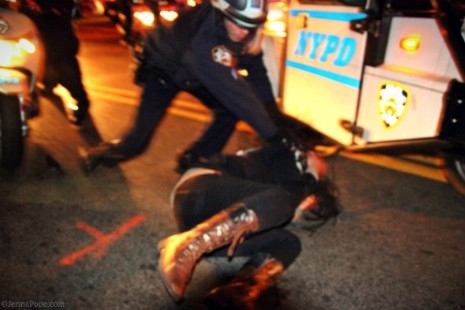
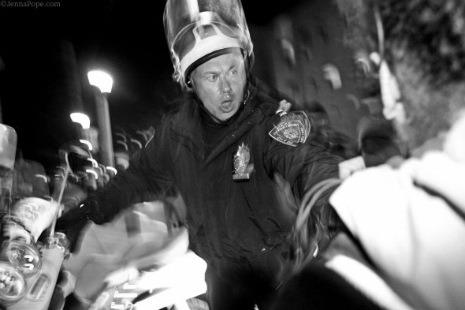
The night ended in a police riot, with Jenna badly injured and in need of hospital treatment.

This is part of her account and some of her photographs from that night, and I ask you check out Jenna’s photographic report over at her blog site.

This week, there have been vigils and marches in response to the NYPD shooting and killing Kimani Gray in Brooklyn. I was there on Wednesday, and although the vigil and march started out peacefully, the cops decided to block us from using a crosswalk while we were on the sidewalk, and continued agitating the whole night. I believe that’s what we call a “police riot.”

I was only able to photograph the beginning of the march since there was a quick end to my night when I was hit by a thrown object. An arrest was happening to my left, and I was hit on the right side. I received a concussion and was driven to the hospital in an ambulance where a doc put 5 stitches in my head. I have no idea what it was, or who threw it. If it was one of the many young, rightfully angry friends of Kimani Gray, then I honestly can say I would not be angry with them. Instead, I am angry that the NYPD shot 11 rounds at 16 year old boy, hitting him the back and killing him – which is what cause this outrage in Brooklyn.

If we want to seriously change the world, then we need more activists and photographers like Jenna Pope to bear witness to the truth, to give a damn and make a difference.

If you want, you can support Jenna Pope fight for justice, one photo at a time, by donating here. Thanks.
 
aaanmghbujjbldyjenna02.jpg
 
More of Jenna Pope’s photographs, after the jump…

 

Written by Paul Gallagher | Discussion
Free Cuddles: Apparently…
02.28.2013
05:20 am

Topics:
Amusing

Tags:
Photography
Free Cuddles

seldduceerffeouhbdl
 
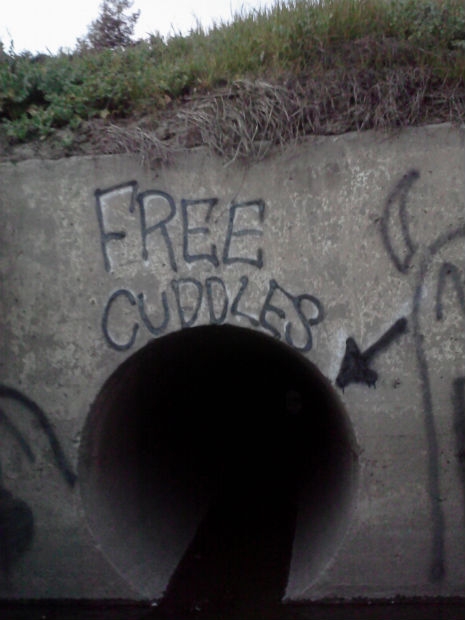
Free Cuddles? Though tempted, I’m unsure whether this is an offer to embrace or, to liberate…?
 
With thanks to Paul Darling, via Eat Liver
 

Written by Paul Gallagher | Discussion
A photograph of Patti Smith aged 11
01.15.2013
08:09 am

Topics:
Music
Pop Culture

Tags:
Photography
Patti Smith

ps11tvamps11amtvps
 
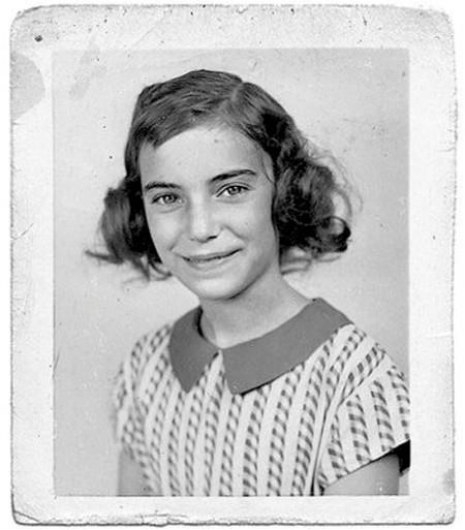
A photograph of Patti Smith aged 11.

Smith was ill for a lot of her childhood - sick with bronchitis, tuberculosis, scarlet fever and ‘three different kinds of measles’. Though she has claimed she was happy throughout her childhood, Smith did, for a time, think of herself as “alien to the human race”, as she explained in an interview with the Observer in 2005:

‘From very early on in my childhood - four, five years old - I felt alien to the human race. I felt very comfortable with thinking I was from another planet, because I felt disconnected - I was very tall and skinny, and I didn’t look like anybody else, I didn’t even look like any member of my family.’

Read the full interview here.
 
With thanks to Tony Vermillion, Via Another Mag
 

Written by Paul Gallagher | Discussion
FILMography: Photographs of movie stills in their original location

Frenchconnection_Filmography
 
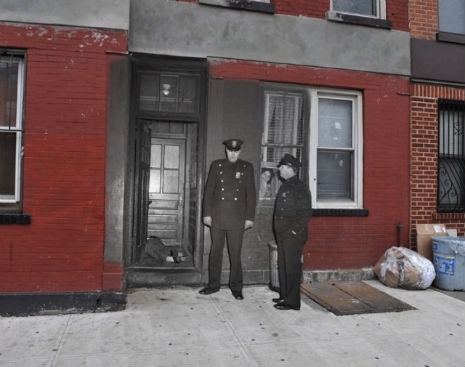
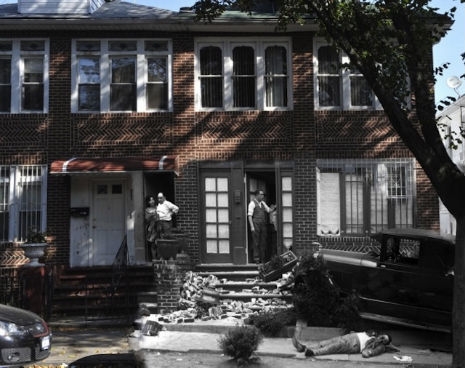
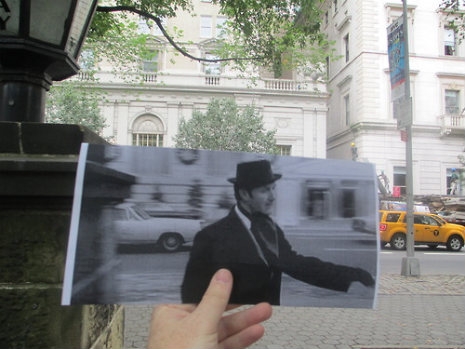
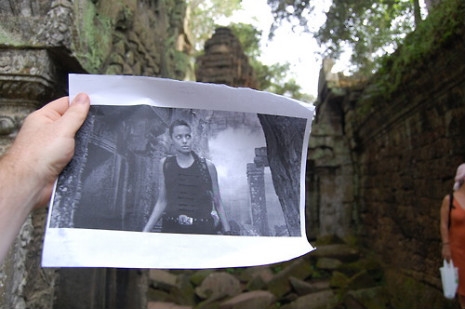
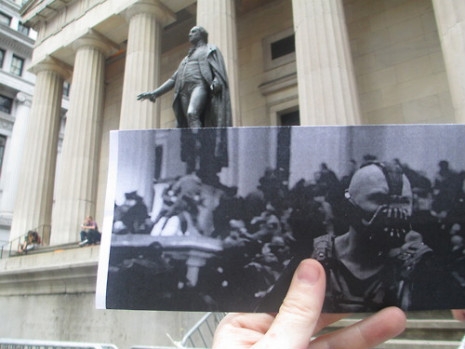
FILMography is a cool site where movie stills are placed within their original film locations, and then photographed.

The theory is: ‘FILM + photography = FILMography.’

This delightful site is curated by writer, journalist and photographer Christopher Moloney.
 
Laracroft_Filmography
 
Darkknightrises_Filomgraphy
 
More Filmography, after the jump…
 
With thanks to Robert Coupée and Anne Billson
 

Written by Paul Gallagher | Discussion
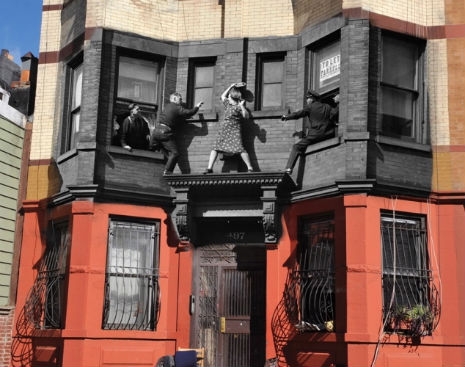
Anne Pigalle: Premieres her new show ‘L’Ame Erotique’

anne_pigalle_salon_kent
 
Fighting against our intellectual and spiritual enslavement, the incomparable Anne Pigalle premieres her new show L’âme érotique, at the Hotel Bijou, Broadstairs in Kent, on August, 23.

The exquisite Anne is one of the world’s great chanteuses, and this new show brings together an intimate salon of her photography, her poetry, her discourse and of course, her brilliant singing.

The show’s title comes from Anne’s last spoken word disc L’âme érotique, which showcased a selection of twenty-one erotically charged poems, each with their own musical accompaniment. The poems dealt with love, sex, and soul, and was a fantastic oeuvre that ranged from the personal (“You Give Me Asthma”, “Lunch”) through the comic and the Surreal to the sexually explicit (“Saint Orgasm”, “X Amount” and “Erotica de toi”). Throughout is Anne’s richly seductive voice sounds as intimate as a kiss. It’s a fabulous mix, and for fans of the legendary Miss Pigalle, and for first timers, it’s a breathless, arousing and unforgettable introduction.

If you are in the UK, then this is your chance to see the legendary Anne Pigalle at her very best. Check here for details, a dn below a selection of Ms. Pigalle’s erotic photographs.


A selection of Anne Pigalle’s erotic photographs, after the jump…
 
Previously on Dangerous Minds

‘L’Amerotica’: The return of the brilliant Anne Pigalle


Written by Paul Gallagher | Discussion
This Week’s Question: Why does the N.M.E. want fans’ photos of The Stone Roses?

nme_roses_photos
 
This week’s question (apart form when will we Nationalize the Banks?) is: why does the N.M.E. want fans to photograph The Stones Roses at their reunion concerts at Heaton Park, Manchester this weekend? Has it anything to do with a certain photographers’ boycott?
 
Previously on Dangerous Minds

Why Photographers are Boycotting The Stone Roses


Via NME’s Facebook page
 

Written by Paul Gallagher | Discussion
Why Photographers are Boycotting The Stone Roses


Something has happened to The Stone Roses and it’s not good. Over the past week a battle has been taking place over who owns the rights of any professional photographs taken of the band during their forthcoming reunion concerts.

The original contract offered to photographers stated:

(For) the payment by us to you of the sum of £1 The group (to keep) all Rights in perpetuity throughout the world so as to enable us to exploit the Photographs and the Rights as we (and/or they) deem fit without further reference or payment to you. You agree to provide us with digital copies of any or all of the Photographs upon request.

Photographers and artists own the rights to their images unless they sign those rights away. The Roses wanted them to sign all future rights away for a lousy quid, or around a buck-fifty.

As acclaimed photographer Ian Tilton told Dangerous Minds, ‘This kind of contract maybe standard when a band pays for a dedicated professional photographer to shoot a performance, but not for invited Press Photographers.

‘A standard contract would always agree to credit the photographers name.

‘A photographer employed by a top band to take photos at a gig, to be used by the band for publicity purposes only would earn £350-£1000 to take the photos. If the band then want to use the photos in a book the payment would be £80 to £250 per picture. If they wanted to use it on a CD or DVD cover the fee would be an extra few hundred pounds. The Stone Roses were just willing to pay £1 for an ALL RIGHTS buyout. This is insulting exploitation at its worst. - sign the contract and give the Roses ALL RIGHTS or they won’t allow the photographer to take any pictures at the gigs.’

Outraged by The Stone Roses’ contract demands, Tilton organized a campaign via his Facebook page, for press photographers to boycott The Stone Roses tour. After a flurry of texts of emails, a new photo release form was issued on behalf of the band, which now included the following:

The license hereby granted to you to photograph the artist is limited to the above grant only and NO right to sell, license or reproduce the material for advertising or commercial purposes (e.g., for use as posters, calendars, T-shirts, biographies, etc.) either to be sold, to be distributed free or to be otherwise exploited in any manner whatsoever. Nor may any material arising from the said session be reproduced in any publication devoted exclusively or predominantly to the artist unless prior permission has been obtained from THE STONE ROSES and their management.

It would seem that The Stone Roses have become so greedy that they not only want to control their image, but want to exploit others’ work.

As Tilton explained to DM, the reason it is important for photographers to own copyright of their work is because:

‘Photographers employed by magazines get paid only around £40-£80 per shot. Most online magazines pay expenses only. If photographers sell their images on after this ‘first use’ (called syndicating via an agency) they can earn between £20 and £250 per image - and the agency takes 50% of this amount. So you see how important it is to be able to syndicate images after their first use. The better the photo - the more chance it will get used again and again in the future.’

In a statement posted on his FB page, Ian Tilton explained why he and other photographers are against signing this new contract:

‘No - not signing it as it stands. It gives away most of our legal rights to earn future money off our photos. I refuse to sign their contract. I refuse to be made to ask the Stone Roses if my photos can be published in books or used in exhibitions in the future. They should not have control over my ‘art’ - I am the creator and I will control who uses it. That is what the current British law says so why do they want to change it and control our photographs, and control our financial income, outside of the British laws.

They were going to spring the original ‘exploitation contract’ on us when we arrived at Heaton Park but we found out about it. Their new replacement contract is controlling, immoral and takes away our rights that have been hard-won by brave people over the past few decades.

We have the choice to carry on with the boycott and be empowered now and for the future or….we set a precedent to be controlled and disempowered by greedy people.

EACH OF YOU is individually responsible for your own future as photographers and the future of all working photographers YES YOU ARE.’

Ian has also sent the following letter to The Stone Roses Press and Publicity Agent, Murray Chalmers:

Letter to STONE ROSES Press/Publicity Agent - Murray Chalmers at 1pm on Tuesday:

Murray,

It gives away most of our legal rights to earn future money off our photos. I don’t want to sign a contract that means I will have to ask the Stone Roses if my photos can be published in books or used in exhibitions in the future. They should not have artistic control over my art - I am the creator and I will control who uses it. That is what the current British law says so why do the Roses want to change that and control our photographs, and control our financial income, outside of the British laws.

Most photographers who will be photographing them live at Heaton Park will only be earning between £40 and nothing for their efforts. They rely on being able to syndicate their images to earn extra monies to pay the rent and afford that expensive equipment needed to take great pictures. Surely having great photos of the band freely circulating this can only be good for the band.

They were going to spring the original ‘exploitation contract’ on us when we arrived at Heaton Park but we found out about it. Their new replacement contract is still controlling, immoral and takes away our rights and income that have been hard-won by brave people over the past few decades.

Please will the Roses open communication with us and share their thoughts and feelings. They too are artists so surely, there are no major differences between us.

I’m finding it hard to reconcile that this contract has come from the band I know and love. It is inconsistent with the characters of the individuals I worked with, respected and was friends with when they were on their rise.

They were exploited by record companies and managers so I hoped they would have empathy and understanding for us photographer/artists, borne out of their difficult past personal experiences.

I love the Roses and feel saddened by all this.

Ian Tilton

The Stone Roses, or those representing them, have got this wrong, and the sooner this error is corrected, then the better it is for the rights of photographers to earn a living from their work.

Check out Ian Titlon’s work here and here.
 

Written by Paul Gallagher | Discussion
David Bowie: Brian Ward’s ‘Ziggy Stardust’ photo-shoot from 1972

bowie_stardust_cover
 
Those darlings at Retronaut have posted a fine selection of Brian Ward’s photographs for David Bowie’s Ziggy Stardust album cover, taken in January 1972. See more here.
 
bowie_stardust_01
 
bowie_stardust_00
 
More of Ziggy, after the jump…
 

Written by Paul Gallagher | Discussion
Lowlife: The powerful and compelling photographs of Scot Sothern (NSFW)

superman_scot_sothern
 
Photography, says Scot Sothern, wasn’t so much an interest, when he was growing-up, as something he was born into. His father owned a photographic studio, for portraits of weddings and baptisms; and Scot’s earliest memory is tied to a photograph.

‘My first clear memory correspond to a photograph and because of that I’m not sure if it’s a memory I would even have if not for the photograph to ring the memory bell in my head.

‘My father was a photographer with a wedding and portrait studio in the Missouri Ozarks and back in the fifties when I was about four years old cowboys were all the rage for boy tots like myself and portraits of little boys dressed in cowboy drag became de rigueur. I remember we were out on a farm and my dad wanted to set me on a rail fence, I guess the way cowboys were supposed to do. Anyway, it was too high and I didn’t trust my balance and freaked out when my dad set me there and so he had to take me down and let me stand in front of the fence instead. I remember him being irritated that I was acting like a pussy.’

Last year, Scot released Lowlife, a collection of his photographs and writing of his experiences amongst prostitutes in the 1980s:

’When I pulled off the freeway into San Diego, I had a single twenty dollar bill in my wallet. My car, a 1973 Toyota station wagon, rattled my teeth and died in idle. At stops I had to divide my right foot: heel on the brake, toes revving the accelerator. I had barely enough gas to get back to Los Angeles.

‘On El Cajon Boulevard I drove slowly and studied the street walkers. In their eyes I could see desperation-induced madness, premature death. In my eyes they could see my craving for the nasty little secret I kept from friends and family. I could give my twenty dollars to any one of these women. I could buy a quick sex fix and she could buy enough crack to put a smile on her face for an hour or so.

‘In the passenger seat, belted and buckled, frail and beautiful, my four-year-old son, Dashiell, slept curled around his best friend, a pillow-sized stuffed facsimile of Hulk Hogan. It was Sunday night and my weekend with my little boy was over.

‘When we arrived at his mother’s house, Dash awoke. He cried and clung tightly, arms around my neck. He didn’t want me to go. His mother Sylvia, my ex-wife, was happy to see me go, but first she wanted money. I made lame excuses. She called me a jerk and pried our son from my embrace. I took my twenty dollars and drove back to El Cajon Boulevard.’

 
scot_sothern_lowlife_book
 
More from Scot Sothern, after the jump…
 

Written by Paul Gallagher | Discussion
‘The Life Cycle of the Pin Mould’: Time-lapse film of fungi from 1943

life_cycle_of_the_pin_mould
 
The order Mucorales consists of 13 families, 56 genera, and 300 species. Mucoralean fungi, or pin mold, is typically fast-growing, and generally found on food, with the most ubiquitous example being bread mold (Rhizopus stolonifer), or the equally common genus mucor, found in rotten vegetables or soil. In The Life Cycle of the Pin Mould we can see the development of fungi through the use of time-lapse photography, watching spores grow on an apple, cheese and porridge.

Made in 1943, The Life Cycle of the Pin Mould was originally intended for educational purposes, and is now one of 125 films currently being re-released by the British Council on Vimeo. Already available are films on London during wartime, hospitals, growing vegetables, the life cycle of a rabbit, the gardens of England and how to make a bicycle, amongst many others. Check here for details.


Written by Paul Gallagher | Discussion
Mediating Between the Visible and the Invisible: Wim Wenders on Photography

wim_wenders
 
Film director Wim Wenders discusses his work as a photographer and his interest in photography, explaining how Digital photography has altered our relationship to transience. Wenders makes reference to his early films Alice in the Cities, where the photographer was a visionary, through to one of his most recent, Palermo Shooting, where the photographer is no longer present in the experience of what is shot, rather thinking ahead, more concerned with how to Photoshop and Digitally alter an image.

Wenders has taken photographs most of his life, and though a pioneer of German Digital cinema, Wenders still refuses to use a digital camera for his photography.

“Over the times I’ve done some digital experiments myself, even with photography. But in the end I gave all these Digital cameras away because I didn’t know what to do with them. I just didn’t know what to do with these things that make time disappear. For me the privilege of photography lies very distinctly in the possibility or the obligation of being here now. To cherish the moment, to enjoy that, which can just happen if you wait half an hour till the light changes. That makes it even more valuable. I am glad to be able to do photography. Since I took up photography I am a much more content person.”

For Wenders photography was a way to deal with the transience of life, where “pictures are mediators, messengers, translators between the visible and the invisible.”

The interview was recorded in Berlin in 2008, and though there are a few typos in the sub-titles, it is a thought provoking interview.


Previously on Dangerous Minds

Room 666: Wim Wenders asks fellow Directors about the State of Cinema, from 1982


Written by Paul Gallagher | Discussion
In a Beautiful Place Out in the Country: 7500 Images, 1 Track, Near Perfection

espen_boards_canada
 
A beautiful video made by qrotozoa productions (aka Espen Hagejordet) from 7500 images shot over 12 hours, at Sør-Fron, Norway, using a Nikon D5000. The marriage between the music of the Boards of Canada (“In a Beautiful Place Out in the Country”) and qrotozoa’s images is near perfection.  Put on headphones, click full screen, enjoy.

More of qrotozoa’s exquisite work here.


Written by Paul Gallagher | Discussion
‘My idols are dead and my enemies are in power’: Does this image speak to you?
03.15.2012
06:15 pm

Topics:
Amusing
Fashion

Tags:
Photography
Strange

myidolsaredeadmyeneimesinpower
 
My dear friend, Paul Darling, posted this image on his page. Instantly, it attracted attention as so many different people seemed to agree with the statement:

My idols are dead and my enemies are in power.

Maybe it connected because we live in the UK under a Tory government? But friends in Europe also agreed. And yes, there is something alluring about this photograph, and something also quite French and existential. So, what do you think? Does this image speak to you? If so why?

While you have a wee think about that, here’s The Stranglers “No More Heroes”.


With thanks to Paul Darling!
 

Written by Paul Gallagher | Discussion
‘The Neglected’: David Gillanders’ heart-breaking film on the street children of Ukraine

david_gillanders_ukraine_street_children
 
There are plenty of reasons why so many children are homeless in Ukraine. Some have been abandoned by their families. Others are victims of abuse. Whatever the reasons, each child is different, and has a unique story to tell.

There are no official statistics for the total number of children and young people living or working on the streets of Ukraine, yet various children’s charities and homeless organizations suggest the number is somewhere between 50,000 and 300,000.

Over the past 8 years, Scottish photographer David Gillanders has photographed the lives of these street children - documenting their stories of grim day-to-day existence on the streets of Odessa.

David found the children living underground, seeking warmth from central heating pipes. They were ravaged by malnutrition and addicted to drugs - nasal decongestants, which they crushed down and then injected.

“When I first started to take pictures of children living like that, I knew that I wasn’t going to change the world. But I did think something would happen - that it would improve. It didn’t.”

A photograph of one street child, Yana, won UNICEF Photograph of the Year. It captured the 13-year-old only 5 days before she froze to death on the streets.

Most of the children David has documented are now dead and his photographs are the only evidence of their tragic, short lives.

Based around his photographs,  David has made a powerful and moving short film, The Neglected for Channel 4 television. Produced by Nicola Black of Blackwatch Media, the film reveals the lives of a lost generation of children who live in desolation underneath the streets of Odessa.

UNICEF on Ukraine street children. Hope and Homes for Children in Ukraine

The Neglected will be broadcast on Channel 4, Thursday 22nd March 12 midnight.

Above photograph copyright to David Gillanders.


Written by Paul Gallagher | Discussion
Ghost Mother: Creepy vintage baby portraits with mothers ‘hiding’
01.26.2012
10:01 am

Topics:
Art
History

Tags:
Photography
Hidden Mother


“Hidden Mother” was a 19th century portrait trend where mothers, who were basically dressed a “ghost,” would hold their young children still while being photographed. The end result was, well… haunting and creepy.

There’s a whole Flickr group pool dedicated to the “Hidden Mother” era.


More after the jump…

Written by Tara McGinley | Discussion
Page 1 of 4  1 2 3 >  Last ›