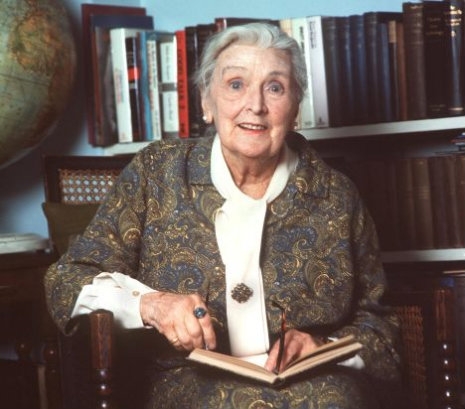
Actresses today don’t have half as much fun as we did, Dame Sybil Thorndike tells her interviewer in this short news report from 1969.
Dame Sybil was starring in There Was An Old Woman at the Thorndike Theater in Leatherhead, sixty-five years after she had first appeared as the Green Fairy in a production in Cambridge of The Merry Wives of Windsor.
The reason Dame Sybil thought younger actresses were missing out on fun was because of television.
‘They have do television all the time, which is such a bore after the theater. Excuse me, but it is. After theater, to do television, which is that size compared to life. It’s tiny, much smaller than life. The theater’s bigger than life.’
Dame Sybil was a socialist, and an active member of the Labour Party. During the Second World War she was a pacifist, and raised money for the Peace Pledge Union by giving theatrical readings across the UK. Together with her husband, the actor Lewis Casson, she brought Shakespeare to workers’ groups and factories. George Bernard Shaw wrote Saint Joan for her, and her performance in the title role is still considered the best. Thorndike also appeared in Major Barbara, MacBeth, Uncla Vanya and the revival of Arsenic and Old Lace. She also famously worked with Laurence Olivier and Ralph Richardson at the Old Vic.
When she found him in the early hours of the morning, it seemed as if he was sleeping. Lying on the bed, with an ink-marked script beside him. Still dressed, his shoes carelessly kicked off, a television flickering in the corner. The room smelled of smoke and sweat. She noticed the table lamp was still on, his pack of cigarettes, an overfilled ashtray. It seemed as if he’d fallen asleep as he worked on his latest screenplay Rosa L., a film about the revolutionary socialist Rosa Luxemburg. He looked pale. An unlit cigarette drooped from his lips, a small trickle of blood glistened from one nostril. For four years, Juliane Lorenz had been his partner, she had seen him tired out like this before, falling asleep while working late at night, geed-up by cocaine and alcohol, but this time there was something different. Juliane listened. He was too quiet. When he slept he snored. But now, all she heard - the ticking clock, the television, the hush of traffic outside - was his silence. Rainer Werner Fassbinder was dead.
It’s still hard to believe Fassbinder managed to do so much in his short thirty-seven years of life. That fact he was working on a script at the moment he died, says everything about his dedication to his art. In less than fifteen years, Fassbinder made forty feature films, three short films; four TV series, twenty-four stage plays and four radio plays. He also acted in thirty-six productions and worked scriptwriter, cameraman, composer, designer, editor, producer and theater manager.
Born into a middle class family, his father was a doctor who worked near Munich’s red light district. His mother helped with her husband, and neither had much time for their son. After their divorce, Fassbinder lived with his mother, who worked as a translator but was often absent, hospitalized with tuberculosis. Then, Fassbinder spent his time with neighbors, listening to their life stories or, going on his own to the cinema - he later claimed he saw a film a day during his childhood.
“The cinema was the family life I never had at home.”
His favorite films were melodramas, his favorite director Douglas Sirk, of whom Fassbinder said:
“The important thing to learn from Douglas Sirk’s movies is that on the screen you are allowed to, or better still, supposed to, enlarge people’s ordinary feelings—as small as they may be—as much as possible.”
Fassbinder started writing plays, and read about the Spanish playwright Lope de Vega, who had over 1,800 plays attributed to him. This became the gold standard to which Fassbinder aimed his ambitions. At eighteen, he joined a theater group, and the first hint of his incredible talents and ambitions became apparent.
Within two months of joining the Action Theater group, he became its leader. This proved too much for other, older members, who led to the group’s disbandment. Fassbinder then created a new company and drew together a team, or family of actors - Peer Raben, Harry Baer, Kurt Raab, Hanna Schygulla and Irm Hermann - who were to work with him until his death.
His first movie was a “deconstruction of the gangster films”, called Love is Colder than Death, it caused considerable controversy at its premiere at the Berlin Film Festival in 1969, where Fassbinder was jeered and denounced as a “dilletante” by members of the audience. Even so, it established his reputation as a talent to watch, and led on to his next film, Katzelmacher, which was adapted from his stage play. It was the start of his movie career that saw such an unparalleled output. Everything in Fassbinder’s life went towards his film-making. He was often ruthless and allegedly pimped some of the theater group actresses to raise money for his films.
“I would like to build a house with my films. Some are the cellars, others the walls, still others the windows. But I hope in the end it will be a house.”
The turning point came in 1971 with the release of The Merchant of the Four Seasons, the tale of a merchant who is slowly destroyed by circumstances beyond his control. the story epitomized Fassbinder’s world view as tragedy. Life was battled out against insurmountable odds, at great cost to its players. Though his films were often described as “bleak”, I never found them less than engrossing, for the theme to all his films is love - the cost love has on us all.
During the 1970s and 1980s, Fassbinder made such unforgettable films as The Bitter Tears of Petra von Kant (1972) (adapted form his play); World on a Wire (1973); his first major international success Fear Eats the Soul (1974), the story of love between an older woman and Moroccan immigrant, played by Fassbinder’s then lover El Hadi ben Salem; Effi Briest (1974); Fox and His Friends (1975); Mother Küsters Goes to Heaven (1975); Despair, his first English film, with a script adapted by Tom Stoppard form the novel by Vladimir Nabokov; In a Year of Thirteen Moons (1978), Fassbinder’s bleakest and personal movie, made in response to the suicide of his lover, Armin Meier; The Marriage of Maria Braun (1978), which became a breakthrough movie in America; Berlin Alexanderplatz (1980), a 13-hour TV series adapted form Alfred Döblin’s novel; Lili Marleen (1981), another big budget English movie; Veronika Voss (1982) which was inspired by Billy Wilder’s Sunset Boulevard; and his last major feature, which progressed cinematic narrative in a new and original way, Querelle (1982), adapted form the novel by Jean Genet. Fassbinder had just finished editing Querelle when he died.
The official cause of his death was “an overdose of cocaine and sleeping pills”. The cost of his lifestyle and his ambition took too great a toll. Before he died, his body had bloated from an excess of drink, food and drugs, and he once said, he became fat to make it harder to be loved. Fassbinder used his body, as he used chain-smoking, or his excessive drinking, as means to protect and distance himself from others. His sense of being unloved or, of being unworthy of love, stemmed from the parental indifference of his childhood. When he was older, he often treated his lovers and those closest to him badly, testing their loyalty and love for him. Emotionally, Fassbinder was childlike, as he always searched for that imagined lack, which would make him feel loved. It was this, Fassbinder’s own emotional biography that underscored his films.
Thirty years after his death, we can more fully appreciate the scale and quality of Fassbinder’s genius; and see the real beauty of the man who was Rainer Werner Fassbinder.
‘He came into the hotel, very quickly indeed. Sharp strides, quick handshake. It was extremely friendly.’
And then he tells you about himself, a slight pride, ‘I’d known his work for many years, of course.’
Of course, as if there would have been any question to otherwise. Then the non sequitur, ‘But it hadn’t led me to believe that he would be such a very fast driver. He drove his little Citreon, from bar-to-bar, throughout the evening. Very quickly, indeed.’
And of course, there are (pauses).
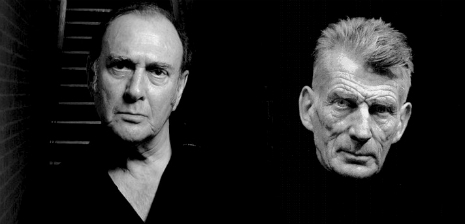
It’s Harold Pinter on Samuel Beckett, recalling an evening spent in his company. A pub crawl in France.
‘We were together for hours, and finally ended up in… (Pause) ...a place in Les Halles, eating onion soup, at about 4 o’clock in the morning. (Longer Pause) And… (Pause) ...I was, by this time, overcome, through, I think, alcohol and tobacco and excitement (Pause) with indigestion and heartburn. So. I lay down on the table, to still see the place. (A Beat) When I looked up he was gone. (Pause) A I say, it was about 4 o’clock in the morning.’
It could be lines from a Pinter play, My Night Out With Samuel, or a comedy, When Harry Met Sammy, but it all progresses beautifully, and menacingly, towards a punchline.
‘I had no idea where he had gone, and he remained away and I thought perhaps this had all been a dream. (Long Pause) I think I went to sleep on the table and…. (Pause) ...About forty-five minutes later, the table jolted and I looked up and there he was, a package in his hand. A bag.
(Pause)
‘And he said, eh, “I’ve been over the whole of damned Paris to find this. I finally found it.” And he opened the bag and he gave me a tin of bicarbonate of soda. Which indeed worked wonders.’
Pinter then goes on to read from a letter he wrote to a friend in 1954, when he was 24, about Beckett - ‘The farther it goes, the more good it does me’ - before performing an extract from Beckett’s The Unnameable. In total, this short program is seven minutes of sheer brilliance.
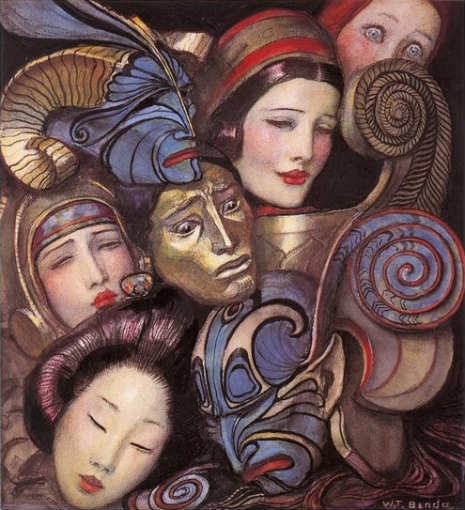
Wladysław Teodor Benda was a Polish-American painter, illustrator, and designer. His work illustrated magazine covers such as Colliers, American, McCalls, Good Housekeeping and Ladies Home Journal. Benda is best know for creating masks for various dance and theatrical productions, including works by Eugene O’Neil and Noël Coward, and the film The Mask of Fu Man Chu. His masks were ranged from the grotesque and the fantastic, to the highly stylized and the beautiful. Here Benda (or W.T.) presents a selection of his strange and fabulous masks in this short British Pathé clip from 1932.
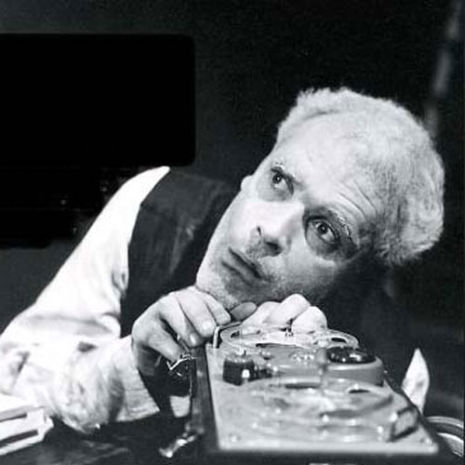
After Samuel Beckett heard Patrick Magee read extracts form his novel Molloy and From Abandoned Work on the radio, he wrote a one act play specifically for the Northern Irish actor. Beckett said Magee’s voice “was the one which he heard inside his mind,” and best suited his intentions for this dark and disturbing monologue on creativity, memory and mortality. Originally titled “Magee Monologue”, it soon became Krapp’s Last Tape.
Krapp’s Last Tape focuses on a man reviewing his life through a series of recordings, each made on the eve of his birthday. Krapp is a sixty-nine year-old, would-be writer who still believes he has the potential to create a great work of art, which will change the world. On listening to his past recordings, Krapp becomes aware of the different aspects of his life that have shaped him. Memory defines who he is, while wearing him down, limiting and inhibiting, until finally, impotent and in despair, Krapp recognizes the futility of his ambitions to create something, anything meaningful.
I suppose you could call this “playwright has mid-life crisis”, but still its themes are universal, and hit at the core of personal creativity and ambition.
Magee originally performed the play at the Royal Court Theater in 1958, under the direction of Donald McWhinnie, and this is the BBC 1972 version of that famous production.
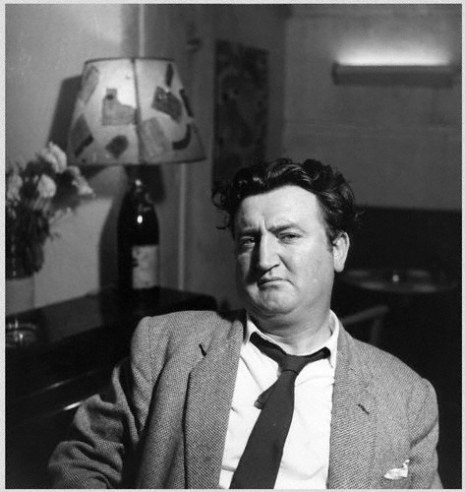
The idea of Brendan Behan eventually became greater than the man himself. No one knew this better than the Roaring Boy, who played up to the image of “a drinker with a writing problem”. By the early sixties Behan was the toast of the West End, the toast of Broadway, the toast of every-effing-where, but his best works, The Quare Fellow, The Hostage, and his biography Borstal Boy, were all behind him, and his confidence had been battered through working with the firebrand director, Joan Littlewood, who had turned the English version of The Hostage into a “Knees Up Mrs Brown”. Unable to stay focussed long enough to put pen to paper, Behan was forced to record his last works (rambling travelogs of New York and Dublin, the play Richard’s Cork Leg) onto tape-recorder for others to transcribe. It was a terrible waste, and of course there’ll be those who’ll say a lesson of sorts, but so what, as his fall form grace didn’t stop the great man’s legend form soaring.
Two years after the Behan’s death, Irish producer / director Norman Cohen (later best known the film version of Spike Milligan‘s Adolf Hitler: My Part in His Downfall and the Confessions of…. comedy porn series) made Brendan Behan’s Dublin, a travelog of the Irish capital based on the playwright’s memoirs, anecdotes and writing of the city by Carolyn Swift, and narrated by Ray McAnally as Behan. The Dubliners supplied the soundtrack.
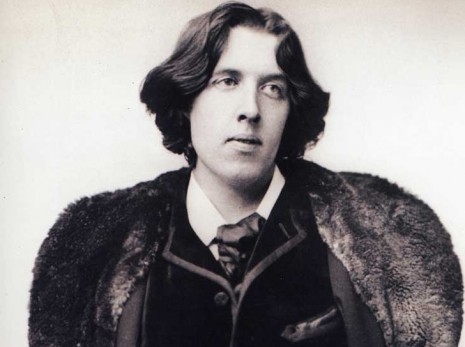
Writer Michael Bracewell examines the importance of being Oscar Wilde, through the events and works of the great poet’s life.
Here, Wilde is compared to an Existential hero, a man who was brave enough to set an example for all of us - to relish in the essence of who we are.
Wilde was rarely modest, and best explained himself in a letter to his lover Alfred Douglas, Jan-Mar. 1897:
‘I was a man who stood in symbolic relations to the art and culture of my age…The gods had given me almost everything. I had genius, a distinguished name, high social position, brilliancy, intellectual daring: I made art a philosophy, and philosophy an art: I altered the minds of men and the colors of things: there was nothing I said or did that did not make people wonder.
I treated Art as the supreme reality, and life as a mere mode of fiction: I awoke the imagination of my century so that it created myth and legend around me: I summed up all systems in a phrase, and all existence in an epigram.’
First aired in 1997, this is a fascinating documentary explaining why Oscar Wilde still really matters, with contributions from Tom Stoppard, Stephen Fry, Neil Tennant and Ulick O’Connor.
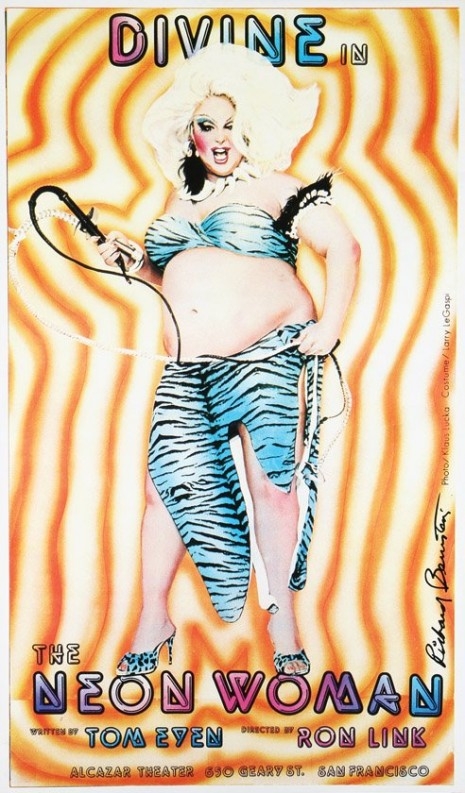
The fabulous Divine in highlights from The Neon Woman, Tom Eyen‘s sequel to Women Behind Bars, which was specifically written for Divine. The footage is a bit raw and gritty, but still gives more than a fair idea as to why Divine was so loved as a performer.
Produced in 1978, The Neon Woman is an “outrageous murder mystery” set in a run-down Baltimore burlesque house managed by a retired stripper, Flash Storm (Divine). The story was inspired by Gypsy Rose Lee’s classic burlesque thriller, The G-String Murders. Directed by Ron Link, and co-starring Helen Hanft, Brenda Bergman, William Duff-Griffin, Maria Duval, and Sweet William Edgar. The production ran for eighty-four performances at the Hurrah Discotheque, New York.
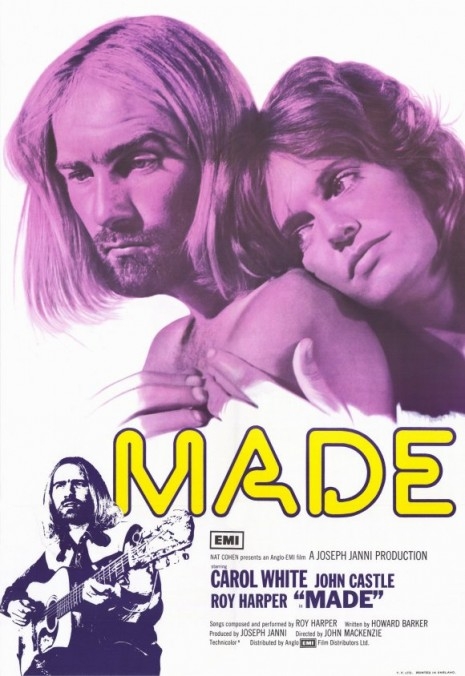
Dangerous Minds reader, Eric Kleptone kindly shared this early film Made, by the late and sadly missed director, John Mackenzie, best known for the exceptional The Long Good Friday and his work with brilliant playwright, Peter McDougall. Made is adapted from a play by Howard Barker, one of the most prolific and original playwrights in modern English theater.
Barker is a writer of secrets, who sees theater as a place where secrets can be shared. What he is not interested in is enlightening the audience with “truths”::
“When I write, I am not giving a lecture, I am speculating on behavior. Sometimes this is dangerous, but it should be. As I say often, theatre is a dark place and we should keep the light out of it.”
This is true of Made (1972), in which Barker speculates on the behavior of single mother, Valerie Marshall (played by Carol White), and her relationships with a musician, Mike Preston (played by folk singer/songwriter Roy Harper, yes, The Roy Harper), and a priest, Father Dyson (John Castle), while dealing with her family and elderly mother (Margery Mason). It’s very much a film of its time - a mix of social observation and exploration of identity, sexuality and independence, which often promises more than it delivers. But MacKenzie draws good performances and keeps the film moving.
Roy Harper contributed to the soundtrack, which became his classic album Lifemask.
In November 1964, Pinter appeared at the 92nd Street Y Poetry Center, New York, where he read a selection of his poetry and short stories. This audio recording is the full program of Pinter’s reading and includes:
“Tea Party”
“New Year in the Midlands”
“A Glass at Midnight”
“You in the Night”
“The Drama in April”
“The Anesthetist’s Pen”
“Jig”
“Episode”
“Afternoon”
“The Error of Alarm”
“The Table”
“The Black and White Selection”
“The Examination”
This is followed by a Q&A where Pinter:
...talks about literary influences, point of view, his opinion of Edward Albee’s Whos Afraid of Virginia Woolf? and the classic Beatles vs. Rolling Stones debate.
I started reading Pinter when I was about 12, and found his work strangely reassuring, for here was the dialog of the adults all around me, full of peopled silences and casual menace. Whether it was The Caretaker or The Birthday Party, it all seemed so normal, only as I gained a year, did I realize that perhaps it wasn’t meant to be so normal after all.
Pinter observed and refracted the world around him through the prism of his experience - a repertory actor caught in digs, mixing with landladies, traveling salesman, became The Room, The Basement, and The Birthday Party. As Pinter told his biographer, Michael Billington:
“I went to these digs and found, in short, a very big woman who was the landlady and a little man, the landlord. There was no one else there, apart from a solitary lodger, and the digs were really quite filthy ... I slept in the attic with this man I’d met in the pub ... we shared the attic and there was a sofa over my bed ... propped up so I was looking at this sofa from which hairs and dust fell continuously. And I said to the man, “What are you doing here?” And he said, “Oh well I used to be…I’m a pianist. I used to play in the concert-party here and I gave that up.” ... The woman was really quite a voracious character, always tousled his head and tickled him and goosed him and wouldn’t leave him alone at all. And when I asked him why he stayed, he said, “There’s nowhere else to go.”
Or, the start of family life, married to the actress Vivian Merchant, living together in a threadbare flat in Chiswick, the location which inspired The Caretaker:
“a very clean couple of rooms with a bath and kitchen. There was a chap who owned the house: a builder, in fact, like Mick who had his own van and whom I hardly ever saw. The only image of him was of this swift mover up and down the stairs and of his van going . . . Vroom . . . as he arrived and departed. His brother lived in the house. He was a handyman . . . he managed rather more successfully than Aston, but he was very introverted, very secretive, had been in a mental home some years before and had had some kind of electrical shock treatment . . . ECT, I think . . . Anyway, he did bring a tramp back one night. I call him a tramp, but he was just a homeless old man who stayed three or four weeks.”
Then there was his sexual and romantic relationships Landscape, Silence, Betrayal; and even his influences - a moot point that without Joe Orton’s Entertaining Mr. Sloane, he wouldn’t have written The Homecoming.
In 1963, Pinter wrote an essay about his theater and his plays:
I’m not a theorist. I’m not an authoritative or reliable commentator on the dramatic scene, the social scene, any scene. I write plays, when I can manage it, and that’s all. That’s the sum of it.
I’ve had two full-length plays produced in London. The first ran a week, and the second ran a year. Of course, there are differences between the two plays. In The Birthday Party I employed a certain amount of dashes in the text, between phrases. In The Caretaker I cut out the dashes and used dots instead. So that instead of, say, “Look, dash, who, dash, I, dash, dash, dash,” the text would read, “Look, dot, dot, dot, who, dot, dot, dot, I, dot, dot, dot, dot.” So it’s possible to deduce from this that dots are more popular than dashes, and that’s why The Caretaker had a longer run than The Birthday Party. The fact that in neither case could you hear the dots and dashes in performance is beside the point. You can’t fool the critics for long. They can tell a dot from a dash a mile off, even if they can hear neither.
Nigel Williams directed this superb two-part film biography on Harold Pinter for BBC’s Arena strand, which explores:
Pinter’s life, work, and political passions - from his East End childhood to his work as an actor, his experience of both early critical rejection and adulation, his screenwriting, and his love of poetry and passion for cricket.
Part One explores Pinter’s key theme - the room - through the very rooms in which he wrote his first great series of plays. Arena reveals the links between the plays and places, and meets the people who live there now. We visit the East London terraced house room where Pinter grew up and first wrote poetry; the theatre dressing room where he began to formulate his ideas about playwriting and language; the sitting room in the London cold-water flat where he wrote his first hit, The Caretaker, and his study in the bow-fronted house in Worthing, where he lived in the sixties with his first wife Vivien Merchant, and wrote The Homecoming.
Harold Pinter has given Arena exclusive access to personal recordings in which he talks frankly to his biographer Michael Billington. Presented for the first time on television, they tell Pinter’s story in his own words, as he remembers it.
In part two of this film biography, Arena explores the relationship between the public and private dimensions of the famous playwright and actor’s life and work; the intimacy of his plays since the seventies; his work in films and television drama; his passion for poetry; and his fervent ‘political engagement’.
Arena accompanied Pinter for two years to film plays and events in America and all over Europe. The wildly funny Celebration features a group of friends celebrating in a restaurant and, over the course of the evening, revealing details of their private lives in this very public space.
Arena reunites members of the cast, including Lindsay Duncan, Andy de la Tour, Susan Wooldridge and Indira Varma, who discuss their working relationship with Harold Pinter.
Other contributors include his wife Lady Antonia Fraser, journalist John Pilger and Pinter’s biographer Michael Billington.
Part 2 of this excellent documentary on Harold Pinter, after the jump…
It started when producer Barry Hanson asked writer Barrie Keeffe, one night, what film he’d like to see? Keeffe said he wanted to see an American gangster film set in the East End of London. There was nothing like it on at the cinema, so Hanson told Keeffe to write it. The result was The Long Good Friday, a movie regularly voted the greatest British gangster film, and one of the best British films, of all time. High praise for a movie that was nearly re-cut, dubbed and pumped out onto TV by its original parent company, ITC, who hated it.
I was lucky enough to see The Long Good Friday, when it was screened at the Edinburgh Film Festival in 1980 as the highlight to a mini-retrospective of director John MacKenzie’s work. It had an indelible effect.
MacKenzie was established as a major talent, having made the films Unman, Wittering and Zigo with David Hemmings in 1969, and Made with Carol White and Roy Harper in 1972. He had also achieved further success directing Peter MacDougall’s brilliant dramas Just Another Saturday, which won the Prix Italia, Just A Boys’ Game, which starred rock singer Frankie Miller, and MacDougall’s adaptation of notorious hardman, Jimmy Boyle’s biography, A Sense of Freedom. Now he had just completed a film that captured the essence of 1980’s Britain under Prime Minister Margaret Thatcher.
Written by Barrie Keeffe, a former journalist who made his name writing political drams for TV and theater, Scribes (1976), about newspaper workers during a strike, .Gimme Shelter (1975–7), a powerful trilogy that dealt with deprivation, frustration and anger of working-class youth, and the tremendous BBC drama Waterloo Sunset, starring the legendary Queenie Watts.
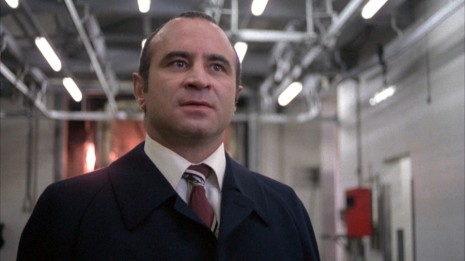
Keeffe wrote The Long Good Friday in three days, over an Easter weekend. Originally called The Paddy Factor, the story dealt with East End gangster Harold Shand (Bob Hoskins) who plans to go into partnership with the Mafia to redevelop London, only to fall foul of the IRA. The film co-starred Helen Mirren, (who battled to make her character, Victoria, stronger), a young Pierce Brosnan, and Eddie Consantine, as the Mafia don.
The script came from all the stories Keeffe heard growing-up and working as a reporter on the Stratford Express, as he told the Arts Desk last year:
The seeds were planted then; it was a very fertile time, just before the end of the Krays’ empire, and a lot of my plays, and some of the incidents in The Long Good Friday, came from my experiences. For instance, one of the gangland punishments, if you strayed into someone else’s territory, was to crucify you to the warehouse floor. As a very innocent junior reporter, a young 18, I was sent to interview a guy in hospital. He was covered in bandages and I asked him what had happened. He said, with that wonderful East End humour, “Do you understand English, son? Well, put it down to a do-it-yourself accident.”
Filmed the same year as Thatcher’s election, The Long Good Friday predicted much of the change Conservative rule would bring to London and the British isles.
The Long Good Friday was obviously about the transformation of the East End. The Bob Hoskins character was talking about the end of the Docks and mile after mile of territory for “profitable progress” - I think that was his phrase. I saw the film again about five years ago and it has a scene showing this model of how the area would look under the developers. It underestimated it completely - it ought to have shown Canary Wharf looking like Manhattan. Looking at it, I was taken by the fact that none of us had foreseen the enormous scale of change.
The Long Good Friday was a film “raging” at what was about to happen to the country, the story of gangsterism / Thatcherism / Captialism coming face-to-face with terrorism / idealism.
Cast and Crew: The Long Good Friday brings together John MacKenzie, Barrie Keeffe, Barry Hanson, actor Derek Thompson, casting director Simone Reynolds to discuss the film, its making and its legacy. There are also interviews from Bob Hoskins and Helen Mirren. Watching Keeffe and MacKenzie around a table together, there is still the crackle of creative tension, as writer and director both lay claim to the film’s success.
In the Fall of 1982, Eric Bogosian traveled to Britain, where he performed in his two solo shows Men Inside and Voices of America. His tour took him from London’s ICA, through Cardiff, Newcastle-Upon-Tyne, Middlesborough, to Glasgow and Edinburgh, during the months of October and November , traveling with just one small suitcase of clothes, a black wool overcoat, and a selection of paperbacks to keep him company. Quite a feat at a time when things were organized without the advantage of the internet, emails, texts or mobile phones. It reveals much about Bogosian’s ambition and self-belief, as it does about his talents.
Bogosian had opened Men Inside and Voices of America that Fall, at the Martinson Hall in New York, where he was hailed as “the best performance artist I’ve yet seen,” by Valentin Tatransky in Arts Magazine. He had also been described as like “a man possessed, a medium, a schizophrenic,” by Sally Banes in the Village Voice, and as someone who could “perform the performer, and out-perform the performance artist,” in Flash Art.
At the time, I was a student, avoiding studies while editing the university magazine. How I’d heard about him, I can’t recall, a press release or flier most likely - my life back then seemed lived from the inside of an aquarium - knowledge, happiness, love and success were always beyond the glass. This disengagement with the external world might explain why I turned up late after his first show at the Third Eye Center, on Sauchiehall Street. Understandably, he was pissed, but I made my excuses and walked him back to his hotel on Cambridge Street, with arrangements to see and meet the following night in Edinburgh. These then are extracts from that interview.
Bogosian performed in a small stage area, surrounded by raised seating. He was imposing, for such a compact figure in black shirt, black pants. A bare stage except for one chair. Everything was suggested, created, from Bogosian’s physical presence. He walked onto stage and became a small child flying as Superman, talking to his father, mimicking adult bigotry before, shockingly, breaking into a stutter. So began the darkly comic Men Inside a carnival of souls from a troubled America - dysfunctional men, unable to interact with the world because of their bigotry and hate.
From Superman, Bogosian became a young man masturbating before declaiming his loneliness by saying “I love you” to a centerfold. Then on to a bored teenager, a stud, a bully, a sleaze-ball, a down-and-out, a Blood and Sword evangelist. It was loud, noisy and funny. Bogosian’s performance was as brilliant as his characters were low:
“Each character, each scene, flows into the next presenting different aspects of man gone wrong: his sexism, his racism, his hate.
It’s my effort on my part to try to communicate from a man’s point of view, trying to be sympathetic to men, saying this is how it happens, this is how a man ends up with these perspectives about women, about life - what can we do about it?
The thing I’m trying to lay out on women is the whole discussion of Women’s Liberation, Feminism, and the like, is all very complicated and that’s the first thing - it’s a complex issue, it’s not black and white. Women are perfectly justified in complaining about their situation, however, in different times men have also been put into situations that are not so great, the biggest one I can think about is certainly war.
War is Hell on Earth, and nobody should ever have to go through that. And of course, now, here in Great Britain people are thinking of the Falklands thing. I mean, it has to be thought about, if anything is sexist, it’s men should have to go off and die, that is sexist thing too. All I’m saying, we’re all people, let’s try and be a little sympathetic to each other, while we try to find out what exactly is going on.
I was in a restaurant on a Sunday morning in Vancouver, on tour, and I came in and had my breakfast around 10 o’clock in the morning, and there was all these men in the place, all by themselves: smoking a cigarette, reading a paper, eating a breakfast, looking kinda glum, kinda down. And these two couple came in, both in their sixties, and each guy was very dapperly dressed with his wife. And the women were happily chatting with each other and the men were sort of ushering their wives in. And you had a very strong feeling that these women were in some way protecting these guys, they were giving them something to do with themselves, yeah know. They weren’t like every other guy in this place, and you got the feeling that these guys were kinda looking across at these two couples, how these guys’ clothes were clean, their clothes were pressed, and how, how they had something to fucking do.
And all those other guys were just crumpled up pieces of paper. And here are these two guys, who because they stuck it out with a couple of marriages, now that they were in their sixties, had something to do. And somehow I wish people would admit this: that mean and women are different, and that for whatever reasons, whether they’re cultural or whatever, they are complimentary aspects of one another.
Bogosian was concerned that some of the Scottish audience was offended by certain aspects of his performance thinking they may have confused the views of the characters with the performer’s. After all, this was dangerous stuff to bring to a city more attuned to the Royal Lyceum’s revival of Noel Coward, than an act billed as a cross between Lenny Bruce and Richard Pryor.
“I don’t expect anyone to be so critical about performance or experimental theater as I have been. I mean, it’s my life, it’s all I’ve been doing for the past 12-13 years, it’s all I’ve been doing - working in theater and complex theater. I don’t expect everyone who walks in off the street to understand about that - they’re taking it at face value, and they may not even notice the technique I’m employing.
For instance, the exotic dancer and the Led Zeppelin thing seem very alike, but their movements are very complex. You just can’t jump out and do that stuff, it’s all choreographed, and all rehearsed a lot, it’s just subtle. Someone might watch and go, ‘Hmm, not bad, that’s good movement.’ But not everyone’s going to understand that, what it’s about. They’re going to go ‘Ha-ha. look at that, he’s playing guitar,’ you know?
I can’t say if that’s something formal or theoretical in my work, it’s just something I’ve always done as an actor. It comes through from the inside. I don’t think any good actor can explain what happens when they become Someone. I become them totally and I know I’m inside them, and somehow it reads, and that’s the funny thing because at acting school they teach you how to relate what’s going on inside your head to what you look like outside. I don’t know what I look like, I’ve seen photos and stuff, but somehow what I look like is corresponding to what I’m feeling.
In a way that’s very direct and without any real training on it, I just hit the stage and it starts happening to me. But that’s just me, it’s like something I’ve got to my advantage, that I should make the best use of.”
The second half of the show was Voices of America a relentless tour of America’s airwaves, where every speaker, no matter how cheery or inane, seemed obsessed with death:
“If you had a choice to die from a nuclear holocaust (oh no!) or, a heroin overdose (oh wow!), which would you choose?” - ‘Voices of America’
This was all very much a hint of Bogosian’s Barry Champlain in Oliver Stone’s Talk Radio.
“Voices of America started out as a sort of finger exercise, so I could practice my voice, and it ended up as a piece.
At the time I was trying to get into advertising, so I made this demo tape of adverts and jingles and stuff, but the company thought it too cynical.
It’s very black. I’m interested in the way society’s fascinated with the lives of its stars and superstars, with its violence and consumption, its decadence.
Like how Keith Richard’s habits became published or how real death and real suffering are treated. How things are mass produced indifferently, and people’s suffering doesn’t come through, but is just forgotten.
Though I don’t think my philosophy or my ideas about anything are social or profound or anything, they’re just basic, mundane, liberal ideas, what we call liberal in America. It’s just like everyone else should be nice to everyone else, and how you can do it and go vote and I’m against the death penalty and for social programs. It’s just dumb stuff - I don’t mean these things are dumb - I mean I’ve got nothing to tell anybody that they shouldn’t already know. I’m just making stuff I’m interested in, it’s the piece I’m interested in - how can construct them and how can I act them out, it’s just all that stuff is in my head and it all might as well come out in the show, it might as well be there, as not be there.
And I know they’ll never put me on TV for saying these things, that’s the funny thing about it: I don’t think there’s anything radical about what I’m saying or doing, but they’ll never put me on a TV station saying this kind of stuff.
The current comedians in the States are just zany, they’re just crazy guys. Comedians with a conscience are not wanted in the mass media.
It’s just intuitive, a whole set of things are interesting to me, things that operate in my life. It’s like my face, if I get a nose job, and get my nose to be straight and my chin to be stuck out and stuff like that.
If I’m eloquent in expressing my particular set of perameters in my frame of mind they start to seem universal, or interesting or something like that, or, somebody at least might identify with them. I don’t start off with a theory and try to work it all out, it’s just that I try to express myself as best I can.”
Later, we walked out into the Georgian cobbled streets of Edinburgh’s New Town. It was late and cold, and the evening’s silence reminded us of our own past experiences of walking around empty streets at night listening for parties to crash.
Bonus clips of Eric Bogosian in performance, after the jump…
In the winter of 1963, Kirk Douglas returned to theater in the first stage production of Ken Kesey’s novel, One Flew Over the Cuckoo’s Nest. Douglas starred as McMurphy, with a supporting cast that included Gene Wilder as Billy Bibbit, and Ed Ames as Chief Bromden. What should have been a triumphant return for Douglas and a theatrical success for Kesey’s novel proved to be a disaster, which was savaged by critics and closed after 11 weeks.
On January 7th of 1964, sickened by the relentless stream of invective from the press, Kesey wrote the following letter to the New York Times, defending the production, its cast, and in particular, responding to the journalists who had criticized the play for its “unrealistic storyline”. Little did these reviewers know the truth of Kesey’s novel. Now read on.
KIRK DOUGLAS
ONE FLEW OVER THE
CUCKOO’S NEST
January 7, 1964
From: Ken Kesey, [Redacted]
Drama Mailbag:
The answering of one’s critics has always struck me as doing about as much good as fighting crabgrass with manure. Critics generally thrive on the knowledge that their barbs are being felt; best to keep silent and starve them of such attention, let them shrivel and dry, spines turned in. So I have tried to keep this silence during the attacks on the Wasserman play of my novel, One Flew Over The Cuckoo’s Nest…figuring that the people who saw the play as being about a mental hospital, because it is set in a mental ward, are the sort that would fault Moby Dick for being an “exaggerated” story about a boat, also figuring that such simplemindedness is relatively harmless. And even keeping silent when the play was condemned because the subject of mental health as a whole was treated disrespectfully, or irresponsibly, or—god forbid!—humorously.
But when the defenders of “Cuckoo’s Nest” begin to show signs of suffering some of the same misconceptions as the critics, I feel I must speak out.
Mr. Friedman’s letter last Sunday was as good an argument as I’ve read for judging a work on it’s own terms. Still, by comparing the reality of the setting of “Cuckoo’s Nest” with “1984” or “The Trial,” he does injustice to a number of people connected with the research that went into that setting. First, the director, Alex Segel, who created an atmosphere so faithful to the wacky-weird world of a nuthouse ward (faithful to the real wards, not the public conception of what a hospital should be like) that a friend of mine, (a Speech Therapist in a V.A. Hospital who took time off to fly back to the opening), remarked after the final curtain, “I feel as though I just put in a hard day at the office.”
Second, the actors. Who capture that nuthouse feeling so completely with their characterizations that I found myself wondering where some of them had been sprung from. Just, for a small example, their movement: inmates have a way of walking that is both piticully random and terribly purposeful, and peculiar to no other place I know of save the mental ward. The cast has this peculiar movement. Watch Ruckly when he shuffles onto stage; he’s been shuffling that same path in those same slippers for centuries. Or watch Billy Bibbit’s neck contortions, or the caged-squirell frolicking of Marini’s madness. And Kirk Douglas..after watching his performance, in which the usual Douglas’ gestures and gyrations were secondary, to subtler actions (the way he will playfully punch another character’s arm as he passes, a gesture barely noticible, familiar, reinforcing..) I asked if he had visited any hospital in preparing for the part. “Spent a lot of time in Camarillo,” he told me. “Got to know a lot of the guys. I still correspond with one. “Quite a place. And different, you know? then you think it’ll be…”
And last, the notion that this setting is only a fictional and fantastic one does an injustice to thousands of patients in hundreds of wards almost identical to that ward on the stage of the Cort. While Cuckoo’s Nest is, as Mr. Friedman rightly points out, about more than just a mental hospital, it is also an attack on tyranny of the sort that is perhaps more predominant in mental hospitals then any place else in our land. It is by no accident that the acute ward was picked for the setting; after working for close to a year as an aide in two hospitals in California I could imagine no better backdrop for my parable. I only needed describe what I had seen and heard, what I had felt after endless swing shift hours talking with the broken and defeated men of our society, and what I concluded to be the stress thar broke them. McMurphy is, of course, fictional—a dream, a wild hope fabricated out of need in defeat—but the men he comes to save, and the menace he battles, these are real, live human being. While this world may be fantastic, it is not mere fantasy. Neither is it an exaggeration; when I hear of someone accusing the book, or the play, of “exaggerating the bad” I think of my last days at the hospital: the first draft of the book almost finished, I had handed in my letter of resignation (a day before, incidently, I received a letter from the superior nurse advising me I was being discharged for “a lack of interest in the hospital…”) and I had only one bit of research left: I wished to try shock treatment to get some idea why the patients thought it so bad. And I did. And I found out. And to those who think it is fictionally exaggerated I only say try it first and see.
Because it can never be as bad in fiction as it is in real life.
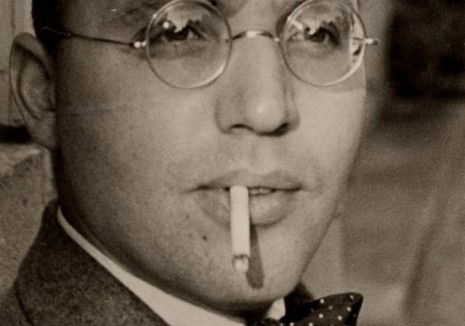
The composer Kurt Weill was born today March 2 1900. Best known for his collaborations with Bertolt Brecht on The Threepenny Opera,Rise and Fall of the City of Mahagonny, Der Jasager and The 7 Deadly Sins, Weill was a committed socialist, who believed music must serve a socially useful purpose. However, it was politics that eventually split the brilliant partnership of Brecht and Weill, as the musician felt the playwright was pushing too far to the left without question, or as Weill joked, he felt unable to set the Communist Party Manifesto to music.
Weill was married to the brilliant actress and singer, Lotte Lenya, who starred in The Threepenny Opera and later played the SMERSH assassin, Rosa Klebb in the Bond movie, From Russia With Love. With the rise of Hitler, the couple quit Germany and moved to America, where they worked in Hollywood (as did Brecht).
Though Weill’s music is best associated with cabaret and political theater of Berlin in the 1920s and 1930s (influencing John Kander and Fred Ebb’s musical Cabaret), he also wrote two symphonies, several cantatas, a great number of songs, set the poetry of Rilke and Walt Whitman’s Song of Myslef to music, and worked with Ira Gershwin on the Hollywood musical Where Do We Go From Here?. Weill died of a heart attack in 1950.
To celebrate Weill’s birthday, here is the brilliant Lenya from 1962, in fine form, singing a selection of her husband’s best known songs “Mack the Knife”, “Pirate Jenny”, “Sarabaya Johnny” and “Alabama Song”. This clip has sub-titles, but that’s unimportant, when compared to the quality of her voice and performance. The production was filmed by Ken Russell for the BBC’s arts series Monitor, and the segment was introduced by legendary arts editor, Huw Weldon.